


Redox redux: protecting the ischemic myocardium
- PMID: 22201673
- PMCID: PMC3248805
- DOI: 10.1172/JCI61467
Redox redux: protecting the ischemic myocardium
Abstract
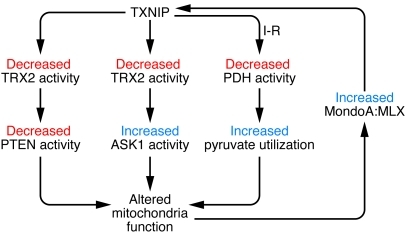
Cardiac ischemia-reperfusion (I-R) injury occurs upon prompt restoration of blood flow to the ischemic myocardium after an acute myocardial infarction. Interestingly, many of the features of I-R injury are related to impaired mitochondrial signaling and mitochondrial dysfunction. Restoring cardiac energy bioavailability and reduction-oxidation (redox) signaling are therefore important in recovery after I-R injury. In this issue of the JCI, Yoshioka and colleagues describe an important and unexpected role for thioredoxin-interacting protein (TXNIP) in the control of mitochondrial respiration and cell energy metabolism. Their findings could open the door for development of TXNIP-targeted therapeutic approaches for the treatment of cardiac I-R injury.
Figures
Comment on
-
Deletion of thioredoxin-interacting protein in mice impairs mitochondrial function but protects the myocardium from ischemia-reperfusion injury.J Clin Invest. 2012 Jan;122(1):267-79. doi: 10.1172/JCI44927. Epub 2011 Dec 27. J Clin Invest. 2012. PMID: 22201682 Free PMC article.
References
-
- Wang Y, De Keulenaer GW, Lee RT. Vitamin D(3)-up-regulated protein-1 is a stress-responsive gene that regulates cardiomyocyte viability through interaction with thioredoxin. J Biol Chem. 2002;277(29):26496–26500. - PubMed
