


Comment
doi: 10.1172/JCI61163.
Epub 2011 Dec 27.
IL-1 and atherosclerosis: a murine twist to an evolving human story
Affiliations
- PMID: 22201674
- PMCID: PMC3248309
- DOI: 10.1172/JCI61163
Item in Clipboard
Comment
IL-1 and atherosclerosis: a murine twist to an evolving human story
J Clin Invest.
2012 Jan.
Abstract
Inflammation is a critical component of atherosclerosis. IL-1 is a classic proinflammatory cytokine that has been linked to atherosclerosis. A clinical trial has been launched in which an antibody specific for IL-1β is being studied for its effects on cardiovascular events in patients with atherosclerosis. In this issue of the JCI, Alexander et al. report that mice lacking the receptor for IL-1 unexpectedly have features of advanced atherosclerosis that suggest the atherosclerotic plaques may be less stable. These findings illustrate the complexity of inflammatory pathways in atherosclerosis and suggest the need for careful calibration of antiinflammatory approaches to atherosclerosis.
Figures
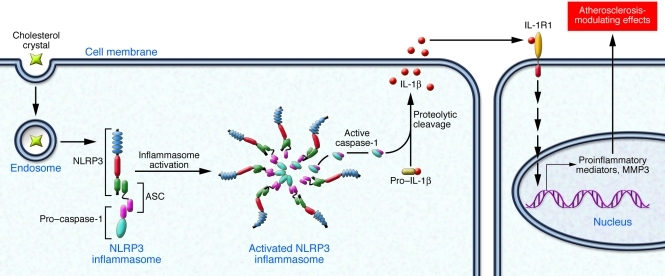
Extracellular cholesterol crystals act as a “danger signal” and activate the NLRP3 inflammasome, which triggers activation of caspase-1, leading to cleavage of pro–IL-1β to its active form. The active form of IL-1β is then secreted from the cell, where it mediates autocrine and paracrine effects through activation of the IL-1R1.
Comment on
-
Genetic inactivation of IL-1 signaling enhances atherosclerotic plaque instability and reduces outward vessel remodeling in advanced atherosclerosis in mice.J Clin Invest. 2012 Jan;122(1):70-9. doi: 10.1172/JCI43713. Epub 2011 Dec 27. J Clin Invest. 2012. PMID: 22201681 Free PMC article.
