


Alteration of hypothalamic cellular dynamics in obesity
- PMID: 22201678
- PMCID: PMC3248311
- DOI: 10.1172/JCI61562
Alteration of hypothalamic cellular dynamics in obesity
Abstract
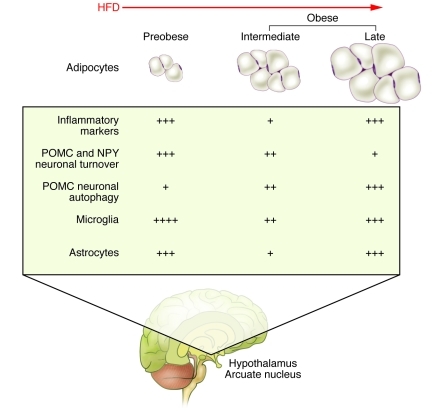
The number of people who suffer from obesity and one or more of its adverse complications is rapidly increasing. It is becoming clear that diet, exercise, and other lifestyle modifications are insufficient strategies to combat this growing problem. Greater understanding of the mechanisms controlling our desire to feed and our ability to balance energy intake with energy expenditure are key to the development of pharmacological approaches for treating obesity. Although great strides have been made in our understanding of how the hypothalamus regulates feeding and energy balance, much less is known about how obesity affects the structure of the hypothalamus. The authors of two papers in this issue of the JCI have addressed this issue by examining the effects of obesity on neurons and glia in the hypothalamus. These studies reveal that obesity may be in part due to hypothalamic injury, which leads to inflammation and reduced neurogenesis. These findings support the notion that obesity is a disease that affects multiple organs, including the brain, and that disruption of normal brain function leads to abnormal regulation of peripheral metabolism.
Figures
Comment on
-
Remodeling of the arcuate nucleus energy-balance circuit is inhibited in obese mice.J Clin Invest. 2012 Jan;122(1):142-52. doi: 10.1172/JCI43134. Epub 2011 Dec 27. J Clin Invest. 2012. PMID: 22201680 Free PMC article.
-
Obesity is associated with hypothalamic injury in rodents and humans.J Clin Invest. 2012 Jan;122(1):153-62. doi: 10.1172/JCI59660. Epub 2011 Dec 27. J Clin Invest. 2012. PMID: 22201683 Free PMC article.
