RAGE is a key cellular target for Abeta-induced perturbation in Alzheimer's disease
- PMID: 22202057
- PMCID: PMC3687351
- DOI: 10.2741/s265
RAGE is a key cellular target for Abeta-induced perturbation in Alzheimer's disease
Abstract
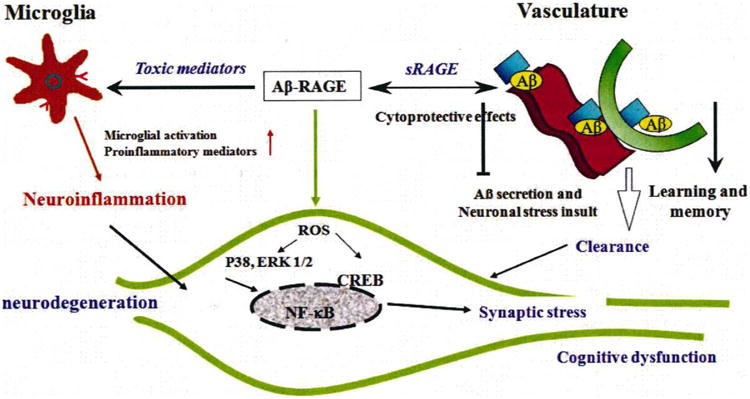
RAGE, a receptor for advanced glycation endproducts, is an immunoglobulin-like cell surface receptor that is often described as a pattern recognition receptor due to the structural heterogeneity of its ligand. RAGE is an important cellular cofactor for amyloid beta-peptide (Abeta)-mediated cellular perturbation relevant to the pathogenesis of Alzheimer's disease (AD). The interaction of RAGE with Abeta in neurons, microglia, and vascular cells accelerates and amplifies deleterious effects on neuronal and synaptic function. RAGE-dependent signaling contributes to Abeta-mediated amyloid pathology and cognitive dysfunction observed in the AD mouse model. Blockade of RAGE significantly attenuates neuronal and synaptic injury. In this review, we summarize the role of RAGE in the pathogenesis of AD, specifically in Abeta-induced cellular perturbation.
Figures
References
-
- Manczak M, Anekonda TS, Henson E, Park BS, Quinn J, Reddy PH. Mitochondria are a direct site of A beta accumulation in Alzheimer's disease neurons: implications for free radical generation and oxidative damage in disease progression. Hum Mol Genet. 2006;15:1437–1449. - PubMed
-
- Hansson Petersen CA, Alikhani N, Behbahani H, Wiehager B, Pavlov PF, Alafuzoff I, Leinonen V, Ito A, Winblad B, Glaser E, Ankarcrona M. The amyloid beta-peptide is imported into mitochondria via the TOM import machinery and localized to mitochondrial cristae. Proc Natl Acad Sci U S A. 2008;105:13145–13150. - PMC - PubMed
-
- Eckert A, Hauptmann S, Scherping I, Meinhardt J, Rhein V, Drose S, Brandt U, Fandrich M, Muller WE, Gotz J. Oligomeric and fibrillar species of beta-amyloid (A beta 42) both impair mitochondrial function in P301L tau transgenic mice. Journal of molecular medicine (Berlin, Germany) 2008;86:1255–1267. - PubMed
-
- Du H, Guo L, Fang F, Chen D, Sosunov AA, McKhann GM, Yan Y, Wang C, Zhang H, Molkentin JD, Gunn-Moore FJ, Vonsattel JP, Arancio O, Chen JX, Yan SD. Cyclophilin D deficiency attenuates mitochondrial and neuronal perturbation and ameliorates learning and memory in Alzheimer's disease. Nat Med. 2008;14:1097–1105. - PMC - PubMed
Publication types
MeSH terms
Substances
Grants and funding
LinkOut - more resources
Full Text Sources
Medical