


Female CGG knock-in mice modeling the fragile X premutation are impaired on a skilled forelimb reaching task
- PMID: 22202169
- PMCID: PMC3278548
- DOI: 10.1016/j.nlm.2011.12.006
Female CGG knock-in mice modeling the fragile X premutation are impaired on a skilled forelimb reaching task
Abstract
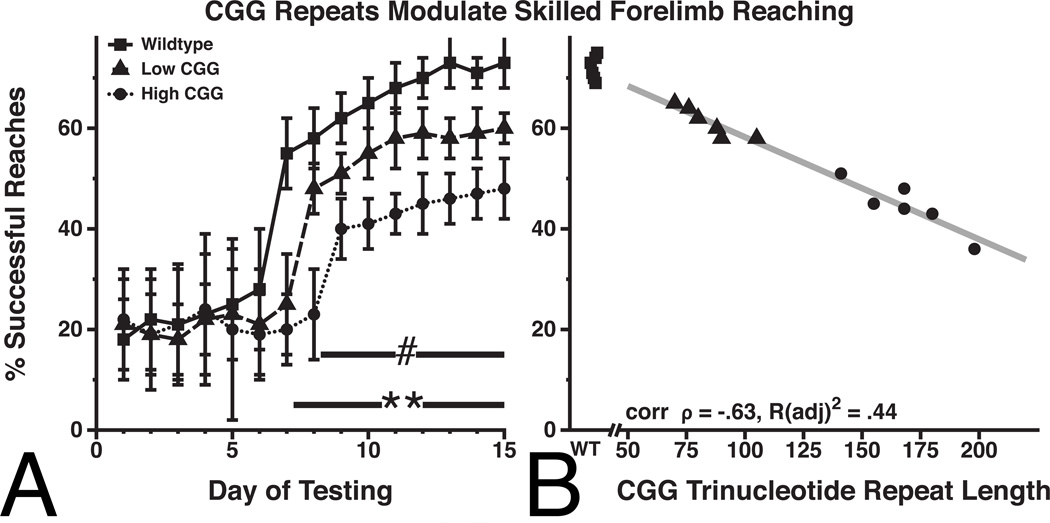
The fragile X premutation is a tandem CGG trinucleotide repeat expansion in the fragile X mental retardation 1 (FMR1) gene between 55 and 200 repeats in length. A CGG knock-in (CGG KI) mouse has been developed that models the neuropathology and cognitive deficits reported in fragile X premutation carriers. Previous studies have demonstrated that CGG KI mice have spatiotemporal information processing deficits and impaired visuomotor function that worsen with increasing CGG repeat length. Since skilled forelimb reaching requires integration of information from the visual and motor systems, skilled reaching performance could identify potential visuomotor dysfunction in CGG KI mice. To characterize motor deficits associated with the fragile X premutation, 6 month old female CGG KI mice heterozygous for trinucleotide repeats ranging from 70-200 CGG in length were tested for their ability to learn a skilled forelimb reaching task. The results demonstrate that female CGG KI mice show deficits for learning a skilled forelimb reaching task compared to wildtype littermates, and that these deficits worsen with increasing CGG repeat lengths.
Copyright © 2011 Elsevier Inc. All rights reserved.
Figures
References
-
- Adams JS, Adams PE, Nguyen D, Brunberg JA, Tassone F, Zhang W, Hagerman RJ. Volumetric brain changes in females with fragile X-associated tremor/ataxia syndrome (FXTAS) Neurology. 2007;69:851–859. - PubMed
-
- Barneoud P, Descombris E, Aubin N, Abrous DN. Evaluation of simple and complex sensorimotor behaviours in rats with a partial lesion of the dopaminergic nigrostriatal system. European Journal of Neuroscience. 2000;12:322–336. - PubMed
-
- Beloozerova IN, Sirota MG. Integration of motor and visual information in the parietal area 5 during locomotion. Journal of Neurophysiology. 2003;90:961–971. - PubMed
-
- Benjamini Y, Drai D, Elmer G, Kafkafi N, Golani I. Controlling the false discovery rate in behavior genetics research. Behavioural Brain Research. 2001;125:279–284. - PubMed
Publication types
MeSH terms
Substances
Grants and funding
LinkOut - more resources
Full Text Sources
