. 2012 Jan 10;109(2):564-9.
doi: 10.1073/pnas.1117665109. Epub 2011 Dec 27.

Alpha-1-antitrypsin monotherapy reduces graft-versus-host disease after experimental allogeneic bone marrow transplantation

Affiliations

Alpha-1-antitrypsin monotherapy reduces graft-versus-host disease after experimental allogeneic bone marrow transplantation

Isao Tawara et al. Proc Natl Acad Sci U S A. .

Abstract

Acute graft-versus-host disease (GvHD) is a major complication that prevents successful outcomes after allogeneic bone marrow transplantation (BMT), an effective therapy for hematological malignancies. Several studies demonstrate that donor T cells and host antigen-presenting cells along with several proinflammatory cytokines are required for the induction of GvHD and contribute to its severity. Increasing evidence demonstrates that human serum-derived αalpha-1- anti-trypsin (AAT) reduces production of proinflammatory cytokines, induces anti-inflammatory cytokines, and interferes with maturation of dendritic cells. Using well-characterized mouse models of BMT, we have studied the effects of AAT on GvHD severity. Administration of AAT early after BMT decreased mortality in three models of GvHD and reduced serum levels of proinflammatory cytokines in the allogeneic recipients compared with vehicle (albumin) treated animals. AAT treatment reduced the expansion of alloreactive T effector cells but enhanced the recovery of T regulatory T cells, (Tregs) thus altering the ratio of donor T effector to T regulatory cells in favor of reducing the pathological process. However, despite altering the ratio in vivo, AAT had no direct effects on either the donor T effector cells or T regulatory cells Tregs in vitro. In contrast, AAT suppressed LPS-induced in vitro secretion of proinflammatory cytokines such as TNF-α and IL-1β, enhanced the production of the anti-inflammatory cytokine IL-10, and impaired NF-κB translocation in the host dendritic cells. In light of its long history of safety in humans, these findings suggest that administration of AAT represents a novel unique and viable strategy to mitigate clinical GvHD.


Conflict of interest statement

The authors declare no conflict of interest.

Figures
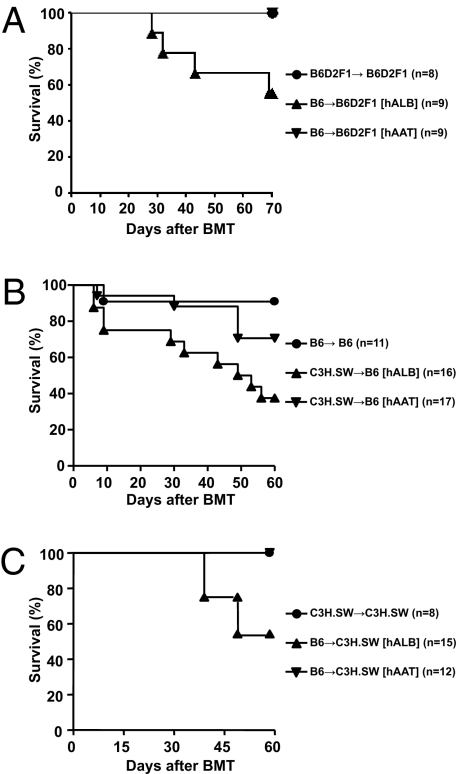
Fig. 1.
Fig. 1.
AAT reduces mortality from GvHD. (A) B6D2F1 mice were irradiated with 1,000 centigray (cGy) of total-body irradiation on day −1 and transplanted with 5 × 10⁶ T-cell–depleted BM cells and 2 × 10⁶ CD90+T cells from either syngeneic F1 or allogeneic B6 donors. Each allo-recipient was injected i.p. with either 4 mg hAAT (n = 9) or human albumin (n = 9) for 6 d from day −2 to day +13. Data shown are combined from two similar experiments. Percentage survival after BMT is shown. For ▼ vs. ▲, P < 0.02. (B) B6 mice were given 1,000 cGy of total-body irradiation on day −1 and transplanted with 5 × 10⁶ T-cell–depleted BM cells and 2 × 10⁵ CD8+T cells from either syngeneic B6 or allogeneic C3H.SW donors. Each allo-recipient was injected i.p. with either 2 mg hAAT (n = 17) or human albumin (n = 16) for 6 d from day −2 to day +13 and was monitored for GvHD survival. Data shown are combined from three similar experiments. Percentage survival after BMT is shown. For ▼ vs. ▲, P = 0.029. (C) C3H.SW mice were irradiated as above and transplanted with 4 × 10⁶ T-cell–depleted BM cells and 1 × 10⁶ CD90+T cells from either syngeneic C3H.SW or allogeneic B6 donors. The allo-recipients were injected i.p. with either 2 mg hAAT (n = 12) or human albumin (n = 15) and were monitored for GvHD survival as above. Data shown are combined from two similar experiments. Percentage survival after BMT is shown. For ▼ vs. ▲, P = 0.019.
Fig. 2.
Fig. 2.
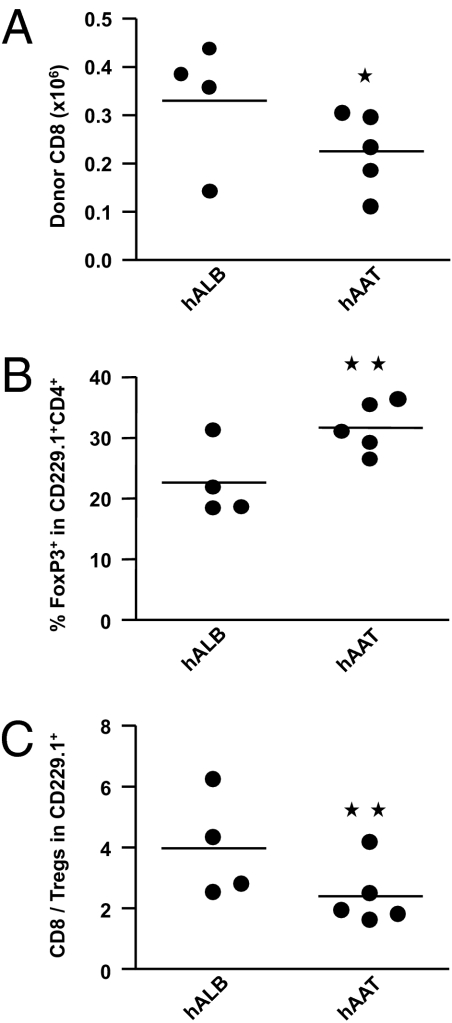
hAAT reduces Teff expansion but enhances Treg expansion. B6 mice were irradiated and transplanted with either allogeneic C3H.SW donor. The recipient animals received either hAAT or albumin as above. Expansion of C3H.SW donor (CD229.1+) CD8+ and CD4+FoxP3+ T cells was analyzed using day 29 spleen cells. Absolute numbers of C3H.SW donor-derived (CD229.1+) (A) CD8+ and (B) CD4+ FoxP3+ T cells are shown. (C) The ratio of CD8+ to CD4+ FoxP3+ T-cell absolute numbers is shown. Each point represents one individual mouse (n = 4–5/group). *P < 0.05 for A and P < 0.04 for B and C.
Fig. 3.
Fig. 3.
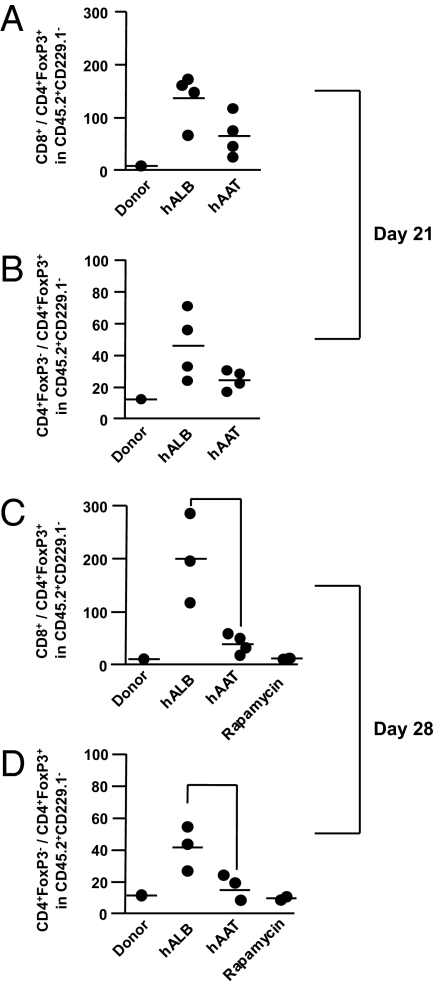
hAAT alters the ratio of mature donor Teff to Treg cells. C3H.SW mice were irradiated and transplanted with either allogeneic B6GFP+Foxp3 knock-in donor. The recipient animals received either hAAT or rapamycin or the control vehicle as above. Expansion of mature donor (CD45.2+CD45.1CD229.1GFP) CD4 and CD8+ effectors and the mature donor (CD45.1CD45.2+CD229.1GFP+) Tregs was analyzed in the peripheral blood on day +21 and day +28 for the ratio of CD8+ to CD4+ FoxP3+ T-cell absolute numbers of mature donor-derived (CD45.2+CD45.1CD229.1+). Each point represents one individual mouse (n = 2–5/group). (A) CD4+:Treg ratio on day +21, vehicle vs. hAAT; P = 0.037. (B) CD8+:Treg ratio on day +21, vehicle vs. hAAT, P = 0.022. (C) CD4+:Treg ratio on day +28, vehicle vs. hAAT; P = 0.0223. (D) CD8+:Treg ratio on day +28, vehicle vs. hAAT; P = 0.0127.
Fig. 4.
Fig. 4.
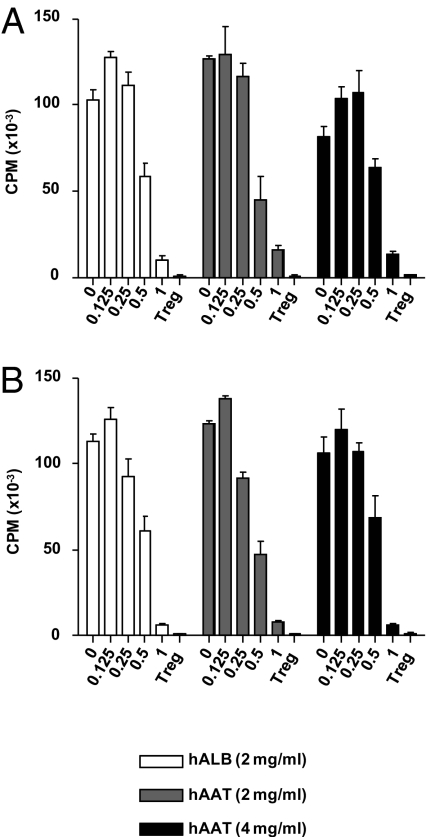
AAT does not affect T-cell responses in vitro. (A) BALB/c splenic CD4+25 T cells were treated overnight with hAAT or albumin at either 2 or 4 mg/mL and were then used as responder in an MLR with B6 BM DCs as stimulators. Freshly isolated BALB/c CD4+CD25+ Tregs were added at the indicated ratios to the above cultures, and T-cell proliferation was determined by 3H-thymidine incorporation at 96 h. Data are mean ± SEM of quadruplicate cultures. P = not significant, control vs. hAAT-treated CD4+ T cells. Data shown are from one of two similar experiments. (B) Treg treatment with hAAT. BALB/c splenic CD4+25+Tregs were treated overnight with hAAT or albumin at either 2 or 4 mg/mL and were then used as suppressors of freshly isolated BALB/c CD4+25 at the indicated ratios in an MLR with B6 BM DCs as stimulators. T-cell proliferation was determined by 3H-thymidine incorporation at 96 h. Data are mean ± SEM of quadruplicate cultures. P = NS at all of the ratios, control vs. hAAT-treated CD4+25+ Tregs. Data shown are from one of two similar experiments.
Fig. 5.
Fig. 5.
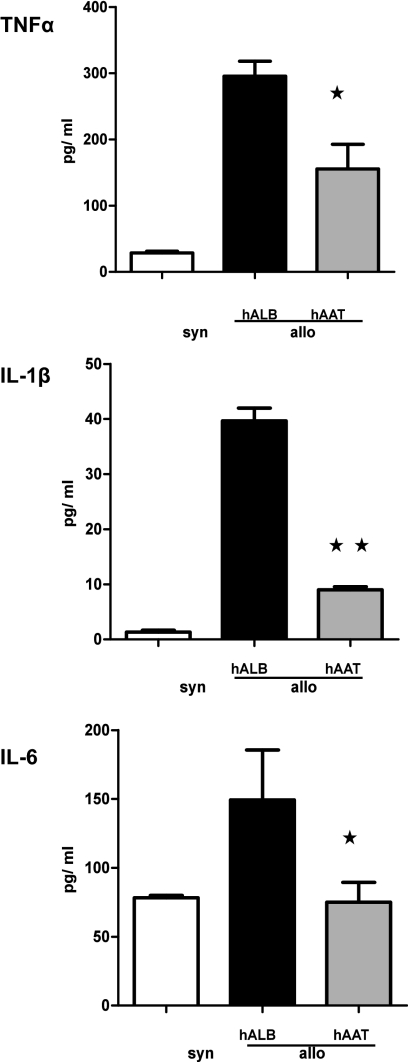
Injection of hAAT inhibits in vivo proinflammatory cytokine production after BMT. B6D2F1 mice were exposed to 1,000 cGy of total-body irradiation and transplanted with 5 × 10⁶ T-cell–depleted BM cells and 2 × 10⁶ T cells from either allogeneic (B6) or syngeneic (B6D2F1) donors. Each F1 recipient of the allogeneic cells was injected i.p. with 4 mg hAAT or human albumin on days −2, +1, and +4. Sera from the recipient animals (n = 4–5/group) were obtained on day 7 after BMT and analyzed for TNF-α, IL-1β, and IL-6. Albumin-treated allogeneic controls (solid bars) vs. hAAT allogeneic recipients (open and gray bars) for TNF-α. *P < 0.04, IL-1β; Allo, **P < 0.03; IL-6, *P < 0.04.
Fig. 6.
Fig. 6.
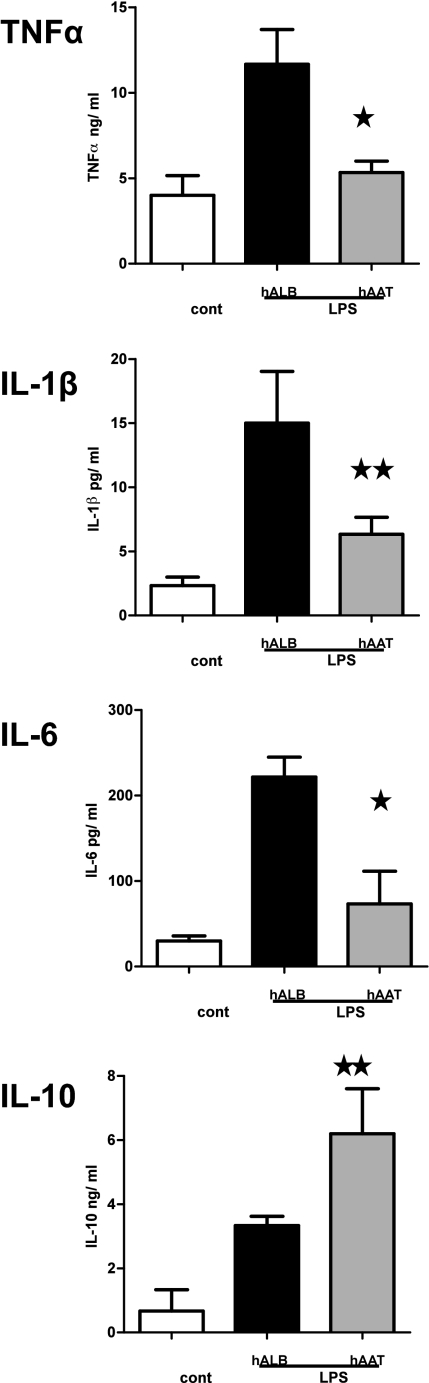
AAT suppresses proinflammatory cytokine secretion by BM DCs. BM DCs were obtained from C57BL/6 animals as described in Materials and Methods. BM DCs were preincubated overnight with 4 mg/mL concentration of hAAT or hALB and were then stimulated for 8 h with LPS (100 ng/mL). Cytokine TNF-α, IL-1β, IL-6, and IL-10 levels in the supernatants were measured by ELISA. *P < 0.02; **P < 0.03.
Fig. 7.
Fig. 7.
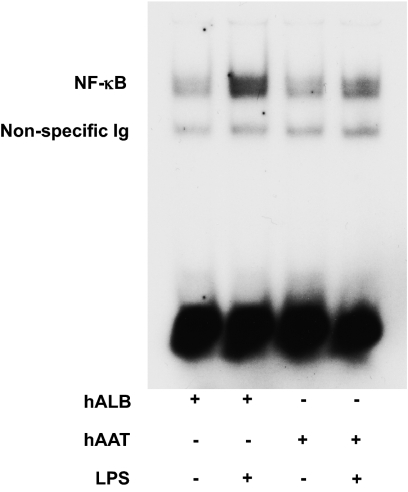
hAAT reduces LPS-induced nuclear translocation of NF-κB. BM DCs were obtained from C57BL/6 animals and were preincubated overnight with 4 mg/mL of hAAT or hALB and then stimulated for 6 h with LPS or hALB (100 ng/mL). NF-κB translocation was evaluated by the gel-shift EMSA assay. This figure is representative of one of two similar experiments.

References

    1. Appelbaum FR. Hematopoietic-cell transplantation at 50. N Engl J Med. 2007;357:1472–1475. - PubMed
    1. Welniak LA, Blazar BR, Murphy WJ. Immunobiology of allogeneic hematopoietic stem cell transplantation. Annu Rev Immunol. 2007;25:139–170. - PubMed
    1. Paczesny S, Hanauer D, Sun Y, Reddy P. New perspectives on the biology of acute GVHD. Bone Marrow Transplant. 2010;45(1):1–11. - PMC - PubMed
    1. Antin JH, Ferrara JL. Cytokine dysregulation and acute graft-versus-host disease. Blood. 1992;80:2964–2968. - PubMed
    1. Riley JL, June CH, Blazar BR. Human T regulatory cell therapy: Take a billion or so and call me in the morning. Immunity. 2009;30:656–665. - PMC - PubMed

Publication types