


From rapid to delayed and remote postconditioning: the evolving concept of ischemic postconditioning in brain ischemia
- PMID: 22204317
- PMCID: PMC3346695
- DOI: 10.2174/138945012799201621
From rapid to delayed and remote postconditioning: the evolving concept of ischemic postconditioning in brain ischemia
Abstract
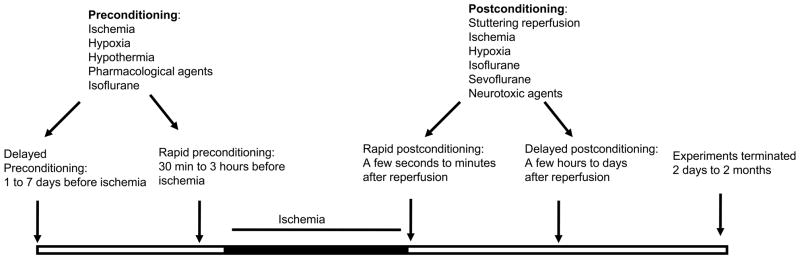
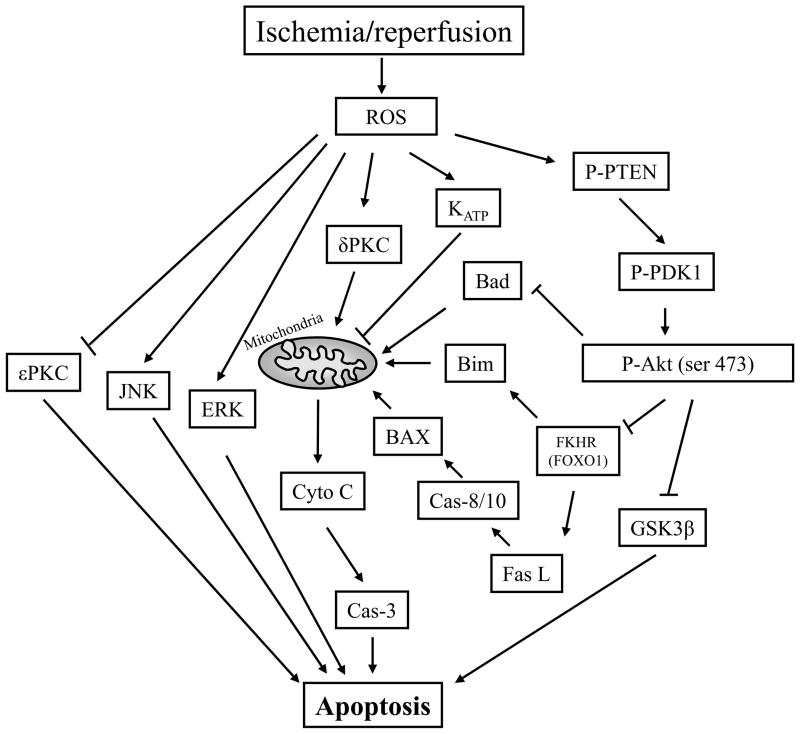
Ischemic postconditioning is a concept originally defined to contrast with that of ischemic preconditioning. While both preconditioning and postconditioning confer a neuroprotective effect on brain ischemia, preconditioning is a sublethal insult performed in advance of brain ischemia, and postconditioning, which conventionally refers to a series of brief occlusions and reperfusions of the blood vessels, is conducted after ischemia/reperfusion. In this article, we first briefly review the history of preconditioning, including the experimentation that initially uncovered its neuroprotective effects and later revealed its underlying mechanisms-of-action. We then discuss how preconditioning research evolved into that of postconditioning--a concept that now represents a broad range of stimuli or triggers, including delayed postconditioning, pharmacological postconditioning, remote postconditioning--and its underlying protective mechanisms involving the Akt, MAPK, PKC and K(ATP) channel cell-signaling pathways. Because the concept of postconditioning is so closely associated with that of preconditioning, and both share some common protective mechanisms, we also discuss whether a combination of preconditioning and postconditioning offers greater protection than preconditioning or postconditioning alone.
Figures
References
-
- Zhao H, Sapolsky RM, Steinberg GK. Interrupting reperfusion as a stroke therapy: ischemic postconditioning reduces infarct size after focal ischemia in rats. J Cereb Blood Flow Metab. 2006;26:1114–21. - PubMed
-
- Zhao ZQ, Corvera JS, Halkos ME, et al. Inhibition of myocardial injury by ischemic postconditioning during reperfusion: comparison with ischemic preconditioning. Am J Physiol Heart Circ Physiol. 2003;285:H579–88. - PubMed
-
- Murry CE, Jennings RB, Reimer KA. Preconditioning with ischemia: a delay of lethal cell injury in ischemic myocardium. Circulation. 1986;74:1124–36. - PubMed
-
- Dirnagl U, Simon RP, Hallenbeck JM. Ischemic tolerance and endogenous neuroprotection. Trends Neurosci. 2003;26:248–54. - PubMed
-
- Schaller B, Graf R. Cerebral ischemic preconditioning. An experimental phenomenon or a clinical important entity of stroke prevention? J Neurol. 2002;249:1503–11. - PubMed
Publication types
MeSH terms
Substances
Grants and funding
LinkOut - more resources
Full Text Sources