. 2012 Feb;50(1-2):42-8.
doi: 10.1016/j.molimm.2011.12.001. Epub 2011 Dec 26.

The down regulation of neutrophil oxidative metabolism by S100A8 and S100A9: implication of the protease-activated receptor-2

Affiliations

The down regulation of neutrophil oxidative metabolism by S100A8 and S100A9: implication of the protease-activated receptor-2

Herve Y Sroussi et al. Mol Immunol. 2012 Feb.

Abstract

S100A8 and S100A9 regulate polymorphonuclear neutrophils (PMNs) recruitment and represent 40% of PMN cytosolic protein weight. We have shown that S100A8/S100A9 inhibit PMN oxidative metabolism. The present study was designed to elucidate the mechanisms of this anti-oxidative effect. We hypothesized that the protease activated receptor-2 (PAR-2) played a role in the down-regulation of PMN oxidative metabolism by S100A8/S100A9. Freshly isolated PMNs were tested for their ability to oxidize dichlorofluorescin-diacetate. Functional inhibition of PAR-2 with ENMD-1068, the pepducin P2pal-21 or an antibody directed at PAR-2 cleavage/activation site, resulted in a significant inhibition of S100A8 and S100A9 anti-oxidative effect. Conversely, the controlled activation of PAR-2 potentiated S100 anti-oxidative effect. Taken together, the data indicate that the anti-oxidative effect of S100A8/A9 is initiated by PAR-2 activation. S100A8/S100A9 may therefore dampen inflammation without interfering with its initial strength. This finding opens translational possibilities to limit deleterious PMN activation with a dual PAR-2/S100 strategy.


Figures

Figure 1
Figure 1
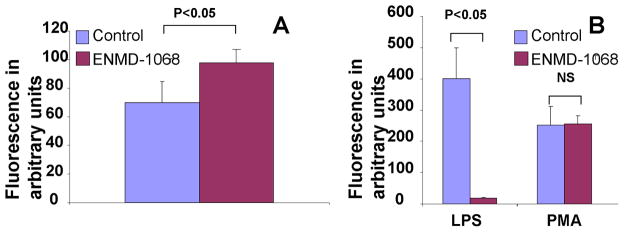
Fluorescence emission of PMNs incubated with DCFH-DA probe for 1 hour in the presence or absence of ENMD-1068 at a concentration of 5 mM. The effect of ENMD-1068 was tested on the constitutive oxidative metabolism of PMNs (A) and on LPS (2.5 μg/ml) and PMA (1μM) (B) The data represent the mean ± SD and it is a representative of at least 4 experiments conducted in triplicates or quadruplicates.
Figure 2
Figure 2
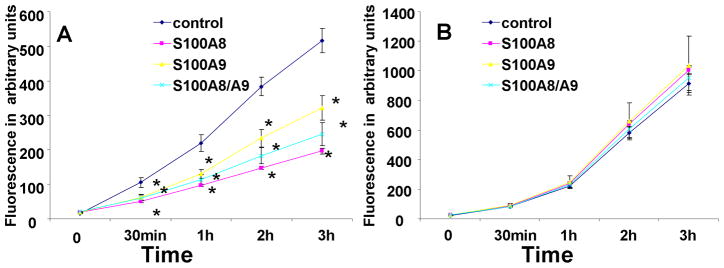
Time course of fluorescence emission of PMNs incubated with DCFH-DA probe in the presence or absence of 10 μg/ml S100A8, S100A9 or S100A8+S100A9 (A). The assay was repeated in the presence of ENMD-1068 at a concentration of 5 mM. (B). The data represent the mean ± SD and it is a representative of at least 4 experiments conducted in triplicates or quadruplicates. *= P<0.05 comparing S100 treated to control.
Figure 3
Figure 3
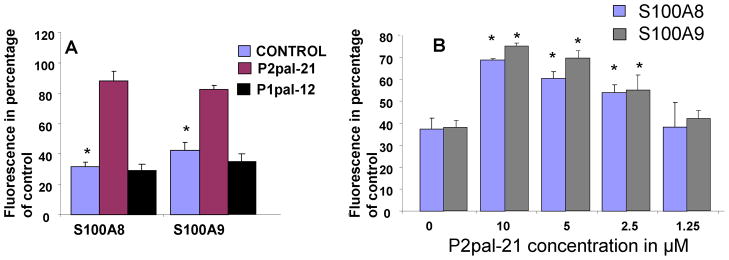
Fluorescence emission of PMNs incubated with DCFH-DA probe for 1 hour in the presence or absence of 10 μg/ml S100A8 or S100A9 and P2pal-21 at a concentration of 10 μM. (A). Dose response to P2pal-21 with a fix concentration of 10 μg/ml S100A8 or S100A9 (B). The data represent the mean ± SD and it is a representative of at least 4 experiments conducted in triplicates or quadruplicates. *=P<0.05 comparing p2pal-21 treated to control.
Figure 4
Figure 4
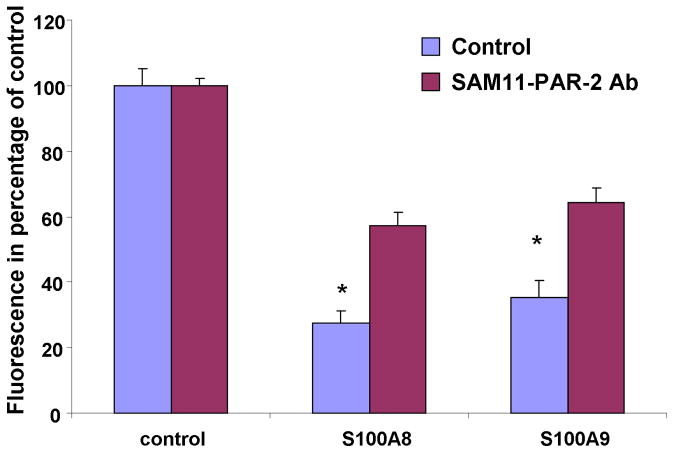
Fluorescence emission of PMNs incubated with DCFH-DA probe for 1 hour in the presence or absence of 10 μg/ml S100A8 or S100A9 and SAM11 anti-PAR-2 monoclonal antibody at a concentration of 25 μg/ml. The data represent the mean ± SD and it is a representative of 3 experiments conducted in triplicates. *=P<0.05 comparing SAM11 treated to control
Figure 5
Figure 5
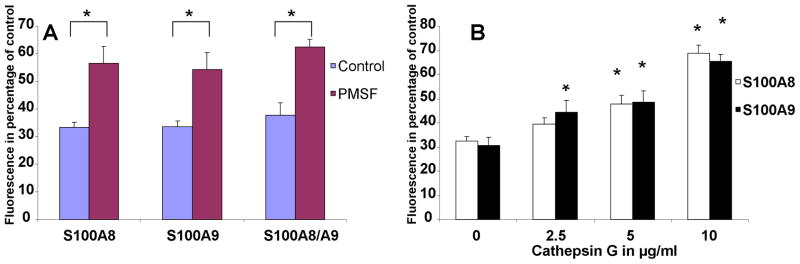
Fluorescence emission of PMNs incubated with DCFH-DA probe for 1 hour in the presence or absence of 10 μg/ml S100A8 or S100A9 with or without PMSF at a concentration of 0.4mM (A) or with various concentrations of Cathepsin G (B). The data represent the mean ± SD and it is a representative of 3 experiments conducted in triplicates. *=P<0.05 when comparing PMSF treated to control (A) or Cathepsin G treated to control without Cathepsin G (B).
Figure 6
Figure 6
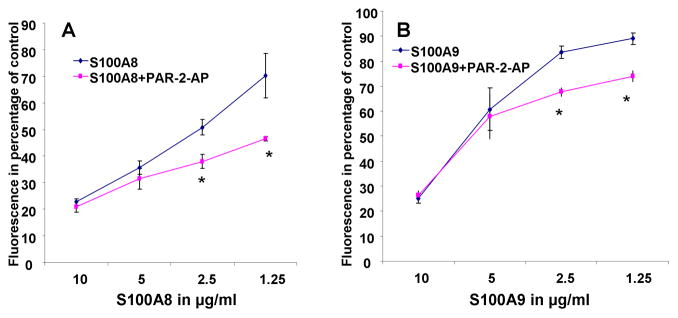
Fluorescence emission of PMNs incubated with DCFH-DA probe for 1 hour in the presence or absence of 10 μM PAR2-AP (SLIGKV) and activated by 2.5 μg/ml LPS. The effect of various concentrations of S100A8 (A) and S100A9 (B) was tested and is presented as percentage inhibition of LPS stimulation. The data represent the mean ± SD and it is a representative of 3 experiments conducted in triplicates. *=P<0.05 when comparing PAR-2-AP treated to control at various concentration of S100A8 or S100A9.
Figure 7
Figure 7
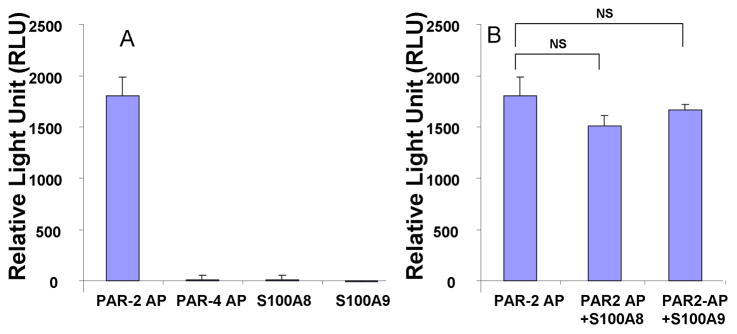
PAR-2 activation assay conducted in PathHunter eXpress β-arrestin PAR-2 cells. The PAR-2 AP (SLIGKV) at 10 μM activates PAR-2 whereas S100A8 or S100A9 at 10 μg/ml or the PAR-4 AP (GYPGQV) at 100 μM do not activate PAR-2 (A). S100A8 and S100A9 fail to inhibit PAR-2 activation by 10 μM PAR-2-AP. The data represent the mean ± SD and it is a representative of 3 experiments conducted in triplicates.

References

    1. Aguiar-Passeti T, Postol E, Sorg C, Mariano M. Epithelioid cells from foreign-body granuloma selectively express the calcium-binding protein MRP-14, a novel down-regulatory molecule of macrophage activation. J Leukoc Biol. 1997;62:852–8. - PubMed
    1. Brun JG, Haland G, Haga HJ, Fagerhol MK, Jonsson R. Effects of calprotectin in avridine-induced arthritis. Apmis. 1995;103:233–40. - PubMed
    1. Cave AC, Brewer AC, Narayanapanicker A, Ray R, Grieve DJ, Walker S, Shah AM. NADPH oxidases in cardiovascular health and disease. Antioxid Redox Signal. 2006;8:691–728. - PubMed
    1. Ciapetti G, Granchi D, Verri E, Savarino L, Cenni E, Savioli F, Pizzoferrato A. Fluorescent microplate assay for respiratory burst of PMNs challenged in vitro with orthopedic metals. J Biomed Mater Res. 1998;41:455–60. - PubMed
    1. Covic L, Gresser AL, Talavera J, Swift S, Kuliopulos A. Activation and inhibition of G protein-coupled receptors by cell-penetrating membrane-tethered peptides. Proc Natl Acad Sci U S A. 2002;99:643–8. - PMC - PubMed

Publication types

MeSH terms