


Evaluation of cellular phenotypes implicated in immunopathogenesis and monitoring immune reconstitution inflammatory syndrome in HIV/leprosy cases
- PMID: 22205964
- PMCID: PMC3244401
- DOI: 10.1371/journal.pone.0028735
Evaluation of cellular phenotypes implicated in immunopathogenesis and monitoring immune reconstitution inflammatory syndrome in HIV/leprosy cases
Abstract
Background: It is now evident that HAART-associated immunological improvement often leads to a variety of new clinical manifestations, collectively termed immune reconstitution inflammatory syndrome, or IRIS. This phenomenon has already been described in cases of HIV coinfection with Mycobacterium leprae, most of them belonging to the tuberculoid spectrum of leprosy disease, as observed in leprosy reversal reaction (RR). However, the events related to the pathogenesis of this association need to be clarified. This study investigated the immunological profile of HIV/leprosy patients, with special attention to the cellular activation status, to better understand the mechanisms related to IRIS/RR immunopathogenesis, identifying any potential biomarkers for IRIS/RR intercurrence.
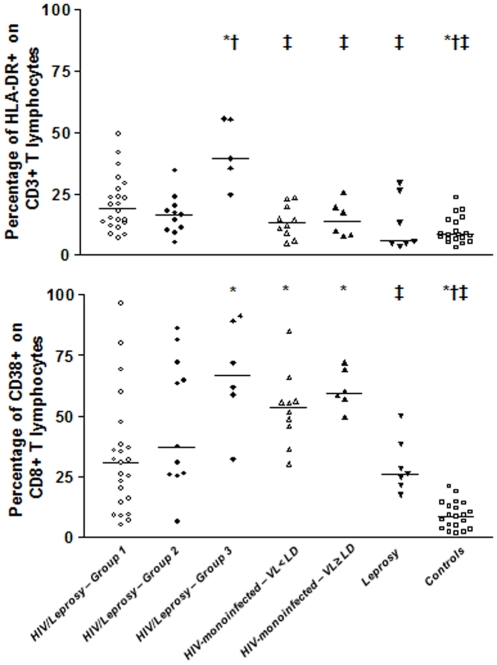
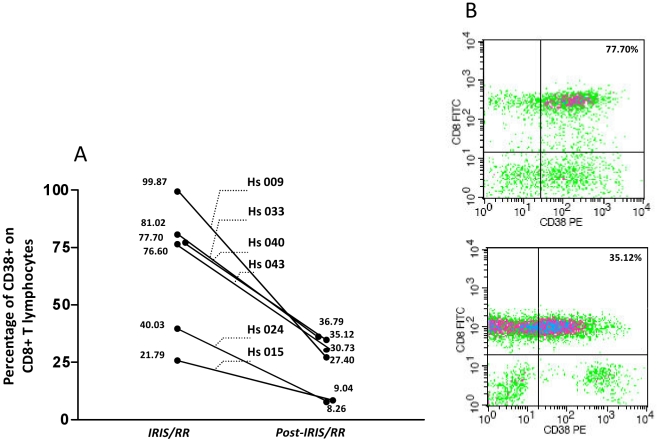
Methods/principal findings: Eighty-five individuals were assessed in this study: HIV/leprosy and HIV-monoinfected patients, grouped according to HIV-viral load levels, leprosy patients without HIV coinfection, and healthy controls. Phenotypes were evaluated by flow cytometry for T cell subsets and immune differentiation/activation markers. As expected, absolute counts of the CD4+ and CD8+ T cells from the HIV-infected individuals changed in relation to those of the leprosy patients and controls. However, there were no significant differences among the groups, whether in the expression of cellular differentiation phenotypes or cellular activation, as reflected by the expression of CD38 and HLA-DR. Six HIV/leprosy patients identified as IRIS/RR were analyzed during IRIS/RR episodes and after prednisone treatment. These patients presented high cellular activation levels regarding the expression of CD38 in CD8+ cells T during IRIS/RR (median: 77,15%), dropping significantly (p<0,05) during post-IRIS/RR moments (median: 29,7%). Furthermore, an increase of cellular activation seems to occur prior to IRIS/RR.
Conclusion/significance: These data suggest CD38 expression in CD8+ T cells interesting tool identifying HIV/leprosy individuals at risk for IRIS/RR. So, a comparative investigation to leprosy patients at RR should be conducted.
Conflict of interest statement
Figures
References
-
- Hogg RS, O'Shaughnessy MV, Gataric N, Yip B, Craib K, et al. Decline in deaths from AIDS due to new antirretrovirals. Lancet. 1997;349:1294. - PubMed
-
- Palella FJ, Jr, Delaney KM, Moorman AC, Loveless MO, Fuhrer J, et al. Declining morbidity and mortality among patients with advanced human immunodeficiency virus infection. HIV Outpatient Study Investigators. N Engl J Med. 1998;338:853–860. - PubMed
-
- Jehle AW, Khanna N, Sigle JP, Glatz-Krieger K, Battegay M, et al. Acute renal failure on immune reconstitution in an HIV-positive patient with miliary tuberculosis. Clin Infect Dis. 2004;38:e32–35. - PubMed
-
- Race EM, Adelson-Mitty J, Kriegel GR, Barlam TF, Reimann KA, et al. Focal mycobacterial lymphadenitis following initiation of protease-inhibitor therapy in patients with advanced HIV-1 disease. Lancet. 1998;351:252–255. - PubMed
-
- Koval CE, Gigliotti F, Nevins D, Demeter LM. Immune reconstitution syndrome after successful treatment of Pneumocystis carinii pneumonia in a man with human immunodeficiency virus type 1 infection. Clin Infect Dis. 2002;35:491–493. - PubMed
Publication types
MeSH terms
Substances
LinkOut - more resources
Full Text Sources
Medical
Research Materials
