


Economic impact of dengue illness and the cost-effectiveness of future vaccination programs in Singapore
- PMID: 22206028
- PMCID: PMC3243704
- DOI: 10.1371/journal.pntd.0001426
Economic impact of dengue illness and the cost-effectiveness of future vaccination programs in Singapore
Abstract
Background: Dengue illness causes 50-100 million infections worldwide and threatens 2.5 billion people in the tropical and subtropical regions. Little is known about the disease burden and economic impact of dengue in higher resourced countries or the cost-effectiveness of potential dengue vaccines in such settings.
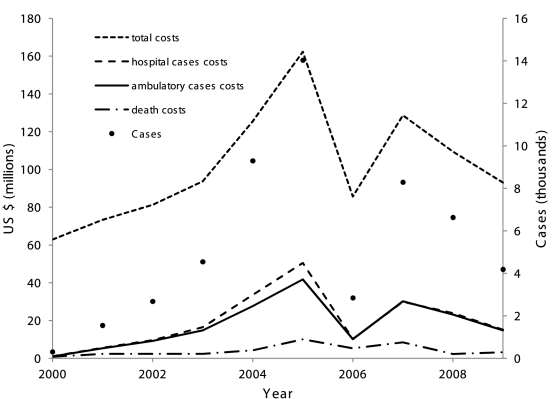
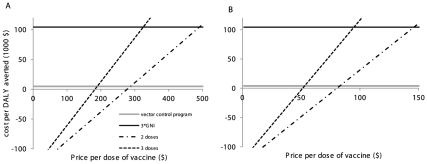
Methods and findings: We estimate the direct and indirect costs of dengue from hospitalized and ambulatory cases in Singapore. We consider inter alia the impacts of dengue on the economy using the human-capital and the friction cost methods. Disease burden was estimated using disability-adjusted life years (DALYs) and the cost-effectiveness of a potential vaccine program was evaluated. The average economic impact of dengue illness in Singapore from 2000 to 2009 in constant 2010 US$ ranged between $0.85 billion and $1.15 billion, of which control costs constitute 42%-59%. Using empirically derived disability weights, we estimated an annual average disease burden of 9-14 DALYs per 100 000 habitants, making it comparable to diseases such as hepatitis B or syphilis. The proportion of symptomatic dengue cases detected by the national surveillance system was estimated to be low, and to decrease with age. Under population projections by the United Nations, the price per dose threshold for which vaccines stop being more cost-effective than the current vector control program ranged from $50 for mass vaccination requiring 3 doses and only conferring 10 years of immunity to $300 for vaccination requiring 2 doses and conferring lifetime immunity. The thresholds for these vaccine programs to not be cost-effective for Singapore were $100 and $500 per dose respectively.
Conclusions: Dengue illness presents a serious economic and disease burden in Singapore. Dengue vaccines are expected to be cost-effective if reasonably low prices are adopted and will help to reduce the economic and disease burden of dengue in Singapore substantially.
Conflict of interest statement
The authors have declared that no competing interests exist.
Figures
References
-
- Gubler DJ. Epidemic dengue/dengue hemorrhagic fever as a public health, social and economic problem in the 21st century. Trends in Microbiology. 2002;10:100–103. - PubMed
-
- Wilder-Smith A, Gubler DJ. Geographic expansion of dengue: the impact of international travel. Medical Clinics of North America. 2008;92:1377–1390. - PubMed
-
- Ooi E-E, Gubler DJ. Global spread of epidemic dengue: the influence of environmental change. Future Virology. 2009;4:571–580.
-
- Halstead SB. Dengue. The Lancet. 2007;370:1644–1652. - PubMed
Publication types
MeSH terms
Substances
LinkOut - more resources
Full Text Sources
Medical
