Cytoplasmic incompatibility as a means of controlling Culex pipiens quinquefasciatus mosquito in the islands of the south-western Indian Ocean
- PMID: 22206033
- PMCID: PMC3243720
- DOI: 10.1371/journal.pntd.0001440
Cytoplasmic incompatibility as a means of controlling Culex pipiens quinquefasciatus mosquito in the islands of the south-western Indian Ocean
Abstract
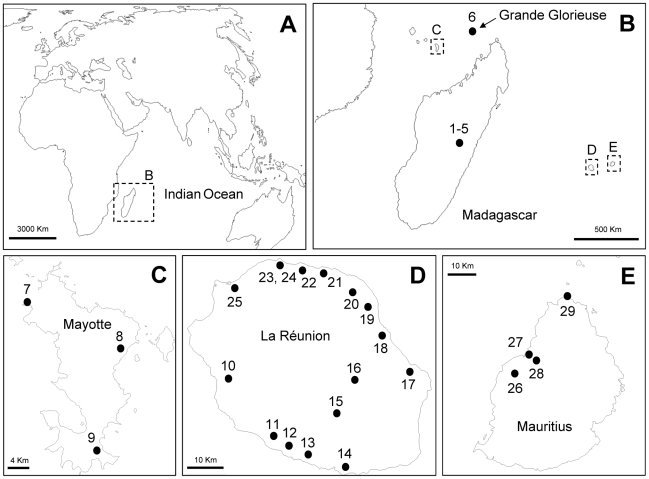
The use of the bacterium Wolbachia is an attractive alternative method to control vector populations. In mosquitoes, as in members of the Culex pipiens complex, Wolbachia induces a form of embryonic lethality called cytoplasmic incompatibility, a sperm-egg incompatibility occurring when infected males mate either with uninfected females or with females infected with incompatible Wolbachia strain(s). Here we explore the feasibility of the Incompatible Insect Technique (IIT), a species-specific control approach in which field females are sterilized by inundative releases of incompatible males. We show that the Wolbachia wPip(Is) strain, naturally infecting Cx. p. pipiens mosquitoes from Turkey, is a good candidate to control Cx. p. quinquefasciatus populations on four islands of the south-western Indian Ocean (La Réunion, Mauritius, Grande Glorieuse and Mayotte). The wPip(Is) strain was introduced into the nuclear background of Cx. p. quinquefasciatus mosquitoes from La Réunion, leading to the LR[wPip(Is)] line. Total embryonic lethality was observed in crosses between LR[wPip(Is)] males and all tested field females from the four islands. Interestingly, most crosses involving LR[wPip(Is)] females and field males were also incompatible, which is expected to reduce the impact of any accidental release of LR[wPip(Is)] females. Cage experiments demonstrate that LR[wPip(Is)] males are equally competitive with La Réunion males resulting in demographic crash when LR[wPip(Is)] males were introduced into La Réunion laboratory cages. These results, together with the geographic isolation of the four south-western Indian Ocean islands and their limited land area, support the feasibility of an IIT program using LR[wPip(Is)] males and stimulate the implementation of field tests for a Cx. p. quinquefasciatus control strategy on these islands.
Conflict of interest statement
The authors have declared that no competing interests exist.
Figures
References
-
- Dobson SL. Reversing Wolbachia-based population replacement. Trends Parasitol. 2003;19:128–133. - PubMed
-
- Sinkins SP, Gould F. Gene drive systems for insect disease vectors. Nat Rev Genet. 2006;7:427–435. - PubMed
-
- Bourtzis K. Wolbachia-based technologies for insect pest population control. Adv Exp Med Biol. 2008;627:104–113. - PubMed
-
- Saridaki A, Bourtzis K. Wolbachia: more than just a bug in insect genitals. Curr Opin Microbiol. 2010;13:67–72. - PubMed
-
- Cook PE, McGraw EA. Wolbachia pipientis: an expanding bag of tricks to explore for disease control. Trends Parasitol. 2010;26:373–375. - PubMed
Publication types
MeSH terms
LinkOut - more resources
Full Text Sources