


Is there still a place for the cemented titanium femoral stem? 10,108 cases from the Norwegian Arthroplasty Register
- PMID: 22206445
- PMCID: PMC3278649
- DOI: 10.3109/17453674.2011.645194
Is there still a place for the cemented titanium femoral stem? 10,108 cases from the Norwegian Arthroplasty Register
Abstract
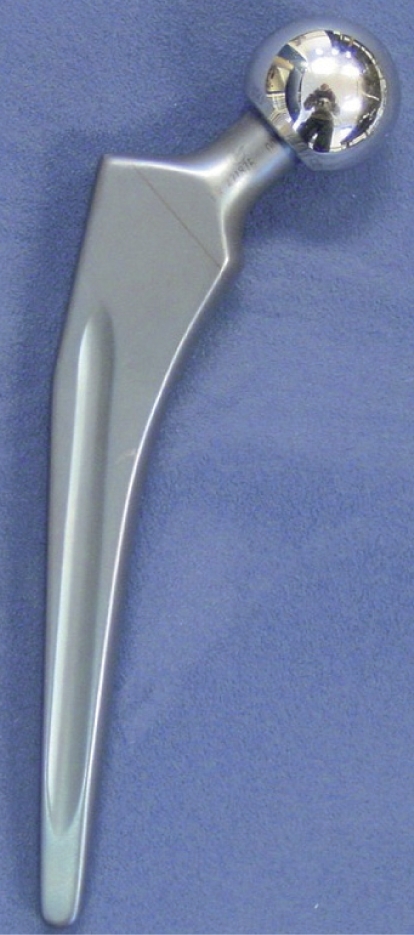
Background and purpose: Despite the fact that there have been some reports on poor performance, titanium femoral stems intended for cemented fixation are still used at some centers in Europe. In this population-based registry study, we examined the results of the most frequently used cemented titanium stem in Norway.
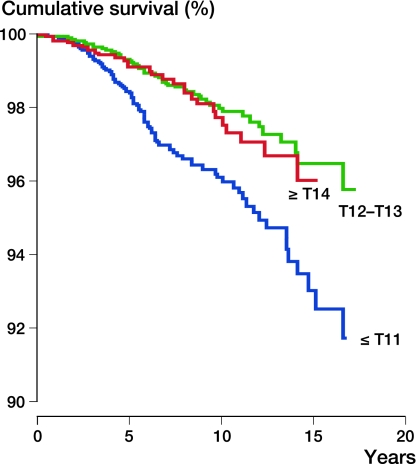
Patients and methods: 11,876 cases implanted with the cemented Titan stem were identified for the period 1987-2008. Hybrid arthroplasties were excluded, leaving 10,108 cases for this study. Stem survival and the influence of age, sex, stem offset and size, and femoral head size were evaluated using Cox regression analyses. Questionnaires were sent to the hospitals to determine the surgical technique used.
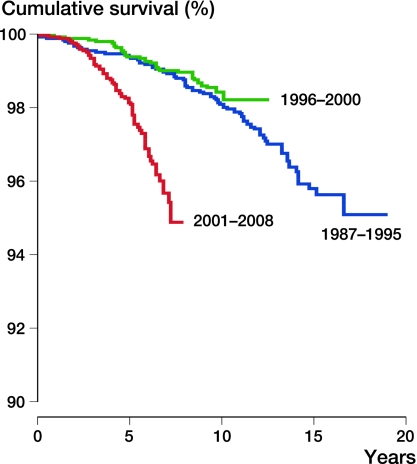
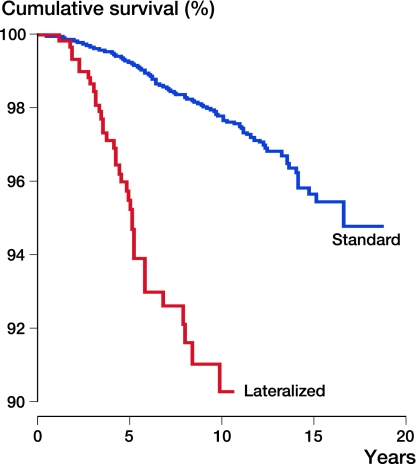
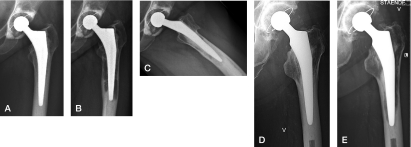
Results: Male sex, high stem offset, and small stem size were found to be risk factors for stem revision, (adjusted RR = 2.5 (1.9-3.4), 3.3 (2.3-4.8), and 2.2 (1.4-3.5), respectively). Patients operated in the period 2001-2008 had an adjusted relative risk (RR) of 4.7 (95% CI: 3.0-7.4) for stem revision due to aseptic stem loosening compared to the period 1996-2000. Changes in broaching technique and cementing technique coincided with deterioration of the results in some hospitals.
Interpretation: The increased use of small stem sizes and high-offset stems could only explain the deterioration of results to a certain degree since the year 2000. The influence of discrete changes in surgical technique over time could not be fully evaluated in this registry study. We suggest that this cemented titanium stem should be abandoned. The results of similar implants should be carefully evaluated.
Figures
References
-
- Acklin YP, Berli BJ, Frick W, Elke R, Morscher EW. Nine-year results of Muller cemented titanium Straight Stems in total hip replacement. Arch Orthop Trauma Surg. 2001;121(7):391–8. - PubMed
-
- Asayama I, Chamnongkich S, Simpson KJ, Kinsey TL, Mahoney OM. Reconstructed hip joint position and abductor muscle strength after total hip arthroplasty. J Arthroplasty. 2005;20(4):414–20. - PubMed
-
- Baumann B, Hendrich C, Barthel T, Bockholt M, Walther M, Eulert J, Rader CP. 9- to 11-year results of cemented titanium mueller straight stem in total hip arthroplasty. Orthopedics. 2007;30(7):551–7. - PubMed
-
- Bridgens J, Davies S, Tilley L, Norman P, Stockley I. Orthopaedic bone cement: do we know what we are using? J Bone Joint Surg (Br) 2008;90(5):643–7. - PubMed
-
- Dall GF, Simpson PM, Breusch SJ. In vitro comparison of Refobacin-Palacos R with Refobacin Bone Cement and Palacos R + G. Acta Orthop. 2007;78(3):404–11. - PubMed
MeSH terms
Substances
LinkOut - more resources
Full Text Sources
Medical