A new oral otoprotective agent. Part 1: Electrophysiology data from protection against noise-induced hearing loss
- PMID: 22207104
- PMCID: PMC3560681
- DOI: 10.12659/msm.882180
A new oral otoprotective agent. Part 1: Electrophysiology data from protection against noise-induced hearing loss
Abstract
Background: Data from animal studies show that antioxidants can compensate against noise-induced stress and sensory hair cell death. The aim of this study was to evaluate the otoprotection efficacy of various versions of orally administered Acuval 400 against noise damage in a rat animal model.
Material/methods: Fifty-five Sprague Dawley rats were divided into 4 groups: A) noise-exposed animals; B) animals exposed to noise and treated with the Acuval; C) animals exposed to noise and treated with a combination of Coenzyme Q10 and Acuval; D) animals treated only with Acuval and Coenzyme Q10 and with no exposure to noise. All solutions were administered orally 5 times: 24 and 2 hrs prior to noise exposure, and then daily for 3 days. The auditory function was assessed by measuring auditory brainstem responses (ABR) in the range from 2 to 32 kHz at times =1, 7, 14 and 21 days after noise exposure.
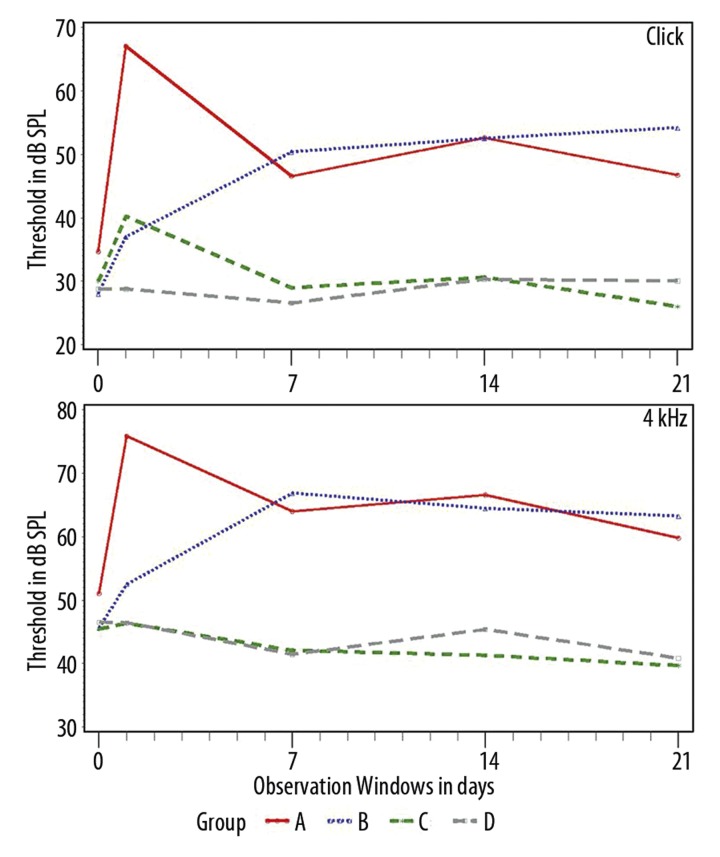
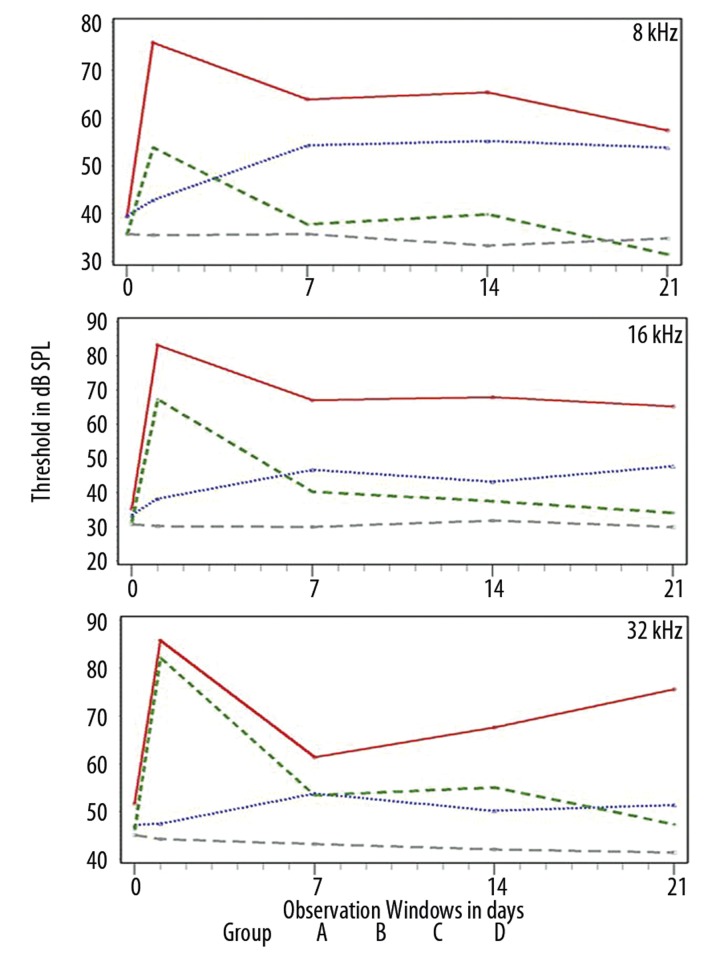
Results: At low frequencies (click and 4 kHz) animals from both A and B groups showed significant threshold shifts in the majority of the tested frequencies and tested times. For the same frequencies, animals from group C presented threshold levels similar to those from group D. At frequencies ≥ 8 kHz the protective performance of the 2 Acuval groups is more clearly distinguished from the noise group A. At 32 kHz the 2 Acuval groups perform equally well in terms of otoprotection. Animals in Group D did not show any significant differences in the hearing threshold during the experiment.
Conclusions: The data of this study suggest that a solution containing Coenzyme Q10 and Acuval 400, administered orally, protects from noise-induced hearing loss.
Figures

References
-
- Yamane H, Nakai Y, Takayama M, et al. Appearance of free radicals in the guinea pig inner after noise-induced acoustic trauma. Eur Arch Otorhinolaryngol. 1995;252:504–8. - PubMed
-
- Halliwell B, Gutteridge J. Free Radicals in Biology and Disease. Oxford: Oxford University Press; 1999.
-
- Ohinata Y, Miller JM, Altschuler RA, Schact J. Intense noise induces formation of vasoactive lipid peroxidation products in the cochlea. Brain Res. 2000a;878(1–2):163–73. - PubMed
-
- Ohlemiller KK, Dugan LL. Elevation of reactive oxygen species following ischemia-reperfusion in mouse cochlea observed in vivo. Audiol Neurootol. 1999;5:219–28. - PubMed
Publication types
MeSH terms
Substances
LinkOut - more resources
Full Text Sources
Other Literature Sources