


Spreading order: religion, cooperative niche construction, and risky coordination problems
- PMID: 22207773
- PMCID: PMC3223343
- DOI: 10.1007/s10539-011-9295-x
Spreading order: religion, cooperative niche construction, and risky coordination problems
Abstract
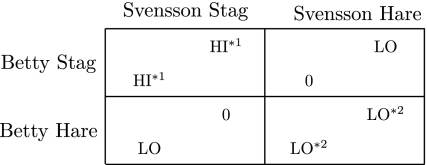
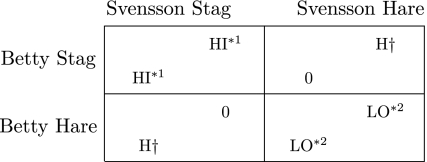
Adaptationists explain the evolution of religion from the cooperative effects of religious commitments, but which cooperation problem does religion evolve to solve? I focus on a class of symmetrical coordination problems for which there are two pure Nash equilibriums: (1) ALL COOPERATE, which is efficient but relies on full cooperation; (2) ALL DEFECT, which is inefficient but pays regardless of what others choose. Formal and experimental studies reveal that for such risky coordination problems, only the defection equilibrium is evolutionarily stable. The following makes sense of otherwise puzzling properties of religious cognition and cultures as features of cooperative designs that evolve to stabilise such risky exchange. The model is interesting because it explains lingering puzzles in the data on religion, and better integrates evolutionary theories of religion with recent, well-motivated models of cooperative niche construction.
Figures
References
-
- Alvard MS, Nolin DA. Rousseau’s whale hunt? coordination among big-game hunters. Current Anthropology. 2002;43(4):533–559. doi: 10.1086/341653. - DOI
-
- Atkinson Q, Bourrat P. Beliefs about god, the afterlife and morality support the role of supernatural policing in human cooperation. Evolution and Human Behavior. 2010;32:41–49. doi: 10.1016/j.evolhumbehav.2010.07.008. - DOI
-
- Atran S, Norenzayan A. Religion’s evolutionary landscape: Counterintuition, commitment, compassion, communion. Behavioral and Brain Sciences. 2004;27:713–770. - PubMed
-
- Austin J. Sense and Sensibilia. New York: Oxford University Press; 1962.
-
- Bacharach M. Beyond Individual Choice: Teams and Frames in Game Theory. Princeton, N.J: Princeton University Press; 2006.
LinkOut - more resources
Full Text Sources