


Caspase-2-Based Regulation of the Androgen Receptor and Cell Cycle in the Prostate Cancer Cell Line LNCaP
- PMID: 22207900
- PMCID: PMC3218410
- DOI: 10.1177/1947601911426007
Caspase-2-Based Regulation of the Androgen Receptor and Cell Cycle in the Prostate Cancer Cell Line LNCaP
Abstract
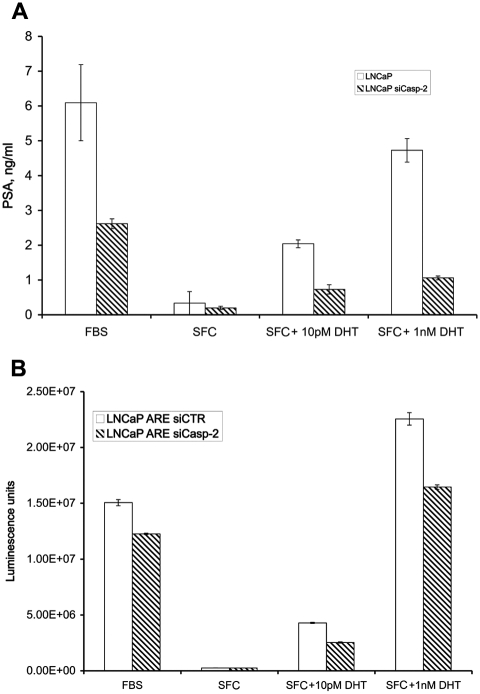
Caspase-2 can induce apoptosis in response to extrinsic and intrinsic signals. Unlike other caspases, this protein is not expressed solely in nonnuclear compartments; a subpopulation is constitutively localized in the nucleus. As one of the most evolutionarily conserved caspases, caspase-2 may have roles in multiple cellular processes. However, its contribution to nonapoptotic processes remains a mystery. In this study, we show that caspase-2 activity is important for proliferation by cells of the androgen-dependent prostate cancer cell line LNCaP. LNCaP cells expressing either a dominant-negative (dn) form of caspase or an siRNA against caspase-2 had lower androgen receptor (AR)-dependent proliferative responses than control cells, and application of the siRNA resulted in downregulation of the expression of both AR-dependent prostate-specific antigen (PSA) and AR-dependent reporter luciferase. Also, caspase-2 formed complexes with the cell cycle regulatory proteins cyclin D3, CDK4, and p21/Cip1, and caspase-2 regulated AR transactivation by inhibiting the repressive function of cyclin D3. Taken together, these results reveal, for the first time, that caspase-2 is involved in cell cycle promotion and AR activation. Given that prostate cancer cells depend on AR activity in order to survive, the fact that our data indicate that caspase-2 positively regulates AR activity suggests that caspase-2 has potential as a target in the treatment of prostate cancer.
Keywords: CDK4; DHT; LNCaP; apoptosis; caspase-2; cell cycle; cyclin D3; p21/Cip1; prostate cancer.
Conflict of interest statement
The author(s) declared no potential conflicts of interest with respect to the research, authorship, and/or publication of this article.
Figures



References
-
- Zhivotovsky B, Orrenius S. Caspase-2 function in response to DNA damage. Biochem Biophys Res Commun. 2005;331:859-67 - PubMed
-
- Tinel A, Tschopp J. The PIDDosome, a protein complex implicated in activation of caspase-2 in response to genotoxic stress. Science. 2004;304:843-6 - PubMed
-
- Baliga BC, Read SH, Kumar S. The biochemical mechanism of caspase-2 activation. Cell Death Differ. 2004;11:1234-41 - PubMed
LinkOut - more resources
Full Text Sources
Research Materials
Miscellaneous