


Women in academic surgery: the pipeline is busted
- PMID: 22208838
- PMCID: PMC3458116
- DOI: 10.1016/j.jsurg.2011.07.008
Women in academic surgery: the pipeline is busted
Abstract
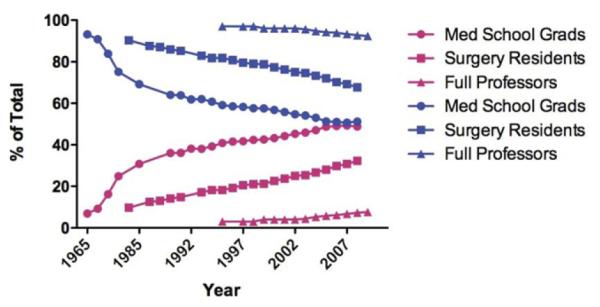
Purpose: This investigation examined the trends for gender-based advancement in academic surgery by performing a comparative analysis of the rate of change in the percentage of medical students, surgery residents, and full professors of surgery who are women.
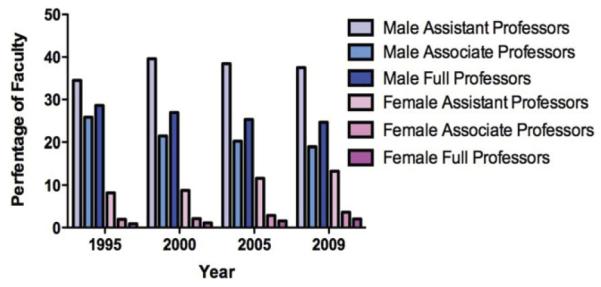
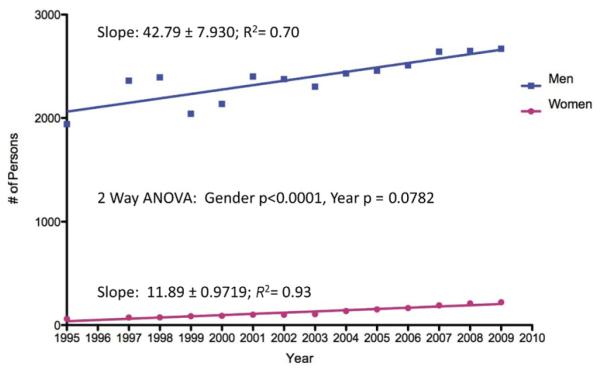
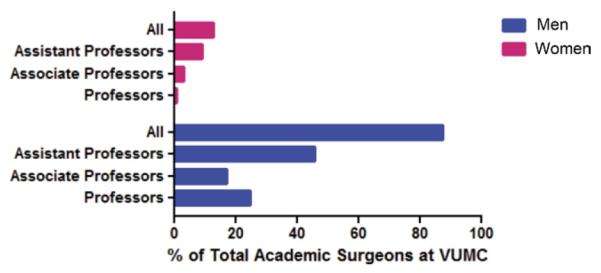
Methods: All available Women in Medicine Annual Reports were obtained from the American Association of Medical Colleges (AAMC). The gender compositions of medical graduates, surgery residents, and full professors were plotted. Binomial and linear trendlines were calculated to estimate the year when 50% of surgery full professors would be women. Additionally, the percentage distribution of men and women at each professorial rank was determined from 1995 to 2009 using these reports to demonstrate the rate of academic advancement of each gender.
Results: The slope of the line of increase for women full professors is significantly less than for female medical students and for female general surgery residents (0.36, compared with 0.75 and 0.99, respectively). This predicts that the earliest time that females will account for 50% of full professors in surgery is the year 2096. When comparing women and men in academic ranks, we find that women are much less likely than men to be full professors.
Conclusions: The percentage of full professors in surgery who are women is increasing at a rate disproportionately slower than the increases in female medical students and surgery residents. The rates of increase in female medical students and surgery residents are similar. The disproportionately slow rate of increase in the number of female full professors suggests that multiple factors may be responsible for this discrepancy.
Copyright © 2012 Association of Program Directors in Surgery. Published by Elsevier Inc. All rights reserved.
Figures
References
-
- McCann KS. The diversity-stability debate. Nature. 2000;405:228–233. - PubMed
-
- Wyrzykowski AD, Han E, Pettitt BJ, Styblo TM, Rozycki GS. A profile of female academic surgeons: training, cre-dentials, and academic success. Am Surg. 2006;72:1153–1157. discussion: 1158-1159. - PubMed
-
- Bickel J, Wara D, Atkinson BF, et al. Increasing women’s leadership in academic medicine: report of the AAMC Project Implementation Committee. Acad Med. 2002;77:1043–1061. - PubMed
-
- Carr PL, Friedman RH, Moskowitz MA, Kazis LE. Comparing the status of women and men in academic medicine. Ann Intern Med. 1993;119:908–913. - PubMed
Publication types
MeSH terms
Grants and funding
LinkOut - more resources
Full Text Sources
