. 2012 Jan 13;90(1):133-41.
doi: 10.1016/j.ajhg.2011.11.025. Epub 2011 Dec 29.

Rare deletions at the neurexin 3 locus in autism spectrum disorder

Affiliations

Rare deletions at the neurexin 3 locus in autism spectrum disorder

Andrea K Vaags et al. Am J Hum Genet. .

Abstract

The three members of the human neurexin gene family, neurexin 1 (NRXN1), neurexin 2 (NRXN2), and neurexin 3 (NRXN3), encode neuronal adhesion proteins that have important roles in synapse development and function. In autism spectrum disorder (ASD), as well as in other neurodevelopmental conditions, rare exonic copy-number variants and/or point mutations have been identified in the NRXN1 and NRXN2 loci. We present clinical characterization of four index cases who have been diagnosed with ASD and who possess rare inherited or de novo microdeletions at 14q24.3-31.1, a region that overlaps exons of the alpha and/or beta isoforms of NRXN3. NRXN3 deletions were found in one father with subclinical autism and in a carrier mother and father without formal ASD diagnoses, indicating issues of penetrance and expressivity at this locus. Notwithstanding these clinical complexities, this report on ASD-affected individuals who harbor NRXN3 exonic deletions advances the understanding of the genetic etiology of autism, further enabling molecular diagnoses.


Figures

Figure 1
Figure 1
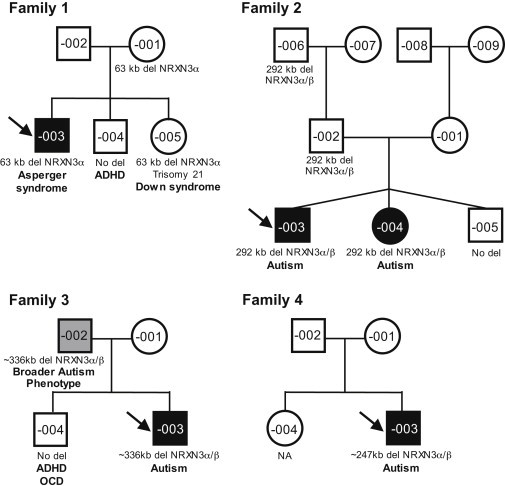
Pedigrees of Four Unrelated Families with Deletions at the NRXN3 Locus Black-filled symbols represent ASD-affected individuals, gray-filled symbols represent broader autism phenotype (BAP)-affected individuals, and unfilled symbols represent apparently unaffected individuals. Probands are marked with an arrow. Clinical diagnosis and segregation of the NRXN3 deletions are shown. Children are placed left to right in birth order from eldest to youngest. Other CNVs and genetic variants are found in Tables S1, S2, and S4–S7. Abbreviations are as follows: ADHD, attention deficit hyperactivity disorder; OCD, obsessive compulsive disorder; and NA, not assessed.
Figure 2
Figure 2
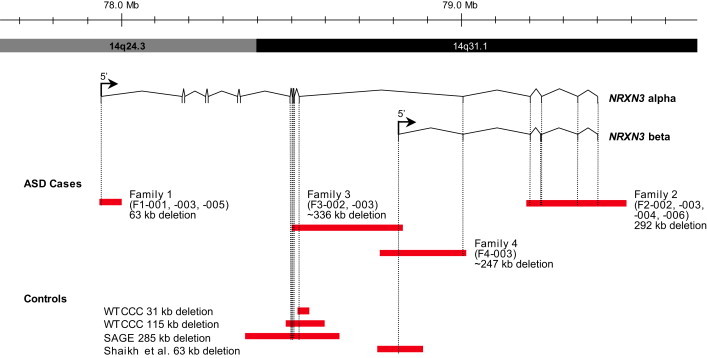
Extent of Genomic NRXN3 Deletions at Chromosomal Region 14q24.3-q31.1 Deletions are shown in red. CNVs detected in control populations (described in this paper) and from the Database of Genomic Variants are also shown. Genomic coordinates and isoform information are from hg18. Control data are as described in this paper.

References

    1. Szatmari P., Paterson A.D., Zwaigenbaum L., Roberts W., Brian J., Liu X.Q., Vincent J.B., Skaug J.L., Thompson A.P., Senman L., Autism Genome Project Consortium Mapping autism risk loci using genetic linkage and chromosomal rearrangements. Nat. Genet. 2007;39:319–328. - PMC - PubMed
    1. Sebat J., Lakshmi B., Malhotra D., Troge J., Lese-Martin C., Walsh T., Yamrom B., Yoon S., Krasnitz A., Kendall J. Strong association of de novo copy number mutations with autism. Science. 2007;316:445–449. - PMC - PubMed
    1. Marshall C.R., Noor A., Vincent J.B., Lionel A.C., Feuk L., Skaug J., Shago M., Moessner R., Pinto D., Ren Y. Structural variation of chromosomes in autism spectrum disorder. Am. J. Hum. Genet. 2008;82:477–488. - PMC - PubMed
    1. Glessner J.T., Wang K., Cai G., Korvatska O., Kim C.E., Wood S., Zhang H., Estes A., Brune C.W., Bradfield J.P. Autism genome-wide copy number variation reveals ubiquitin and neuronal genes. Nature. 2009;459:569–573. - PMC - PubMed
    1. Pinto D., Pagnamenta A.T., Klei L., Anney R., Merico D., Regan R., Conroy J., Magalhaes T.R., Correia C., Abrahams B.S. Functional impact of global rare copy number variation in autism spectrum disorders. Nature. 2010;466:368–372. - PMC - PubMed

Publication types