Editorial
doi: 10.3324/haematol.2011.057109.
ATM and chronic lymphocytic leukemia: mutations, and not only deletions, matter
- PMID: 22210328
- PMCID: PMC3248924
- DOI: 10.3324/haematol.2011.057109
Item in Clipboard
Editorial
ATM and chronic lymphocytic leukemia: mutations, and not only deletions, matter
Haematologica.
2012 Jan.
No abstract available
Figures
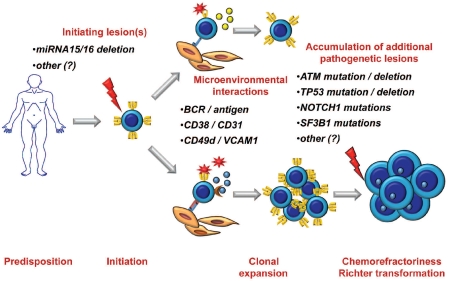
A proposed model of CLL multistep pathogenesis and of its clinical implications. Although the overwhelming majority of cases do not run in families, the genetic background of the host might favor predisposition to CLL in a fraction of patients. A founding genetic lesion, conceivably represented by loss of miRNA15/16 in a substantial fraction of CLL, initiates clonal expansion, that is then favored and promoted by interactions of leukemic cells with antigens and/or the microenvironment. During their clinical course, some patients gain molecular alterations of genes (TP53, ATM, NOTCH1, SF3B1, and possibly other) that confer a higher degree of clinical aggressiveness which translates into refractoriness to conventional treatments and potential of transformation to diffuse large B cell lymphoma known as Richter’s syndrome.
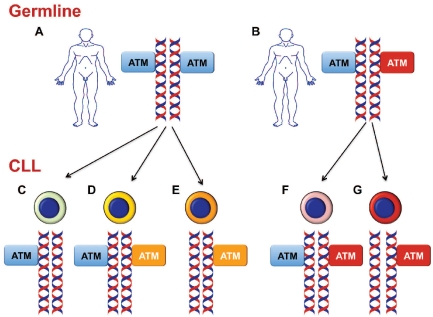
Mechanisms of ATM structural alterations in CLL. Upper panel: most CLL patients carry normal (represented by blue boxes in the figure) ATM genes in their germline DNA (A), although some cases may harbor germline mutations of ATM (represented by red boxes in the figure) (B). Lower panel: at some stage during the clinical history of the disease, CLL cells may acquire somatic alterations of ATM, alternatively constituted by: ATM deletion in the presence of a residual normal ATM allele (C); somatically acquired ATM mutations (represented by orange boxes in the figure) in the presence of a residual normal ATM allele (D); biallelic ATM inactivation through deletion of one allele and somatic mutation (represented by orange boxes in the figure) of the residual allele (E); biallelic ATM inactivation through somatically acquired deletion of one allele and germline mutation (represented by red boxes in the figure) of the other allele (G). In some cases, only a germline ATM mutation (represented by red boxes in the figure) is detected in CLL cells (F).
Comment on
-
ATM germline heterozygosity does not play a role in chronic lymphocytic leukemia initiation but influences rapid disease progression through loss of the remaining ATM allele.Haematologica. 2012 Jan;97(1):142-6. doi: 10.3324/haematol.2011.048827. Epub 2011 Sep 20. Haematologica. 2012. PMID: 21933854 Free PMC article.
-
ATM gene alterations in chronic lymphocytic leukemia patients induce a distinct gene expression profile and predict disease progression.Haematologica. 2012 Jan;97(1):47-55. doi: 10.3324/haematol.2011.049270. Epub 2011 Oct 11. Haematologica. 2012. PMID: 21993670 Free PMC article.
References
-
- Hallek M, Cheson BD, Catovsky D, Caligaris-Cappio F, Dighiero G, Döhner H, et al. Guidelines for the diagnosis and treatment of chronic lymphocytic leukemia: a report from the International Workshop on Chronic Lymphocytic Leukemia updating the National Cancer Institute-Working Group 1996 guidelines. Blood. 2008;111(12):5446–56. - PMC - PubMed
-
- Stilgenbauer S, Zenz T. Understanding and managing ultra high-risk chronic lymphocytic leukemia. Hematology Am Soc Hematol Educ Program. 2010;2010:481–8. - PubMed
-
- Rossi D, Spina V, Deambrogi C, Rasi S, Laurenti L, Stamatopoulos K, et al. The genetics of Richter syndrome reveals disease heterogeneity and predicts survival after transformation. Blood. 2011;117(12):3391–401. - PubMed
-
- Zenz T, Kröber A, Scherer K, Häbe S, Bühler A, Benner A, et al. Monoallelic TP53 inactivation is associated with poor prognosis in chronic lymphocytic leukemia: results from a detailed genetic characterization with long-term follow-up. Blood. 2008;112(8):3322–9. - PubMed
-
- Rossi D, Cerri M, Deambrogi C, Sozzi E, Cresta S, Rasi S, et al. The prognostic value of TP53 mutations in chronic lymphocytic leukemia is independent of Del17p13: implications for overall survival and chemorefractoriness. Clin Cancer Res. 2009;15(3):995–1004. - PubMed
Publication types
MeSH terms
Substances
LinkOut - more resources
Full Text Sources
Research Materials
Miscellaneous