


Nationwide study on trends in hospital admissions for major cardiovascular events and procedures among people with and without diabetes in England, 2004-2009
- PMID: 22210568
- PMCID: PMC3263914
- DOI: 10.2337/dc11-1682
Nationwide study on trends in hospital admissions for major cardiovascular events and procedures among people with and without diabetes in England, 2004-2009
Abstract
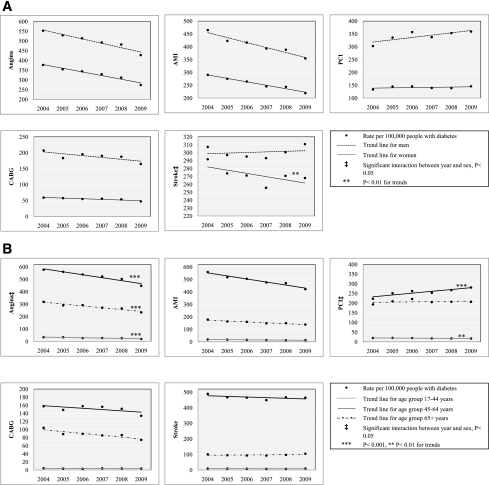
Objective: It is unclear whether people with and without diabetes equally benefitted from reductions in cardiovascular disease (CVD). We aimed to compare recent trends in hospital admission rates for angina, acute myocardial infarction (AMI), stroke, percutaneous coronary intervention (PCI), and coronary artery bypass graft (CABG) among people with and without diabetes in England.
Research design and methods: We identified all patients aged >16 years with cardiovascular events in England between 2004-2005 and 2009-2010 using national hospital activity data. Diabetes- and nondiabetes-specific rates were calculated for each year. To test for time trend, we fitted Poisson regression models.
Results: In people with diabetes, admission rates for angina, AMI, and CABG decreased significantly by 5% (rate ratio 0.95 [95% CI 0.94-0.96]), 5% (0.95 [0.93-0.97]), and 3% (0.97 [0.95-0.98]) per year, respectively. Admission rates for stroke did not significantly change (0.99 [0.98-1.004]) but increased for PCI (1.01 [1.005-1.03]) in people with diabetes. People with and without diabetes experienced similar proportional changes for all outcomes, with no significant differences in trends between these groups. However, diabetes was associated with an ~3.5- to 5-fold risk of CVD events. In-hospital mortality rates declined for AMI and stroke, remained unchanged for CABG, and increased for PCI admissions in both groups.
Conclusions: This national study suggests similar changes in admissions for CVD in people with and without diabetes. Aggressive risk reduction is needed to further reduce the high absolute and relative risk of CVD still present in people with diabetes.
Figures
References
-
- Kesteloot H, Sans S, Kromhout D. Dynamics of cardiovascular and all-cause mortality in Western and Eastern Europe between 1970 and 2000. Eur Heart J 2006;27:107–113 - PubMed
-
- World Health Organization. World health statistics 2009 [article online], 2009. Available from http://www.who.int/whosis/whostat/EN_WHS09_Full.pdf Accessed 10 December 2011
-
- Unal B, Critchley JA, Capewell S. Explaining the decline in coronary heart disease mortality in England and Wales between 1981 and 2000. Circulation 2004;109:1101–1107 - PubMed
-
- Booth GL, Kapral MK, Fung K, Tu JV. Recent trends in cardiovascular complications among men and women with and without diabetes. Diabetes Care 2006;29:32–37 - PubMed
Publication types
MeSH terms
LinkOut - more resources
Full Text Sources
Medical
Miscellaneous
