


Lifestyle and the risk of dementia in Japanese-american men
- PMID: 22211390
- PMCID: PMC3258374
- DOI: 10.1111/j.1532-5415.2011.03768.x
Lifestyle and the risk of dementia in Japanese-american men
Abstract
Objectives: To determine whether adhering to a healthy lifestyle in midlife may reduce the risk of dementia.
Design: Case-control study nested in a prospective cohort.
Setting: The Honolulu-Asia Aging Study, Oahu, Hawaii.
Participants: Three thousand four hundred sixty-eight Japanese-American men (mean age 52 in 1965-1968) examined for dementia 25 years later.
Measurements: Men at low risk were defined as those with the following midlife characteristics: nonsmoking, body mass index (BMI) less than 25.0 kg/m(2) , physically active, and having a healthy diet (based on alcohol, dairy, meat, fish, fruits, vegetables, cereals, and ratio of monounsaturated to saturated fat). Logistic regression was used to calculate odds ratios (ORs) and 95% confidence intervals (CIs) for developing overall dementia, Alzheimer's disease (AD), and vascular dementia (VaD), adjusting for potential confounders.
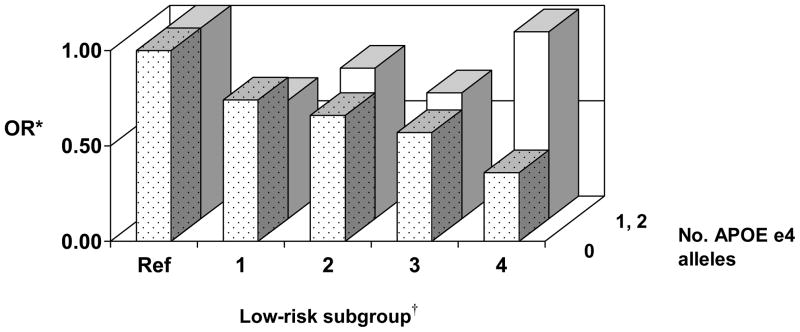
Results: Dementia was diagnosed in 6.4% of men (52.5% with AD, 35.0% with VaD). Examining the risk factors individually, BMI was most strongly associated with greater risk of overall dementia (OR = 1.87, 95% CI = 1.26-2.77; BMI > 25.0 vs <22.6 kg/m(2) ). All of the individual risk factors except diet score were significantly associated with VaD, whereas none were significantly associated with AD alone. Men with all four low-risk characteristics (7.2% of the cohort) had the lowest OR for overall dementia (OR = 0.36, 95% CI = 0.15-0.84). There were no significant associations between the combined low-risk characteristics and the risk of AD alone.
Conclusion: Among Japanese-American men, having a healthy lifestyle in midlife is associated with a lower risk of dementia in late life.
© 2011, Copyright the Authors Journal compilation © 2011, The American Geriatrics Society.
Conflict of interest statement
Figures
References
-
- Raina P, Santaguida P, Ismaila A, et al. Effectiveness of cholinesterase inhibitors and memantine for treating dementia: Evidence review for a clinical practice guideline. Ann Intern Med. 2008;148:379–397. - PubMed
-
- Stampfer MJ, Hu FB, Manson JE, et al. Primary prevention of coronary heart disease in women through diet and lifestyle. N Engl J Med. 2000;343:16–22. - PubMed
-
- Goldberg RJ, Burchfiel CM, Benfante R, et al. Lifestyle and biologic factors associated with atherosclerotic disease in middle-aged men. 20-year findings from the Honolulu Heart Program. Arch Intern Med. 1995;155:686–694. - PubMed
-
- Hu FB, Manson JE, Stampfer MJ, et al. Diet, lifestyle, and the risk of type 2 diabetes mellitus in women. N Engl J Med. 2001;345:790–797. - PubMed
-
- Burchfiel CM, Sharp DS, Curb JD, et al. Physical activity and incidence of diabetes: The Honolulu Heart Program. Am J Epidemiol. 1995;141:360–368. - PubMed
Publication types
MeSH terms
Grants and funding
LinkOut - more resources
Full Text Sources
Medical
