Excess body mass index-years, a measure of degree and duration of excess weight, and risk for incident diabetes
- PMID: 22213749
- PMCID: PMC3524333
- DOI: 10.1001/archpedi.166.1.42
Excess body mass index-years, a measure of degree and duration of excess weight, and risk for incident diabetes
Erratum in
- Arch Pediatr Adolesc Med. 2012 Mar;166(3):239
Abstract
Objective: To evaluate the relation between excess body mass index (BMI)-years, a measure of the degree to which an individual's BMI (calculated as weight in kilograms divided by height in meters squared) exceeds the reference BMI and the duration for which he or she carries excess BMI, and incident diabetes.
Design: Longitudinal analysis.
Setting: United States of America.
Participants: A total of 8157 adolescents and young adults aged 14 to 21 years at the start of the National Longitudinal Survey of Youth 1979 with self-reported measures of height, weight, and diabetes status (type unspecified) from 1981 through 2006.
Main exposure: Excess BMI-years, which were calculated by subtracting the [corrected] reference BMI (25.0 for adults or 85th percentile for adolescents) from the actual BMI [corrected] for each study year and cumulating excess BMI for the study duration.
Main outcome measure: We conducted logistic regression models to predict presumed type 2 diabetes (after excluding presumed type 1 diabetes) as a function of age, sex, race, excess BMI-years, and specific interactions.
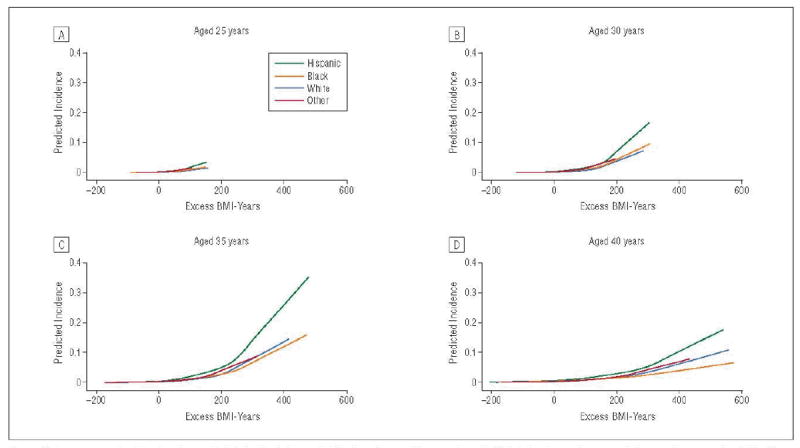
Results: A higher level of excess BMI-years was associated with an increased risk of diabetes. For example, on average, white men aged 40 years with 200 excess BMI-years had 2.94 times (95% confidence interval, 2.36-3.67) higher odds of developing diabetes compared with men of the same age and race with 100 excess BMI-years. For a given level of excess BMI-years, younger compared with older and Hispanic and black compared with white individuals had higher risk of developing diabetes. Our study is limited by use of self-reported data without specification of diabetes type.
Conclusions: Because younger compared with older individuals have a higher risk of self-reported diabetes for a given level of excess BMI-years and cumulative exposure to excess BMI is increasing among younger US birth cohorts, public health interventions should target younger adults.
Figures
References
-
- Colditz GA, Willett WC, Rotnitzky A, Manson JE. Weight gain as a risk factor for clinical diabetes mellitus in women. Ann Intern Med. 1995;122(7):481–486. - PubMed
-
- Colditz GA, Willett WC, Stampfer MJ, et al. Weight as a risk factor for clinical diabetes in women. Am J Epidemiol. 1990;132(3):501–513. - PubMed
-
- Wilson PW, McGee DL, Kannel WB. Obesity, very low density lipoproteins, and glucose intolerance over fourteen years: the Framingham Study. Am J Epidemiol. 1981;114(5):697–704. - PubMed
-
- Feskens EJ, Kromhout D. Cardiovascular risk factors and the 25-year incidence of diabetes mellitus in middle-aged men: the Zutphen Study. Am J Epidemiol. 1989;130(6):1101–1108. - PubMed