Review
. 2012 Jan;33(1):116-25.
doi: 10.1016/j.yfrne.2011.12.002. Epub 2011 Dec 27.

Cytokines and brain excitability

Affiliations
Review

Cytokines and brain excitability

Michael A Galic et al. Front Neuroendocrinol. 2012 Jan.

Abstract

Cytokines are molecules secreted by peripheral immune cells, microglia, astrocytes and neurons in the central nervous system. Peripheral or central inflammation is characterized by an upregulation of cytokines and their receptors in the brain. Emerging evidence indicates that pro-inflammatory cytokines modulate brain excitability. Findings from both the clinical literature and from in vivo and in vitro laboratory studies suggest that cytokines can increase seizure susceptibility and may be involved in epileptogenesis. Cellular mechanisms that underlie these effects include upregulation of excitatory glutamatergic transmission and downregulation of inhibitory GABAergic transmission.


Figures

Fig. 1
Fig. 1
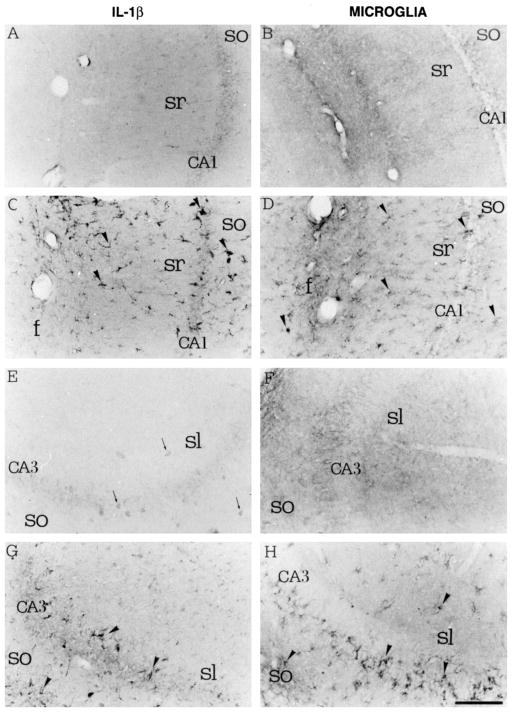
Cytokine induction and microglial activation in the hippocampus after local injection of kainic acid. Left panels show IL-1β immunoreactivity; right panels show microglia revealed by B4-isolectin immunoreactivity. (A and B) Control saline injection in the CA1 area of the hippocampus. (C and D) Kainic acid injection in the same area. (E and F) Control saline injection in the CA3 area of the hippocampus. (G and H) kainic acid injection in the same area (from [161] with permission).
Fig. 2
Fig. 2
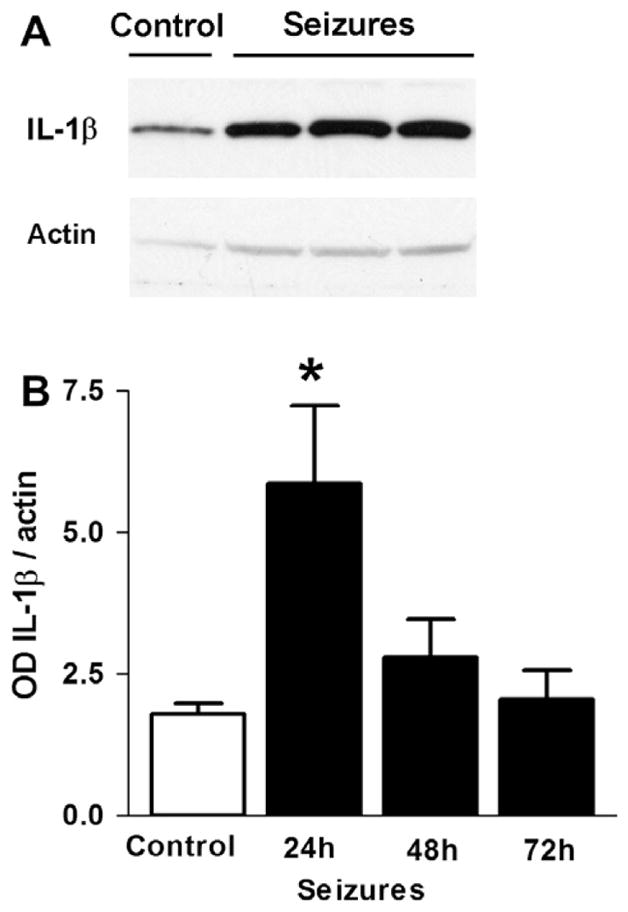
A seizure in a neonatal rat results in transient elevation of IL-1β in the hippocampus. (A) Representative Western blots showing increasing IL-1β protein following a febrile seizure. (B) Quantitative analysis of IL-1β protein levels 24, 48 and 72 h following seizure induction (from [40] with permission).
Fig. 3
Fig. 3
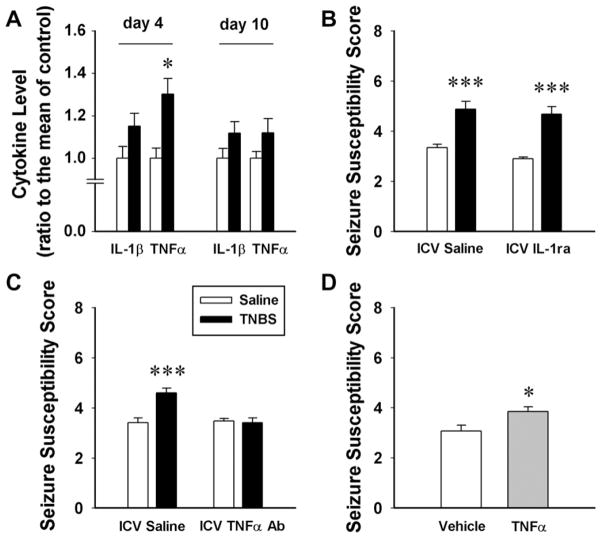
Peripheral inflammation induces hippocampal cytokine synthesis and increases seizure susceptibility in a TNFα dependent manner. (A) At the peak (day 4) of experimental colitis induced by intracolonic infusion of TNBS (black bars) TNFα levels are elevated. (B) Seizure susceptibility is enhanced in colitic rats and intracerebroventricular (ICV) infusion of IL-1ra does not interfere with this. (C) In contrast, ICV TNFα antibody administration blocks the increased seizure susceptibility. (D) ICV TNFα alone increases seizure susceptibility in naïve rats (from [127] copyright © 2008 by the National Academy of Sciences of the USA).
Fig. 4
Fig. 4
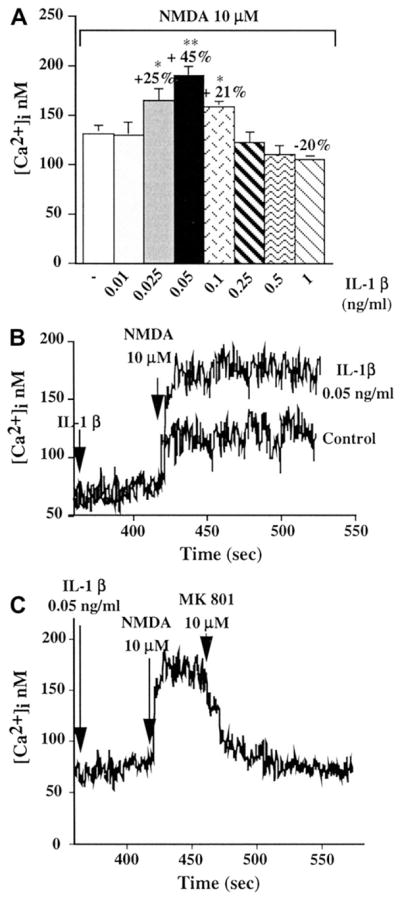
IL-1β augments NMDA effects in cultured hippocampal neurons. (A) Peak calcium responses to NMDA after brief (6 min) pre-exposure to various doses of IL-1β. (B) Representative data showing increased calcium levels after NMDA in the presence of IL-1β. (C) The effect of IL-1β on NMDA induced calcium increases was via an action at the NMDA receptor as it was blocked by the NMDA receptor antagonist MK 801 (from [165] with permission).
Fig. 5
Fig. 5
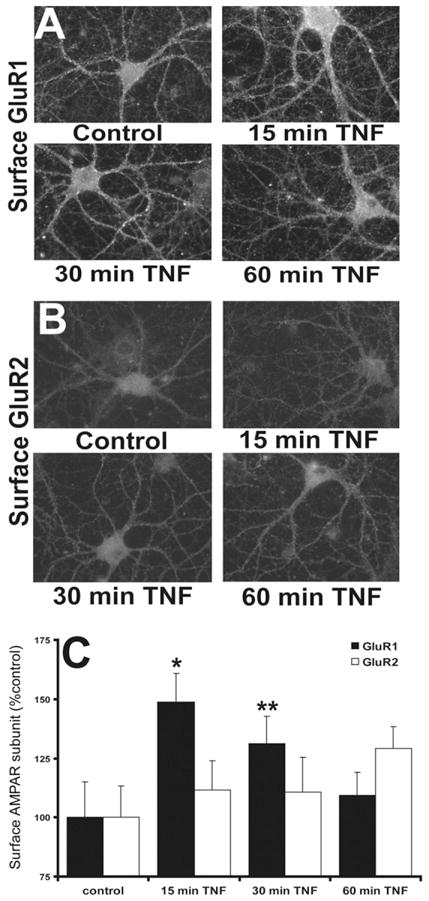
TNFα induces a transient increase in surface expression of GluR2 lacking AMPA receptors at the cell surface of hippocampal neurons. (A) Immunofluorescent detection of surface GluR1 receptors in response to application of TNFα in culture. (B) A similar experiment shows that GluR2 containing AMPA receptors do not move to the membrane in response to TNFα. (C) Compiled data indicating rapid and reversible surface expression of GluR2 lacking AMPA receptors after TNFα (from [93] with permission).

References

    1. Akin D, Ravizza T, Maroso M, Carcak N, Eryigit T, Vanzulli I, Aker RG, Vezzani A, Onat FY. IL-1beta is induced in reactive astrocytes in the somatosensory cortex of rats with genetic absence epilepsy at the onset of spike-and-wave discharges, and contributes to their occurrence. Neurobiol Dis. 2011;44:259–269. - PubMed
    1. Albensi BC, Mattson MP. Evidence for the involvement of TNF and NF-kappaB in hippocampal synaptic plasticity. Synapse. 2000;35:151–159. - PubMed
    1. Allan SM, Tyrrell PJ, Rothwell NJ. Interleukin-1 and neuronal injury. Nat Rev Immunol. 2005;5:629–640. - PubMed
    1. Aronica E, Crino PB. Inflammation in epilepsy: clinical observations. Epilepsia. 2011;52(Suppl 3):26–32. - PubMed
    1. Auvin S, Mazarati A, Shin D, Sankar R. Inflammation enhances epileptogenesis in the developing rat brain. Neurobiol Dis. 2010;40:303–310. - PMC - PubMed

Publication types

Grants and funding