


Spectral and temporal measures in hybrid cochlear implant users: on the mechanism of electroacoustic hearing benefits
- PMID: 22215451
- PMCID: PMC3259253
- DOI: 10.1097/MAO.0b013e318241b6d3
Spectral and temporal measures in hybrid cochlear implant users: on the mechanism of electroacoustic hearing benefits
Abstract
Objective: Compare auditory performance of Hybrid and standard cochlear implant users with psychoacoustic measures of spectral and temporal sensitivity and correlate with measures of clinical benefit.
Study design: Cross-sectional study.
Setting: Tertiary academic medical center.
Patients: Hybrid cochlear implant users between 12 and 33 months after implantation. Hybrid recipients had preservation of low-frequency hearing.
Interventions: Administration of psychoacoustic, music perception, and speech reception in noise tests.
Main outcome measures: Performance on spectral-ripple discrimination, temporal modulation detection, Schroeder-phase discrimination, Clinical Assessment of Music Perception, and speech reception in steady-state noise tests.
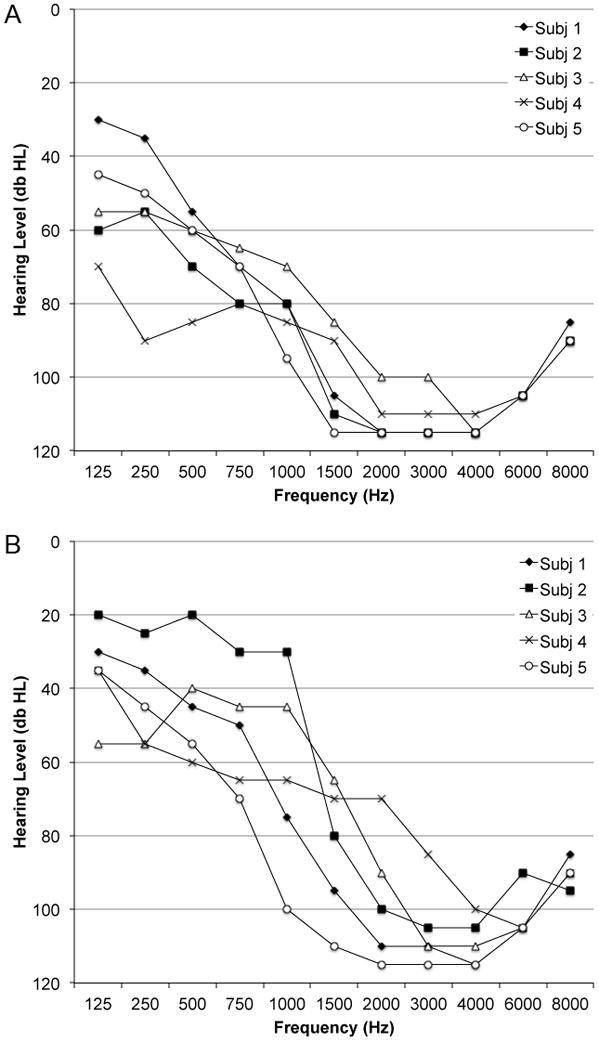
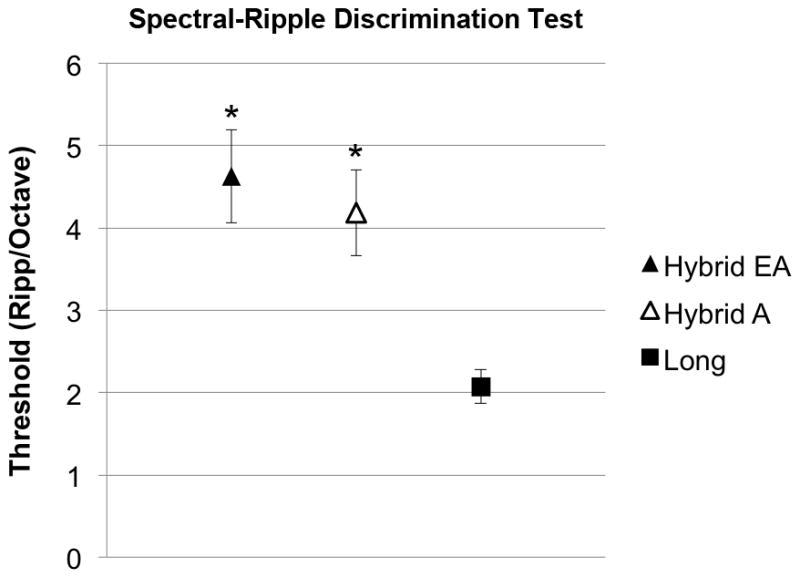
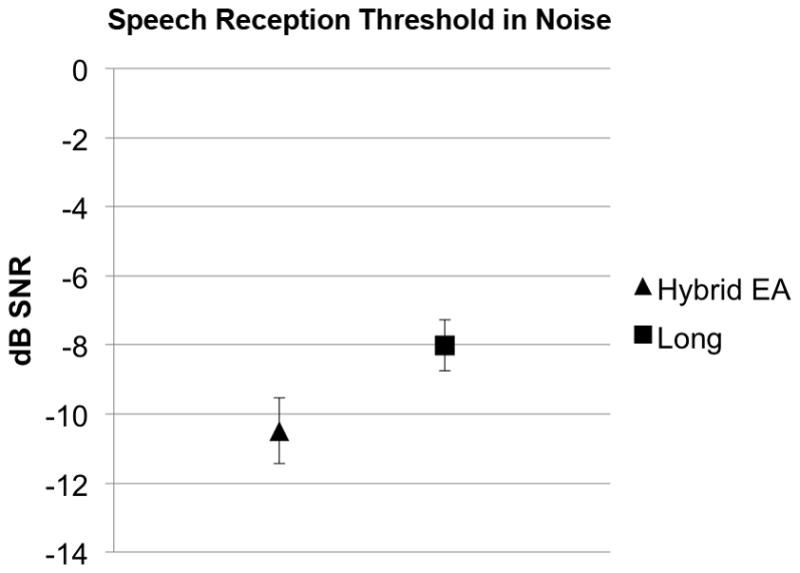
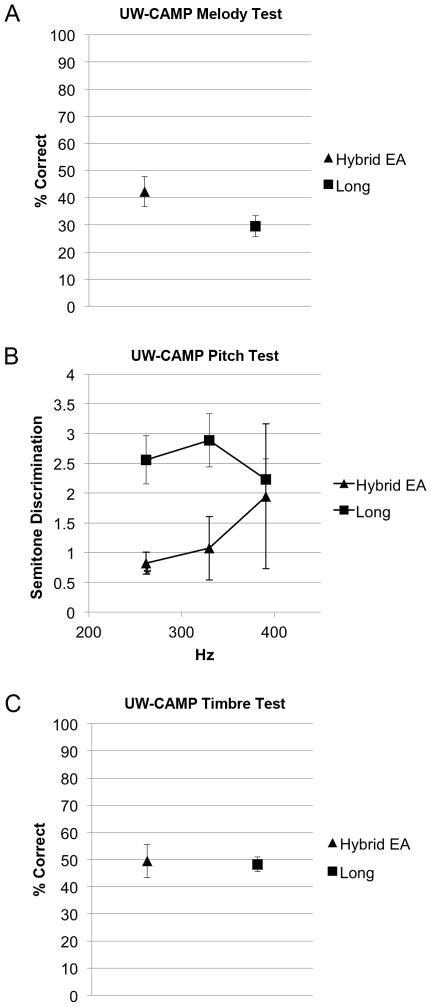
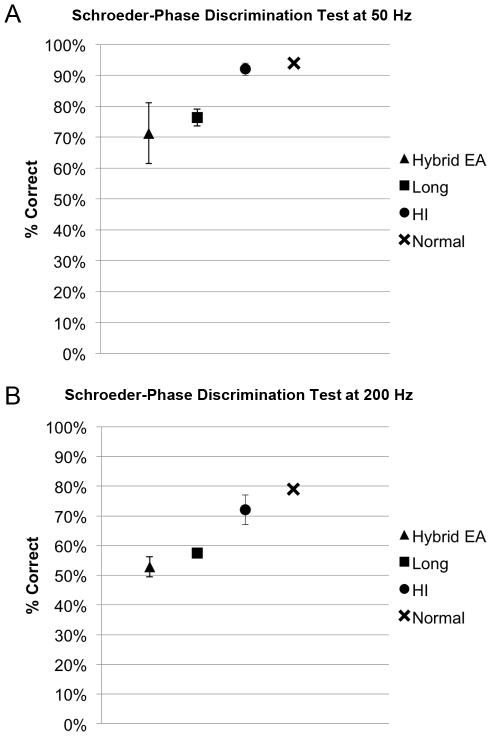
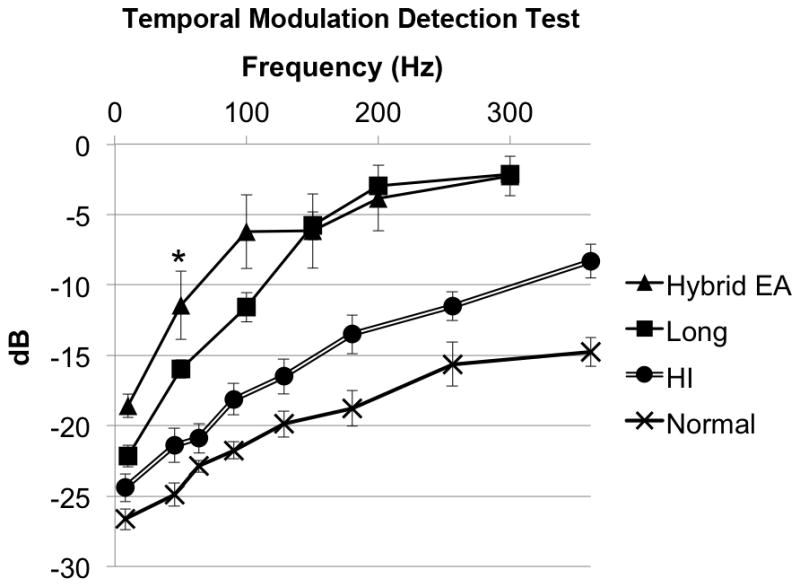
Results: Clinical Assessment of Music Perception pitch performance at 262 Hz was significantly better in Hybrid users compared with standard implant controls. There was a near significant difference on speech reception in steady-state noise. Surprisingly, neither Schroeder-phase discrimination at 2 frequencies nor temporal modulation detection thresholds across a range of frequencies revealed any advantage in Hybrid users. This contrasts with spectral-ripple measures that were significantly better in the Hybrid group. The spectral-ripple advantage was preserved even when using only residual hearing.
Conclusion: These preliminary data confirm existing data demonstrating that residual low-frequency acoustic hearing is advantageous for pitch perception. Results also suggest that clinical benefits enjoyed by Hybrid recipients are due to improved spectral discrimination provided by the residual hearing. No evidence indicated that residual hearing provided temporal information beyond that provided by electric stimulation.
Figures
References
-
- Gantz BJ, Turner CW. Combining acoustic and electrical hearing. The Laryngoscope. 2003 Oct;113(10):1726–1730. - PubMed
-
- Gantz BJ, Turner C, Gfeller KE, Lowder MW. Preservation of hearing in cochlear implant surgery: advantages of combined electrical and acoustical speech processing. Laryngoscope. 2005 May;115(5):796–802. - PubMed
-
- Turner CW, Gantz BJ, Vidal C, Behrens A, Henry BA. Speech recognition in noise for cochlear implant listeners: benefits of residual acoustic hearing. J Acoust Soc Am. 2004 Apr;115(4):1729–1735. - PubMed
-
- Turner C, Gantz BJ, Reiss L. Integration of acoustic and electrical hearing. J Rehabil Res Dev. 2008;45(5):769–778. - PubMed
-
- Gantz BJ, Turner C, Gfeller KE. Acoustic plus electric speech processing: preliminary results of a multicenter clinical trial of the Iowa/Nucleus Hybrid implant. Audiol Neurootol. 2006;11( Suppl 1):63–68. - PubMed
Publication types
MeSH terms
Grants and funding
LinkOut - more resources
Full Text Sources
Medical
