Polymorphisms associated with the risk of lung cancer in a healthy Mexican Mestizo population: Application of the additive model for cancer
- PMID: 22215955
- PMCID: PMC3229106
- DOI: 10.1590/S1415-47572011005000053
Polymorphisms associated with the risk of lung cancer in a healthy Mexican Mestizo population: Application of the additive model for cancer
Abstract
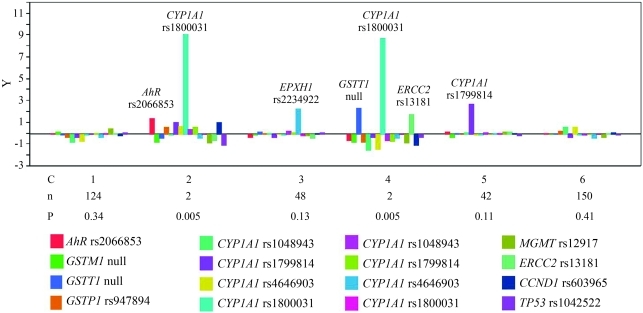
Lung cancer is the leading cause of cancer mortality in Mexico and worldwide. In the past decade, there has been an increase in the number of lung cancer cases in young people, which suggests an important role for genetic background in the etiology of this disease. In this study, we genetically characterized 16 polymorphisms in 12 low penetrance genes (AhR, CYP1A1, CYP2E1, EPHX1, GSTM1, GSTT1, GSTPI, XRCC1, ERCC2, MGMT, CCND1 and TP53) in 382 healthy Mexican Mestizos as the first step in elucidating the genetic structure of this population and identifying high risk individuals. All of the genotypes analyzed were in Hardy-Weinberg equilibrium, but different degrees of linkage were observed for polymorphisms in the CYP1A1 and EPHX1 genes. The genetic variability of this population was distributed in six clusters that were defined based on their genetic characteristics. The use of a polygenic model to assess the additive effect of low penetrance risk alleles identified combinations of risk genotypes that could be useful in predicting a predisposition to lung cancer. Estimation of the level of genetic susceptibility showed that the individual calculated risk value (iCRV) ranged from 1 to 16, with a higher iCRV indicating a greater genetic susceptibility to lung cancer.
Keywords: Mexicans; additive model; genetic polymorphism; lung cancer; molecular epidemiology.
Figures


References
-
- Abdel-Rahman S, El-Zein R. The 399Gln polymorphism in the DNA repair gene XRCC1 modulates the genotoxic response induced in human lymphocytes by the tobacco-specific nitrosamine NNK. Cancer Lett. 2000;159:63–71. - PubMed
-
- Abdel-Rahman S, El-Zein R, Anwar W, Au W. A multiplex PCR procedure for polymorphic analysis of GSTM1 and GSTT1 genes in population studies. Cancer Lett. 1996;107:229–233. - PubMed
-
- Cascorbi I, Brockmöller J, Roots I. A C4887A polymorphism in exon 7 of human CYP1A1: Population frequency, mutation linkages, and impact on lung cancer susceptibility. Cancer Res. 1996;56:4965–4969. - PubMed
-
- Courtney E, Wickliffe J, Wolfe K, Kinslow C, Lopez M, Abdel-Rahman S. The L84F and the I143V polymorphism in the O6-methylguanine-DNA-methyltransferase (MGMT) gene increase human sensitivity to the genotoxic effects of the tobacco-specific nitrosamine carcinogen NNK. Pharmacogenet Genomics. 2005;15:571–578. - PubMed
Internet Resources
-
- GenePop statistical package. http://genepop.curtin.edu.au(October 5, 2010)
LinkOut - more resources
Full Text Sources
Research Materials
Miscellaneous