


Long-term alterations of cytokines and growth factors expression in irradiated tissues and relation with histological severity scoring
- PMID: 22216271
- PMCID: PMC3245280
- DOI: 10.1371/journal.pone.0029399
Long-term alterations of cytokines and growth factors expression in irradiated tissues and relation with histological severity scoring
Abstract
Purpose: Beside its efficacy in cancer treatment, radiotherapy induces degeneration of healthy tissues within the irradiated area. The aim of this study was to analyze the variations of proinflammatory (IL-1α, IL-2, IL-6, TNF-α, IFN-γ), profibrotic (TGF-β1), proangiogneic (VEGF) and stem cell mobilizing (GM-CSF) cytokines and growth factors in an animal model of radiation-induced tissue degeneration.
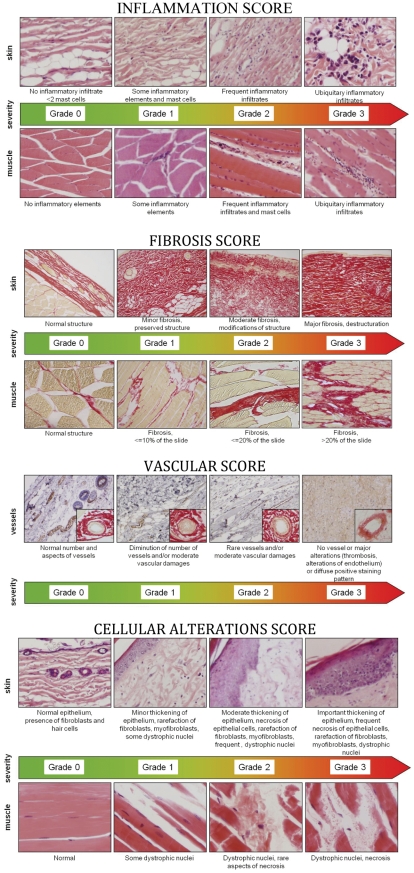
Materials and methods: 24 rats were irradiated unilaterally on the hindlimb at a monodose of 30 Gy. Six weeks (n=8), 6 months (n=8) and 1 year (n=8) after irradiation the mediators expression in skin and muscle were analyzed using Western blot and the Bio-Plex® protein array (BPA) technology. Additional histological severity for fibrosis, inflammation, vascularity and cellularity alterations scoring was defined from histology and immnunohistochemistry analyses.
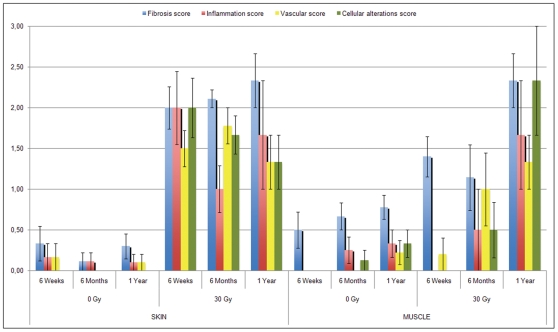
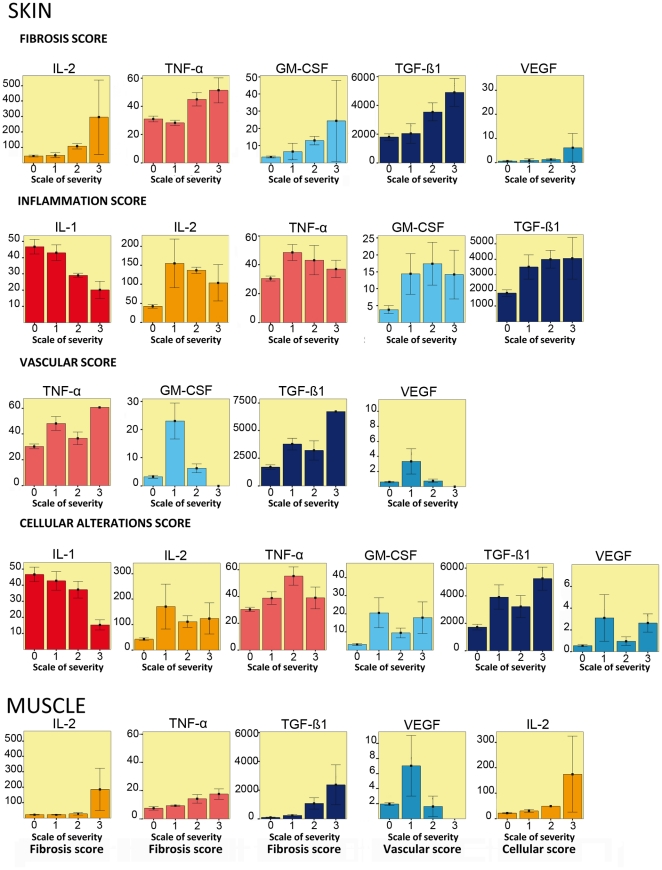
Results: A significant increase of histological severity scoring was found in irradiated tissue. Skin tissues were more radio-sensitive than muscle. A high level of TGF-β1 expression was found throughout the study and a significant relation was evidenced between TGF-β1 expression and fibrosis scoring. Irradiated tissue showed a chronic inflammation (IL-2 and TNF-α significantly increased). Moreover a persistent expression of GM-CSF and VEGF was found in all irradiated tissues. The vascular score was related to TGF-β1 expression and the cellular alterations score was significantly related with the level of IL-2, VEGF and GM-CSF.
Conclusion: The results achieved in the present study underline the complexity and multiplicity of radio-induced alterations of cytokine network. It offers many perspectives of development, for the comprehension of the mechanisms of late injuries or for the histological and molecular evaluation of the mode of action and the efficacy of rehabilitation techniques.
© 2011 Gallet et al.
Conflict of interest statement
Figures


References
-
- Hogle WP. The state of the art in radiation therapy. Semin Oncol Nurs. 2006;22:212–220. - PubMed
-
- Hill RP, Rodemann HP, Hendry JH, Roberts SA, Anscher MS. Normal tissue radiobiology: from the laboratory to the clinic. Int J Radiat Oncol Biol Phys. 2001;49:353–365. - PubMed
-
- Williams J, Chen Y, Rubin P, Finkelstein J, Okunieff P. The biological basis of a comprehensive grading system for the adverse effects of cancer treatment. Semin Radiat Oncol. 2003;13:182–188. - PubMed
-
- Stone HB, Coleman CN, Anscher MS, McBride WH. Effects of radiation on normal tissue: consequences and mechanisms. Lancet Oncol. 2003;4:529–536. - PubMed
Publication types
MeSH terms
Substances
LinkOut - more resources
Full Text Sources
Medical
