


Polymorphisms in the RNASE3 gene are associated with susceptibility to cerebral malaria in Ghanaian children
- PMID: 22216286
- PMCID: PMC3246477
- DOI: 10.1371/journal.pone.0029465
Polymorphisms in the RNASE3 gene are associated with susceptibility to cerebral malaria in Ghanaian children
Abstract
Background: Cerebral malaria (CM) is the most severe outcome of Plasmodium falciparum infection and a major cause of death in children from 2 to 4 years of age. A hospital based study in Ghana showed that P. falciparum induces eosinophilia and found a significantly higher serum level of eosinophil cationic protein (ECP) in CM patients than in uncomplicated malaria (UM) and severe malaria anemia (SA) patients. Single nucleotide polymorphisms (SNPs) have been described in the ECP encoding-gene (RNASE3) of which the c.371G>C polymorphism (rs2073342) results in an arginine to threonine amino acid substitution p.R124T in the polypeptide and abolishes the cytotoxicity of ECP. The present study aimed to investigate the potential association between polymorphisms in RNASE3 and CM.
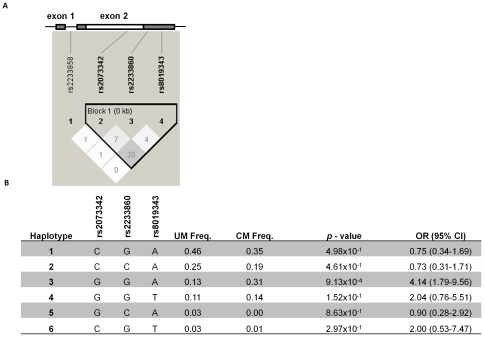
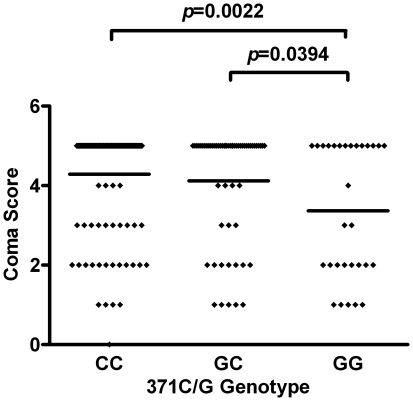
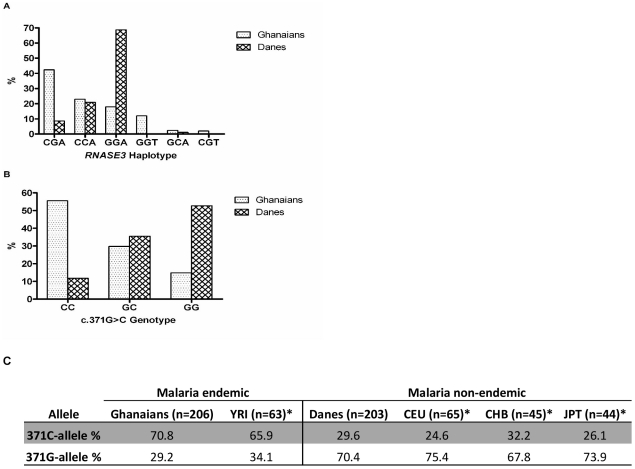
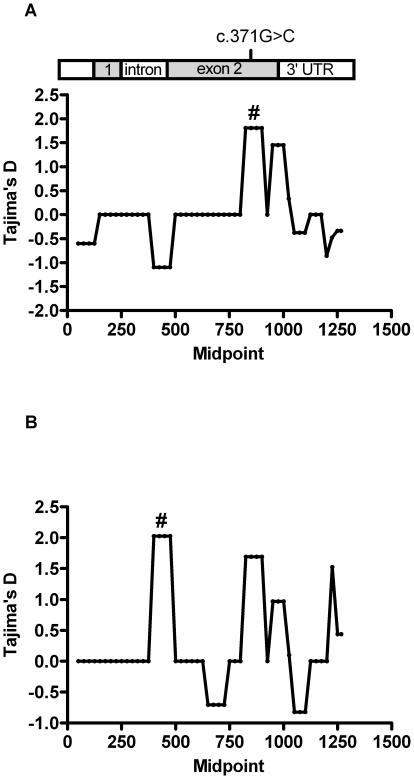
Methodology/principal findings: The RNASE3 gene and flanking regions were sequenced in 206 Ghanaian children enrolled in a hospital based malaria study. An association study was carried out to assess the significance of five SNPs in CM (n=45) and SA (n=56) cases, respectively. The two severe case groups (CM and SA) were compared with the non-severe control group comprising children suffering from UM (n=105). The 371G allele was significantly associated with CM (p=0.00945, OR=2.29, 95% CI=1.22-4.32) but not with SA. Linkage disequilibrium analysis demonstrated significant linkage between three SNPs and the haplotype combination 371G/*16G/*94A was strongly associated with susceptibility to CM (p=0.000913, OR=4.14, 95% CI=1.79-9.56), thus, defining a risk haplotype. The RNASE3 371GG genotype was found to be under frequency-dependent selection.
Conclusions/significance: The 371G allele of RNASE3 is associated with susceptibility to CM and forms part of a risk associated haplotype GGA defined by the markers: rs2073342 (G-allele), rs2233860 (G-allele) and rs8019343 (A-allele) respectively. Collectively, these results suggest a hitherto unrecognized role for eosinophils in CM pathogenesis.
© 2011 Adu et al.
Conflict of interest statement
Figures
References
-
- Miller LH, Good MF, Milon G. Malaria pathogenesis. Science. 1994;264:1878–1883. - PubMed
-
- van der Heyde HC, Nolan J, Combes V, Gramaglia I, Grau GE. A unified hypothesis for the genesis of cerebral malaria: sequestration, inflammation and hemostasis leading to microcirculatory dysfunction. Trends Parasitol. 2006;22:503–508. - PubMed
-
- World Health Organisation. World Malaria Report 2010. Geneva, Switzerland: WHO Press; 2010. pp. 1–238.
-
- Marchiafava E, Bigmani A. Sulle Febbri Estivo Aumnali. ELoesscher; 1894.
-
- Maegraith B. Pathological processes in malaria. Trans R Soc Trop Med Hyg. 1948;41:687–704. - PubMed
Publication types
MeSH terms
Substances
LinkOut - more resources
Full Text Sources
Other Literature Sources
