


MicroRNA-195 plays a tumor-suppressor role in human glioblastoma cells by targeting signaling pathways involved in cellular proliferation and invasion
- PMID: 22217655
- PMCID: PMC3280801
- DOI: 10.1093/neuonc/nor216
MicroRNA-195 plays a tumor-suppressor role in human glioblastoma cells by targeting signaling pathways involved in cellular proliferation and invasion
Abstract
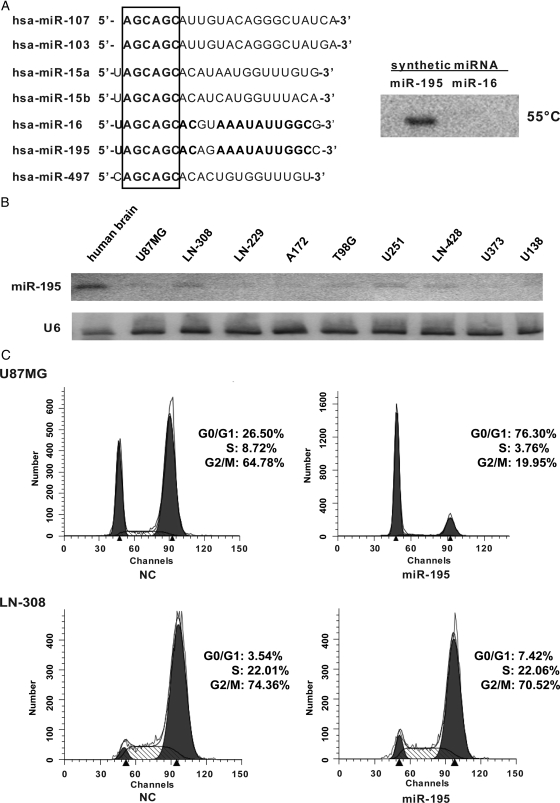
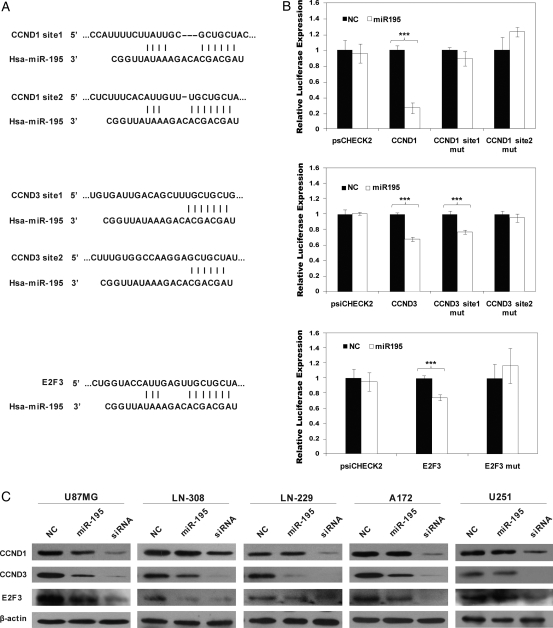
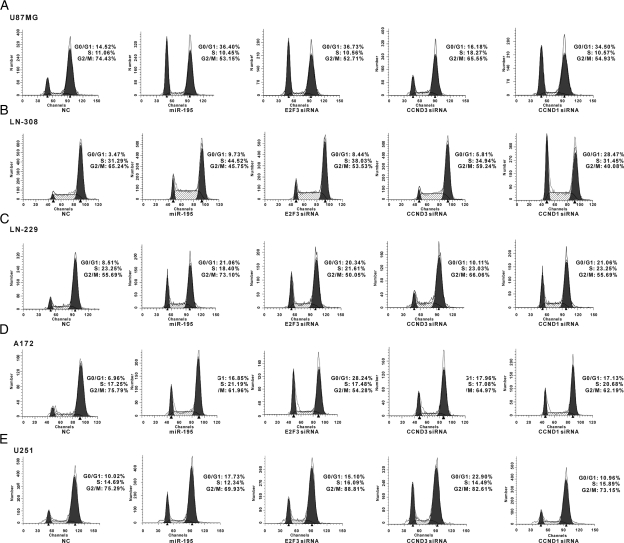
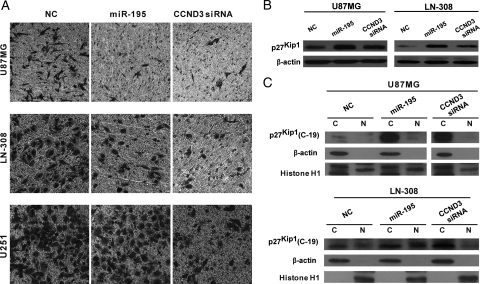
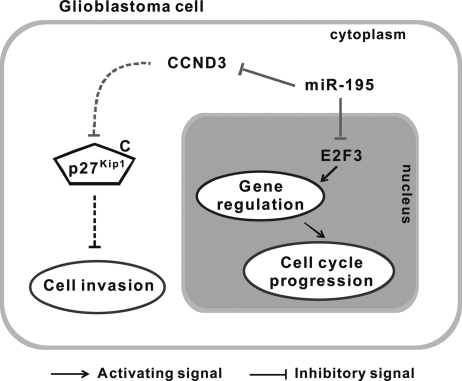
Accumulating evidence has implicated the deregluation of miRNAs in tumorigenesis. Previous studies have reported that microRNA-195 (miR-195) is markedly down-regulated in human glioblastoma cells, compared with normal brain tissue, but the biological role of miR-195 in glioblastoma development is currently unknown. In this study, we define a tumor-suppressor role for miR-195 in human glioblastoma cells. Over-expression of miR-195 in glioblastoma cell lines robustly arrested cell cycle progression and significantly repressed cellular invasion. We identified E2F3 and CCND3 as functional downstream targets of miR-195 in glioblastoma cells. Through knockdown studies, we demonstrated that E2F3 was the dominant effector of miR-195-mediated cell cycle arrest and that CCND3 was a key mediator of miR-195-induced inhibition of glioblastoma cell invasion. Furthermore, we showed that p27(Kip1) was an important regulator downstream of CCND3 and that the accumulation of p27(Kip1) in the cytoplasm might be responsible for the miR-195-mediated cell invasion inhibition in glioblastoma cells. This work provides evidence for the initial mechanism by which miR-195 negatively regulates both the proliferation and invasion of glioblastoma cells, suggesting that the down-regulation of miR-195 might contribute to the malignant transformation of glioblastoma cells and could be a molecular signature associated with glioblastoma progression.
Figures
References
-
- Louis DN, Ohgaki H, Wiestler OD, et al. The 2007 WHO classification of tumours of the central nervous system. Acta Neuropathol. 2007;114(2):97–109. doi:10.1007/s00401-007-0243-4. - DOI - PMC - PubMed
-
- Furnari FB, Fenton T, Bachoo RM, et al. Malignant astrocytic glioma: genetics, biology, and paths to treatment. Genes Dev. 2007;21(21):2683–2710. doi:10.1101/gad.1596707. - DOI - PubMed
-
- Lefranc F, Brotchi J, Kiss R. Possible future issues in the treatment of glioblastomas: special emphasis on cell migration and the resistance of migrating glioblastoma cells to apoptosis. J Clin Oncol. 2005;23(10):2411–2422. doi:10.1200/JCO.2005.03.089. - DOI - PubMed
-
- Wen PY, Kesari S. Malignant gliomas in adults. N Engl J Med. 2008;359(5):492–507. doi:10.1056/NEJMra0708126. - DOI - PubMed
-
- Holland EC. Gliomagenesis: genetic alterations and mouse models. Nat Rev Genet. 2001;2(2):120–129. doi:10.1038/35052535. - DOI - PubMed
Publication types
MeSH terms
Substances
LinkOut - more resources
Full Text Sources
Other Literature Sources
Medical
Miscellaneous
