. 2011:2011:742710.
doi: 10.1155/2011/742710. Epub 2011 Dec 11.

The pivotal role of airway smooth muscle in asthma pathophysiology

Affiliations

The pivotal role of airway smooth muscle in asthma pathophysiology

Annaïg Ozier et al. J Allergy (Cairo). 2011.

Abstract

Asthma is characterized by the association of airway hyperresponsiveness (AHR), inflammation, and remodelling. The aim of the present article is to review the pivotal role of airway smooth muscle (ASM) in the pathophysiology of asthma. ASM is the main effector of AHR. The mechanisms of AHR in asthma may involve a larger release of contractile mediators and/or a lower release of relaxant mediators, an improved ASM cell excitation/contraction coupling, and/or an alteration in the contraction/load coupling. Beyond its contractile function, ASM is also involved in bronchial inflammation and remodelling. Whereas ASM is a target of the inflammatory process, it can also display proinflammatory and immunomodulatory functions, through its synthetic properties and the expression of a wide range of cell surface molecules. ASM remodelling represents a key feature of asthmatic bronchial remodelling. ASM also plays a role in promoting complementary airway structural alterations, in particular by its synthetic function.


Figures
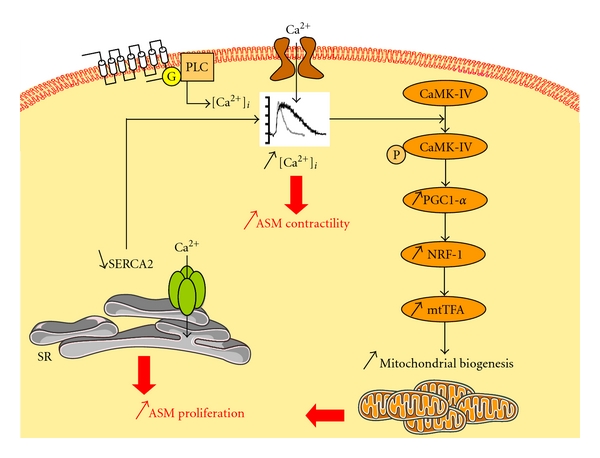
Figure 1
Figure 1
Impaired ASM cell calcium homeostasis leading to enhanced proliferation in asthma. In severe asthmatic ASM cells, an altered calcium homeostasis related to an increased influx leads to phosphorylation and activation of CaMK-IV, that, in turns, successively activates PGC-1α, NRF-1, and mtTFA. This transduction pathway results in an increase of mitochondrial biogenesis leading to enhanced ASM proliferation [61]. In nonsevere asthmatic ASM cells, an altered expression and function of SERCA2 may account for the altered calcium homeostasis, which leads to enhanced ASM proliferation [62]. Whatever the mechanism, such altered calcium homeostasis enhances cell contractility. ASM: airway smooth muscle; CaMK-IV: calcium/calmodulin-dependent protein kinase IV; G: G protein; mtTFA: mitochondrial transcription factor A; NRF: nuclear respiratory factor; PGC: peroxisome proliferator-activated receptor γ coactivator; PLC: phospholipase C; SERCA: sarcoendoplasmic calcium pomp; SR: sarcoplasmic reticulum.
Figure 2
Figure 2
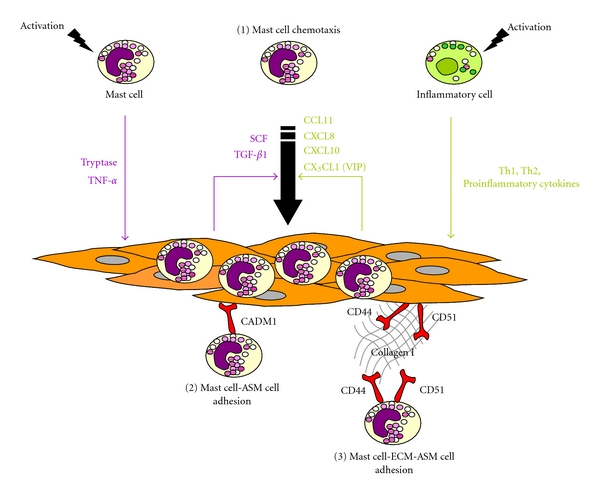
Mechanisms underlying mast cell myositis in asthma. In asthma, the mechanisms leading to an infiltration of airway smooth muscle (ASM) layer by mast cells, termed mast cell myositis, involve (1) mast cell chemotaxis towards the ASM bundle, (2) direct mast cell-ASM cell adhesion, and (3) mast cell-extracellular matrix- (ECM-) ASM cell adherence. Upon mast cell activation, mast cells release mediators which activate ASM cells, such as tryptase and TNF-α (TNFSF2). As a consequence, ASM cells produce and secrete chemotactic factors for mast cells, leading to an autoactivation loop. Under stimulation by Th1, Th2, and/or proinflammatory cytokines, produced by various inflammatory cells, ASM cells also secrete a wide range of mast cell chemotactic factors.
Figure 3
Figure 3
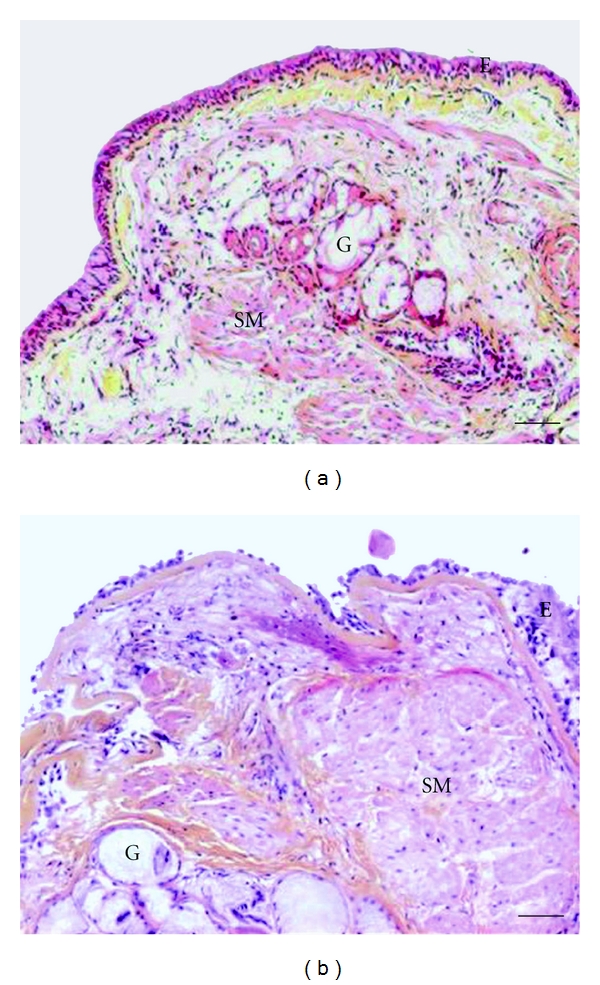
Representative optic microscopic from bronchial sections stained with Haematoxylin, Eosin, and safranin stain were obtained from (a) a control subject or (b) an asthmatic patient (printed from Bara et al. [12], with permission of European Respiratory Journal publisher) E: epithelium; G: mucous gland; SM: smooth muscle. Scale bars represent 50 μm.

References

    1. Busse WW, Lemanske RF., Jr. Asthma. The New England Journal of Medicine. 2001;344(5):350–362. - PubMed
    1. Girodet PO, Ozier A, Trian T, et al. Mast cell adhesion to bronchial smooth muscle in asthma specifically depends on CD51 and CD44 variant 6. Allergy. 2010;65(8):1004–1012. - PubMed
    1. Denis D, Fayon MJ, Berger P, et al. Prolonged moderate hyperoxia induces hyperresponsiveness and airway inflammation in newborn rats. Pediatric Research. 2001;50(4):515–519. - PubMed
    1. Black JL, Roth M. Intrinsic asthma: is it intrinsic to the smooth muscle? Clinical and Experimental Allergy. 2009;39(7):962–965. - PubMed
    1. Zuyderduyn S, Sukkar MB, Fust A, Dhaliwal S, Burgess JK. Treating asthma means treating airway smooth muscle cells. European Respiratory Journal. 2008;32(2):265–274. - PubMed

LinkOut - more resources