Drug-like actions of autoantibodies against receptors of the autonomous nervous system and their impact on human heart function
- PMID: 22220626
- PMCID: PMC3412294
- DOI: 10.1111/j.1476-5381.2012.01828.x
Drug-like actions of autoantibodies against receptors of the autonomous nervous system and their impact on human heart function
Abstract
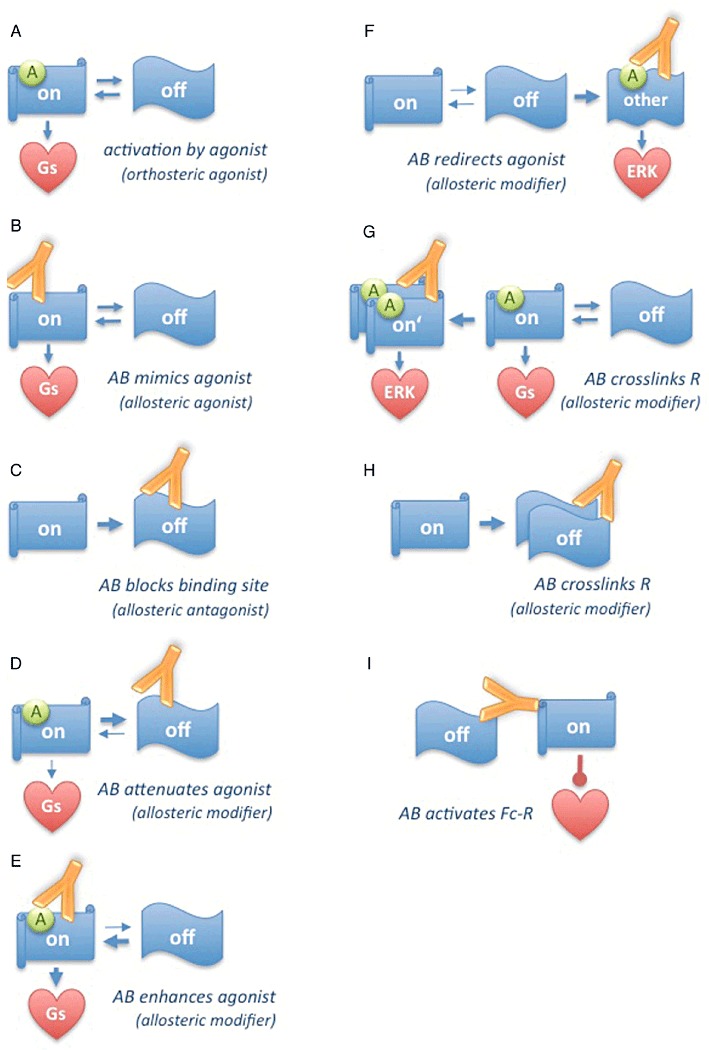
Antibodies against cholinergic and adrenergic receptors (adrenoceptors) are frequent in serum of patients with chronic heart failure. Their prevalence is associated with Chagas' disease, idiopathic dilated cardiomyopathy (DCM), and ischaemic heart disease. Among the epitopes targeted are first and second extracellular loops of the β-adrenergic (β-adrenoceptor) and M2 muscarinic receptor. β(1)-adrenoceptor autoantibodies affect radioligand binding and cardiomyocyte function similar to agonists. Corresponding rodent immunizations induce symptoms compatible with chronic heart failure that are reversible upon removal of the antibodies, transferable via the serum and abrogated by adrenergic antagonists. In DCM patients, prevalence and stimulatory efficacy of β(1)-adrenoceptor autoantibodies are correlated to the decline in cardiac function, ventricular arrhythmia and higher incidence of cardiac death. In conclusion, such autoantibodies seem to cause or promote chronic human left ventricular dysfunction by acting on their receptor targets in a drug-like fashion. However, the pharmacology of this interaction is poorly understood. It is unclear how the autoantibodies trigger changes in receptor activity and second messenger coupling and how that is related to the pathogenesis and severity of the associated diseases. Here, we summarize the available evidence regarding these issues and discuss these findings in the light of recent knowledge about the conformational activation of the human β(2)-adrenoceptor and the properties of bona fide cardiopathogenic autoantibodies derived from immune-adsorption therapy of DCM patients. These considerations might contribute to the conception of therapy regimen aimed at counteracting or neutralizing cardiopathogenic receptor autoantibodies.
© 2012 The Authors. British Journal of Pharmacology © 2012 The British Pharmacological Society.
Figures
References
-
- Baba A, Yoshikawa T, Fukuda Y, Sugiyama T, Shimada M, Akaishi M, et al. Autoantibodies against M2-muscarinic acetylcholine receptors: new upstream targets in atrial fibrillation in patients with dilated cardiomyopathy. Eur Heart J. 2004;25:1108–1115. - PubMed
-
- Bywater RP. Location and nature of the residues important for ligand recognition in G-protein coupled receptors. J Mol Recognit. 2005;18:60–72. - PubMed
-
- Caforio AL, Daliento L, Angelini A, Bottaro S, Vinci A, Dequal G, et al. Autoimmune myocarditis and dilated cardiomyopathy: focus on cardiac autoantibodies. Lupus. 2005;14:652–655. - PubMed
Publication types
MeSH terms
Substances
LinkOut - more resources
Full Text Sources
Other Literature Sources
Medical