


Retinal cone and rod photoreceptor cells exhibit differential susceptibility to light-induced damage
- PMID: 22220722
- PMCID: PMC3303932
- DOI: 10.1111/j.1471-4159.2012.07647.x
Retinal cone and rod photoreceptor cells exhibit differential susceptibility to light-induced damage
Abstract
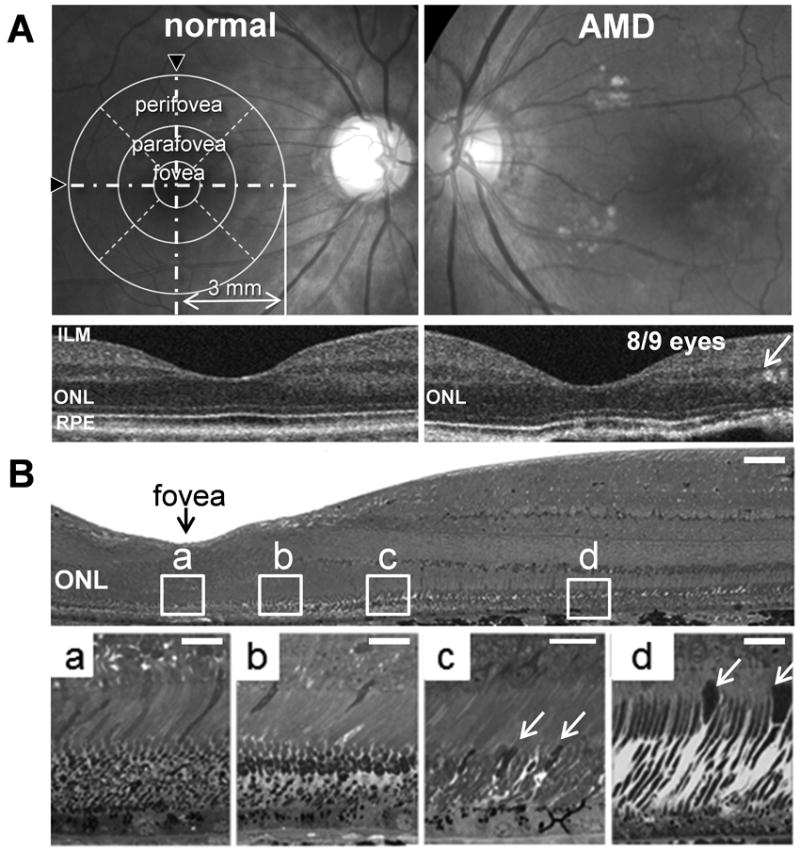
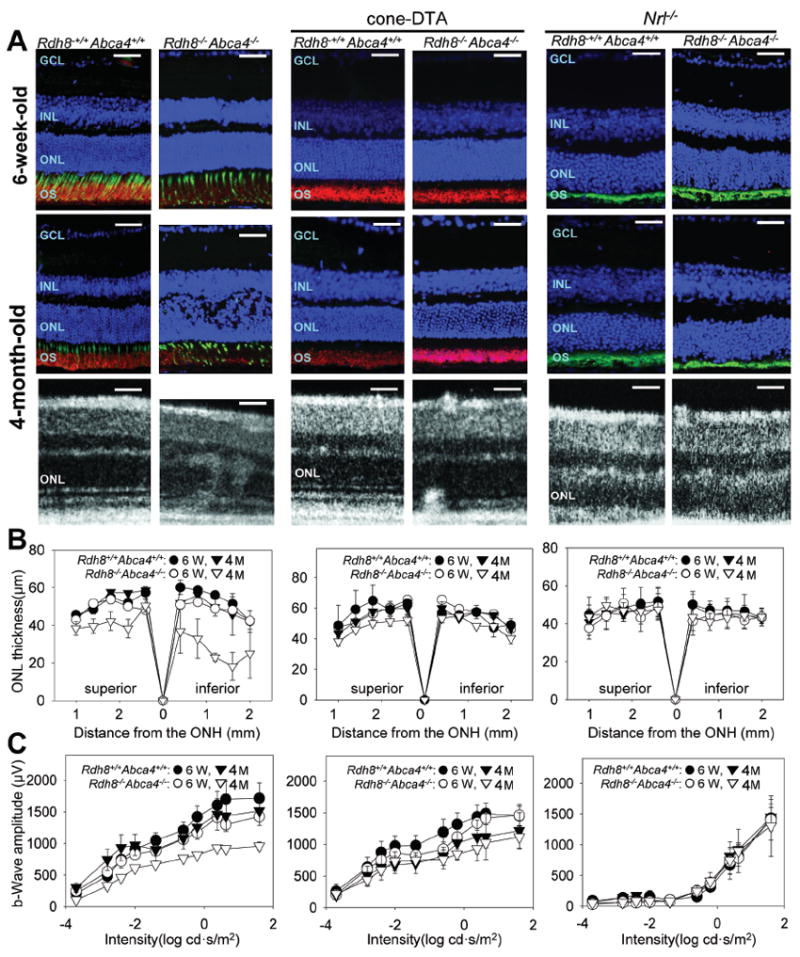
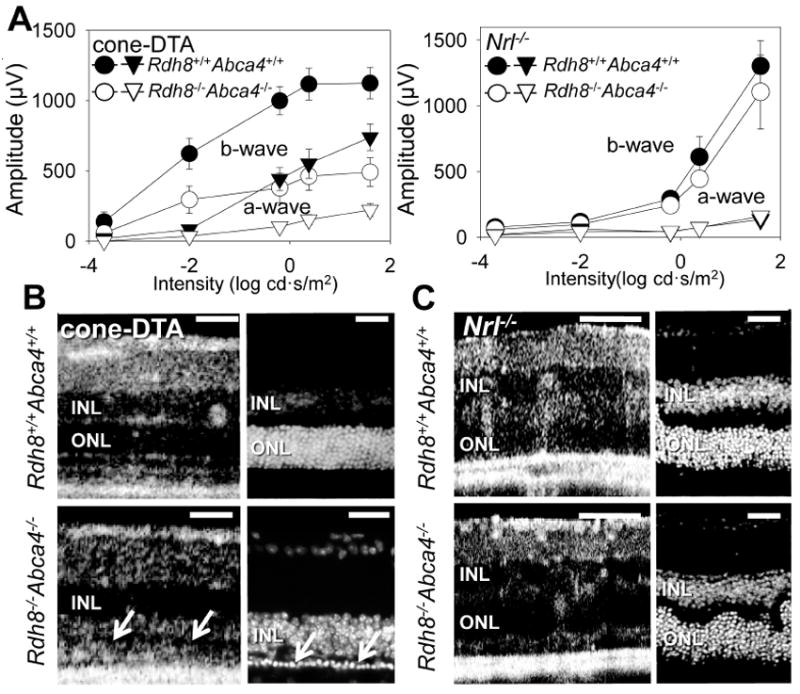
All-trans-retinal and its condensation-products can cause retinal degeneration in a light-dependent manner and contribute to the pathogenesis of human macular diseases such as Stargardt's disease and age-related macular degeneration. Although these toxic retinoid by-products originate from rod and cone photoreceptor cells, the contribution of each cell type to light-induced retinal degeneration is unknown. In this study, the primary objective was to learn whether rods or cones are more susceptible to light-induced, all-trans-retinal-mediated damage. Previously, we reported that mice lacking enzymes that clear all-trans-retinal from the retina, ATP-binding cassette transporter 4 and retinol dehydrogenase 8, manifested light-induced retinal dystrophy. We first examined early-stage age-related macular degeneration patients and found retinal degenerative changes in rod-rich rather than cone-rich regions of the macula. We then evaluated transgenic mice with rod-only and cone-like-only retinas in addition to progenies of such mice inbred with Rdh8(-/-) Abca4(-/-) mice. Of all these strains, Rdh8(-/-) Abca4(-/-) mice with a mixed rod-cone population showed the most severe retinal degeneration under regular cyclic light conditions. Intense light exposure induced acute retinal damage in Rdh8(-/-) Abca4(-/-) and rod-only mice but not cone-like-only mice. These findings suggest that progression of retinal degeneration in Rdh8(-/-) Abca4(-/-) mice is affected by differential vulnerability of rods and cones to light.
© 2012 The Authors. Journal of Neurochemistry © 2012 International Society for Neurochemistry.
Conflict of interest statement
Figures
References
-
- Allikmets R. Retinal Degenerations: Biology, Diagnostics and Therapeutics. Humana Press; Totowa, N.J: 2007. Stargardt disease: from gene discovery to therapy; pp. 105–118.
-
- Chen J, Nathans J. Genetic ablation of cone photoreceptors eliminates retinal folds in the retinal degeneration 7 (rd7) mouse. Investigative ophthalmology & visual science. 2007;48:2799–2805. - PubMed
-
- Cideciyan AV, Aleman TS, Swider M, et al. Mutations in ABCA4 result in accumulation of lipofuscin before slowing of the retinoid cycle: a reappraisal of the human disease sequence. Human molecular genetics. 2004;13:525–534. - PubMed
Publication types
MeSH terms
Substances
Grants and funding
LinkOut - more resources
Full Text Sources
Medical
Molecular Biology Databases
