. 2012 Jan 5:7:1; discussion 1.
doi: 10.1186/1745-6150-7-1.

Evolution before genes

Affiliations

Evolution before genes

Vera Vasas et al. Biol Direct. .

Abstract

Background: Our current understanding of evolution is so tightly linked to template-dependent replication of DNA and RNA molecules that the old idea from Oparin of a self-reproducing 'garbage bag' ('coacervate') of chemicals that predated fully-fledged cell-like entities seems to be farfetched to most scientists today. However, this is exactly the kind of scheme we propose for how Darwinian evolution could have occurred prior to template replication.

Results: We cannot confirm previous claims that autocatalytic sets of organic polymer molecules could undergo evolution in any interesting sense by themselves. While we and others have previously imagined inhibition would result in selectability, we found that it produced multiple attractors in an autocatalytic set that cannot be selected for. Instead, we discovered that if general conditions are satisfied, the accumulation of adaptations in chemical reaction networks can occur. These conditions are the existence of rare reactions producing viable cores (analogous to a genotype), that sustains a molecular periphery (analogous to a phenotype).

Conclusions: We conclude that only when a chemical reaction network consists of many such viable cores, can it be evolvable. When many cores are enclosed in a compartment there is competition between cores within the same compartment, and when there are many compartments, there is between-compartment competition due to the phenotypic effects of cores and their periphery at the compartment level. Acquisition of cores by rare chemical events, and loss of cores at division, allows macromutation, limited heredity and selectability, thus explaining how a poor man's natural selection could have operated prior to genetic templates. This is the only demonstration to date of a mechanism by which pre-template accumulation of adaptation could occur.


Figures

Figure 1
Figure 1
Classification of various network modules within autocatalytic sets. food1-food6: food set that is assumed to be present at all times, A-D: non-food species generated by ligation/cleavage reactions. Solid lines: reactions; dotted lines: catalytic activities. Orange dotted lines show the superimposed autocatalytic loops. (A) Viable autocatalysts (A in all three examples) are the necessary units needed for exponential growth of an autocatalyst, in contrast to suicidal autocatalysts (B in all three examples) that use reactants only produced by the autocatalytic reaction itself. (B) A molecular species can be directly autocatalytic, forming a one-member autocatalytic loop, or several species can form loops of various sizes that result in indirect autocatalysis. (C) A loop is autocatalytic - and able to grow exponentially - as long as at least one of the steps is a catalytic dependency. Therefore a loop can be made of solely catalytic or mixed couplings. (D) An autocatalytic core contains one or more linked loops. Note that any member of a core (A and B in all three examples) is sufficient to act as a seed for the core. Several distinct cores can form within a catalytic reaction network. Some can exist independently of other cores, while dependent cores rely on others as food supply or catalysts. (E) An autocatalytic core is typically associated with a periphery that is dependent on the core (C and D in first example). It is also possible that a molecular periphery appears only if two or more cores are present (D in second example). We propose that autocatalytic cores are the units of heritable adaptation in chemical networks.
Figure 2
Figure 2
Multiple cores result in selectable attractors for a chemical network. food1-food11: food set that is assumed to be present at all times, A-H: non-food species generated by ligation/cleavage reactions. Solid lines: reactions; dotted lines: catalytic activities. Orange dotted lines show the superimposed autocatalytic loops. Structural considerations: Autocatalytic sets can contain several distinct autocatalytic units, each of which can be divided to a core of autocatalytic molecules and a periphery. Here, two independent cores are shown. The first consists of the two linked loops A → A and A → B → A. The second core includes the two linked loops C → C and C → D → E → C, with the periphery of F and G. H is the shared periphery of the two cores that requires both for its production. Dynamical considerations: This platonic reaction network can manifest in four possible stable compositions of the core-periphery units: (i) no cores (only food species); (ii) only first core (A, B; yellow area); (iii) only second core (C, D, E, F, G; blue area); (iv) both cores (all species). Now imagine that we have a compartment that only contains food species, but rare uncatalyzed reactions among them are possible. The uncatalyzed appearance of any one molecule of core species is sufficient to produce all the core species and the periphery species of that core, e.g. either A or B for the first core and either C, D, E for the second. Now let us assume that after reaching a certain size a compartment that contains both cores will split and produce propagules. If neither C, D or E is present in the daughter compartment, the second core is lost and the remaining molecules of its periphery will be washed out from the compartment. Discovering cores by rare reactions, and losing cores by segregation instability opens up the possibility for a chemical reaction network to respond to natural selection.
Figure 3
Figure 3
Emergence of a self-sustaining network of reactions in a flow reactor. (A) The squares show critical thresholds for subcritical (empty squares) or supracritical (coloured squares) growth of the reaction network as a function of the firing disc (maximum length of molecular species in the food set) and the probability P that a species catalyses a specific reaction. The darkness of a square reflects the proportion of 100 runs in which the network exceeded one of the following conditions: > 2 × 10⁷ reactions or > 105 molecular species (note that in any finite system the reaction network cannot be explored infinitely due to mass constraints). (B) The crucial parameter P was decomposed into its two elementary probabilities: P' (the probability that a species can be catalytic) and P'' (the per reaction probability that this catalyst catalyses a reaction). When P' decreases P'' must be considerably higher for reaction networks to keep growing, but there is a threshold above which catalytic networks grow supracritically. (C) Weak inhibition does not prevent formation of large catalytic reaction networks. For values of P that do produce catalytic network growth, strong non-competitive inhibition is introduced by choosing with probability K that a species removes another species from the reactor completely if at least one molecule of the inhibiting species exists (this is clearly a worst-case assumption). Left: supracritical growth without inhibition. Middle: weak inhibition results in alternating fast and slow growth phases. Right: strong inhibition makes the network subcritical.
Figure 4
Figure 4
Persistent increase in non-food set mass due to novel viable loops. We simulated 460 runs lasting 30,000 growth steps each, with food set size M = 4, P' = 0.75, P'' = 0.0025, K = 0 (without inhibition), but with spontaneous emergence of rare novel species from uncatalyzed reactions. 5 out of 460 runs showed persistent increases in non-food set mass (B). This was always due to the incorporation of at least one viable loop. (A) Example of viable loop organization used in evolutionary simulations. Solid lines: reactions; dotted lines: catalytic activities. Orange dotted lines show the superimposed autocatalytic loop. The original network, on the left side of the blue line, is not shown in detail.
Figure 5
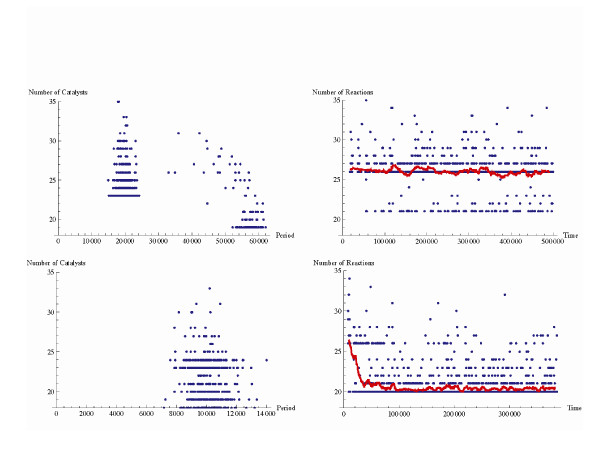
Figure 5
Selectability of potentially coexisting attractors in a molecular network. Each dot corresponds to a compartment just prior to division. (Top) Due to its autocatalytic properties a viable loop enables a higher growth rate and therefore the network with the large viable loop (characterized by 26 reactions and dividing after approximately 20 000 time steps) constitutes the most frequent network type. Spontaneous reaction rate = 0.00001. Propagule size 800; no selection (S = 1). (Bottom) However, with a mere 1 percent fitness advantage (S = 1.01) attributed to the networks without the loop, it is possible to reduce its frequency. In this case the original network without any viable loops is the most frequent.

References

    1. Kauffman SA. The Origins of Order. New York: Oxford University Press; 1993.
    1. Shapiro R. A simpler origin for life. SciAm. 2007;296:46–53. - PubMed
    1. Hunding A, Kepes F, Lancet D, Minsky A, Norris V, Raine D, Sriram K, Root-Bernstein R. Compositional complementarity and prebiotic ecology in the origin of life. Bioessays. 2006;28:399–412. doi: 10.1002/bies.20389. - DOI - PubMed
    1. Vasas V, Szathmáry E, Santos M. Lack of evolvability in self-sustaining autocatalytic networks constraints metabolism-first scenarios for the origin of life. Proceedings of the National Academy of Sciences. 2010;107:1470. doi: 10.1073/pnas.0912628107. - DOI - PMC - PubMed
    1. Allwood AC, Grotzinger JP, Knoll AH, Burch IW, Anderson MS, Coleman ML, Kanik I. Controls on development and diversity of Early Archean stromatolites. Proceedings of the National Academy of Sciences of the United States of America. 2009;106:9548–9555. doi: 10.1073/pnas.0903323106. - DOI - PMC - PubMed

Publication types