Review
. 2012 Feb;35(2):135-43.
doi: 10.1016/j.tins.2011.12.002. Epub 2012 Jan 3.

Postsynaptic signaling during plasticity of dendritic spines

Affiliations
Review

Postsynaptic signaling during plasticity of dendritic spines

Hideji Murakoshi et al. Trends Neurosci. 2012 Feb.

Abstract

Dendritic spines, small bulbous postsynaptic compartments emanating from neuronal dendrites, have been thought to serve as basic units of memory storage. Despite their small size (~0.1 femtoliter), thousands of species of proteins exist in the spine, including receptors, channels, scaffolding proteins and signaling enzymes. Biochemical signaling mediated by these molecules leads to morphological and functional plasticity of dendritic spines, and ultimately learning and memory in the brain. Here, we review new insights into the mechanisms underlying spine plasticity brought about by recent advances in imaging techniques to monitor molecular events in single dendritic spines. The activity of each protein displays a specific spatiotemporal pattern, coordinating downstream events at different microdomains to change the function and morphology of dendritic spines.


Figures

Figure 1
Figure 1. Visualization of signaling molecules and spine volume changes in stimulated spines
(a) Visualization of Ca2+, Ca2+/calmodulin-dependent kinase II (CaMKII), Ras homolog A (RhoA), and Cell division cycle 42 (Cdc42) activation during morphological plasticity in single spines using 2-photon fluorescence lifetime imaging microscopy combined with 2-photon glutamate uncaging. Warmer color indicates higher levels of activation. The white arrowheads indicate stimulated spines. Scale bars (white) are 1 μm. Images adapted, with permission from [39] (Ca2+ and CaMKII panels), [36] (Cdc42 and RhoA), and [84] (spine volume changes). (b–d) Time-courses of signaling activity and spine volume changes in stimulated spines. Please note that (c) and (d) represent the same data, illustrated at time-intervals immediately after (d) and much later after (c) stimulation. The time courses of Ca2+ and CaMKII were adapted from [36], and RhoA, Cdc42, and spine volume changes are from [84]. The timecourses of CaMKII in (c) and (d) were originally taken under the condition of 45 pulses at 0.5 Hz [36], but the data points corresponding to the 30th–45th pulses were removed so that the plot approximately represents the one in response to 30 pulses stimulation. The time course of mutant CaMKII (T286A) was normalized to the peak of the wildtype CaMKII [36]. Autophosphorylation at T286 results in CaMKII activation independent of Ca2+/calmodulin, and thus, the activity decays slower than Ca2+ [36]. Unlike wildtype, the T286A mutant fails to integrate Ca2+ signals [36]. These findings indicate that CaMKII activation peaks rapidly after Ca2+ stimulation, followed by RhoA and Cdc42 activation. Subsequent changes in spine volume then occur.
Figure 2
Figure 2. Signal transduction underlying spine morphological plasticity and long-term potentiation (LTP)
Spatiotemporal regulation of signaling cascades triggered by NMDAR activation in single dendritic spines in response to glutamate uncaging. NMDAR activation increases spine Ca2+ concentration, leading to activation of Ca2+/Calmodulin-dependent kinase (CaMKII) [36]. It further activates downstream Rat sarcoma (Ras) [77], Cell division cycle 42 (Cdc42) and Ras homolog A(RhoA) [84]. CaMKII phosphorylates postsynaptic density 95 (PSD95) and causes dissociation of the postsynaptic density (PSD). Rho kinase (ROCK) and p21-activated kinase (PAK) are activated downstream of Rho and Cdc42, respectively. Exocytosis of AMPARs show similar patterns as Ras activation [38, 39] and requires Ras activation [39]. Trapping of diffused AMPARs into the PSD requires stargazin phosphorylation by CaMKII [53]. Fluorescence lifetime images are adapted from [77, 84] with permission. Color-coded intensity map of AMPAR exocytosis is adapted from [38] with permission. Warmer color indicates higher levels of activation/ receptor exocytosis. The white arrowheads indicate stimulated spines.
Box 1 Figure I
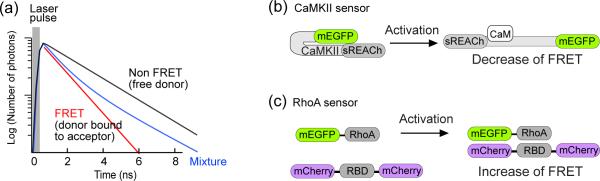
Box 1 Figure I. Fluorescence resonance energy transfer (FRET) sensor for fluorescence lifetime imaging (FLIM)
(a) Theoretical fluorescence lifetime curves of fluorescent protein (i.e. GFP as donor). The free donor at the excited state typically decays mono-exponentially (black line). When FRET occurs by the binding of acceptor to donor, the donor lifetime in the excited state is shortened (red line). For mixed population, the decay curve follows a multi-exponential curve (blue line). Thus, the population of donor bound to acceptor can be calculated from the curve. (b) Schematic illustration of a CaMKII sensor. CaMKII takes compact form when it is inactive, but the binding of Calmodulin (CaM) induces the opening of CaMKII, increasing the distance between donor (monomeric EGFP or mEGFP) and acceptor (sREACh) and decreasing FRET [36]. (c) Schematic illustration of a RhoA sensor. The activation of mEGFP-RhoA induces the binding of Rho binding domain of Rhotekin (RBD) flanked by two mCherry molecules, and increases FRET [84].
Box 2 Figure I
Box 2 Figure I. Spatial spreading of small GTPase activity upon single-spine stimulation
Upon single-spine stimulation with 2-photon glutamate uncaging (indicated by the orange circle at the tip of spine), Cell division cycle 42 (Cdc42) is activated and localized in the spine, whereas the activity of Ras homolog A (RhoA) and Harvey Rat sarcoma (HRas) diffuse into the dendrite (top).The spatial profile of Cdc42, RhoA, and HRas activities measured with 2-photon fluorescence lifetime imaging microscopy were plotted as a function of the contour distance along the dendrite from the stimulated spines (bottom; at the stimulated spine, distance = 0). The curves were obtained by fitting the data with Eq. 3. For each protein, the activity in the stimulated spine was normalized to 1. Figure is adapted, with permission, from [85].

References

    1. Harris KM, et al. Three-dimensional structure of dendritic spines and synapses in rat hippocampus (CA1) at postnatal day 15 and adult ages: implications for the maturation of synaptic physiology and long-term potentiation. J Neurosci. 1992;12:2685–2705. - PMC - PubMed
    1. Svoboda K, et al. Direct measurement of coupling between dendritic spines and shafts. Science. 1996;272:716–719. - PubMed
    1. Bloodgood BL, Sabatini BL. Neuronal Activity Regulates Diffusion Across the Neck of Dendritic Spines. Science. 2005;310:866–869. - PubMed
    1. Sabatini BL, et al. The life cycle of Ca2+ ions in dendritic spines. Neuron. 2002;33:439–452. - PubMed
    1. Noguchi J, et al. Spine-neck geometry determines NMDA receptor-dependent Ca2+ signaling in dendrites. Neuron. 2005;46:609–622. - PMC - PubMed

Publication types