Comparative Study
. 2012 Feb 7;125(5):677-84.
doi: 10.1161/CIRCULATIONAHA.111.065391. Epub 2012 Jan 5.

Hyponatremia, hypernatremia, and mortality in patients with chronic kidney disease with and without congestive heart failure

Affiliations
Comparative Study

Hyponatremia, hypernatremia, and mortality in patients with chronic kidney disease with and without congestive heart failure

Csaba P Kovesdy et al. Circulation. .

Abstract

Background: Hyponatremia is common in patients with conditions such as congestive heart failure and is associated with increased mortality in hospitalized patients. Congestive heart failure is common in patients with chronic kidney disease, but the association of serum sodium concentration with mortality in such patients is not well characterized.

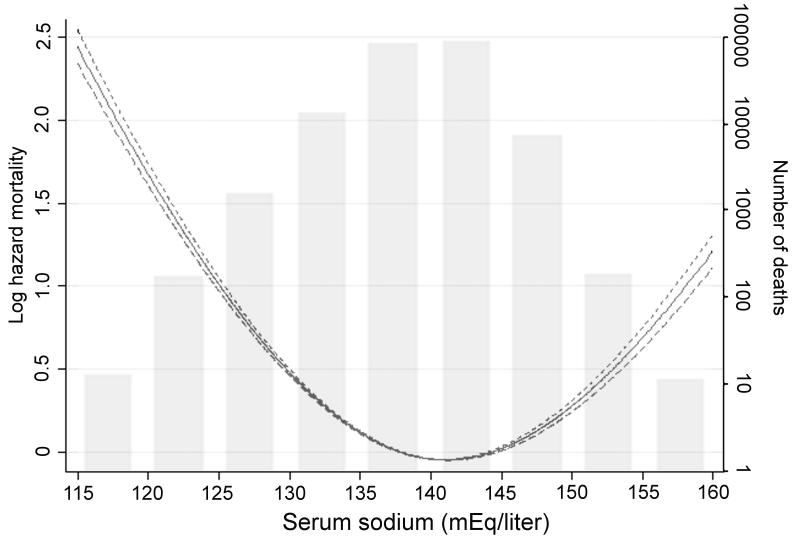
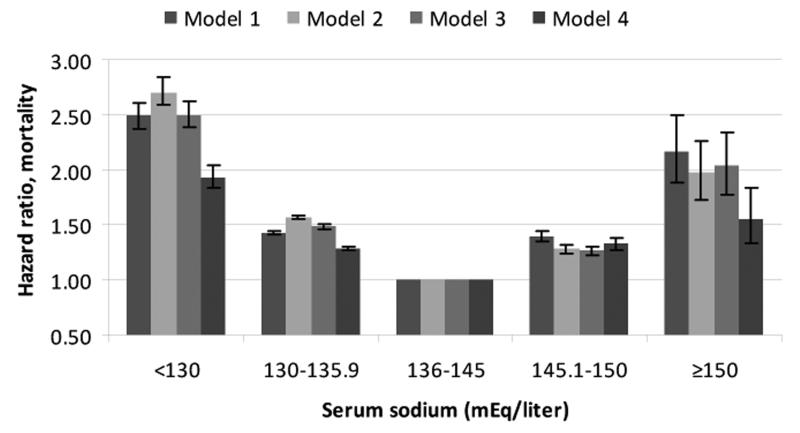
Methods and results: We examined the association of serum sodium concentration with all-cause mortality in a nationally representative cohort of 655 493 US veterans with non-dialysis-dependent chronic kidney disease (95 961 [15%] of them with congestive heart failure). Associations were examined in time-dependent Cox models with adjustment for potential confounders. During a median follow-up of 5.5 years, a total of 193 956 patients died (mortality rate, 62.5/1000 patient-years; 95% confidence interval, 62.2-62.8). The association of serum sodium level with mortality was U-shaped, with the lowest mortality seen in patients with sodium level of 140 mEq/L and with both lower and higher levels showing significant associations with increased mortality. Patients with serum sodium levels of <130, 130 to 135.9, 145.1 to 150, and ≥150 mEq/L compared with 136 to 145 mEq/L had multivariable-adjusted mortality hazard ratios (95% confidence interval) of 1.93 (1.83-2.03), 1.28 (1.26-1.30), 1.33 (1.28-1.38), and 1.56 (1.33-1.83) (P<0.001 for all). The associations remained consistent in subgroups of patients with and without congestive heart failure.

Conclusions: Both lower and higher serum sodium levels are independently associated with higher mortality in patients with non-dialysis-dependent chronic kidney disease, irrespective of the presence or absence of congestive heart failure.


Figures
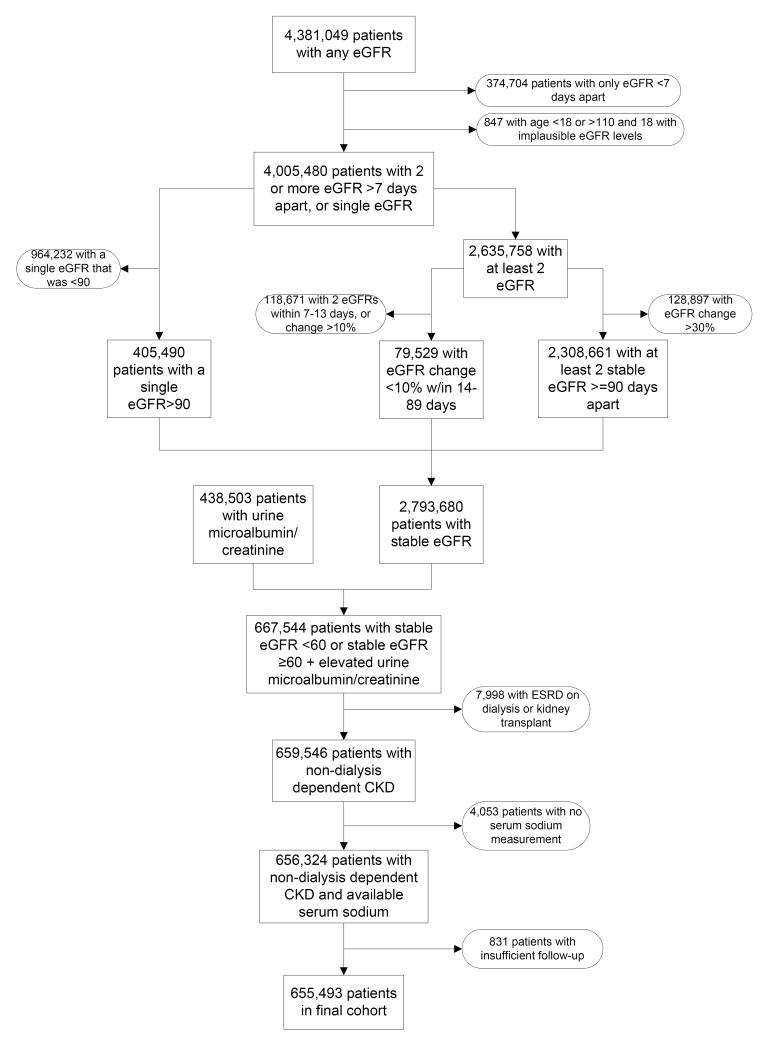
Figure 1
Figure 1
Algorithm used to define the study cohort. eGFR, estimated glomerular filtration rate; ESRD, end stage renal disease.
Figure 2
Figure 2
Multivariable adjusted log hazard ratios (95% confidence intervals) of all-cause mortality associated with serum sodium levels in a time-dependent Cox model using restricted cubic splines, adjusted for age, gender, race, geographic location, diabetes mellitus, ASCVD, CHF, liver disease, malignancy, depression, the Charlson comorbidity index, systolic blood pressure, eGFR, serum albumin, alkaline phosphatase, aspartate and alanine aminotransferase, total bilirubin, blood hemoglobin, glucose and white blood cell count. The bars represent the number of deaths in patients with serum sodium levels grouped in increments of 5 mEq/liter from 115 to 160 mEq/liter, on a logarithmic scale.
Figure 3
Figure 3
Unadjusted and multivariable adjusted hazard ratios (95% confidence intervals) of all-cause mortality associated with various levels of serum sodium in time-dependent Cox models. The groups with serum sodium 136-145 served as referent. Models represent unadjusted association (Model 1) and associations after adjustment for age, gender, race and geographic location (Model 2), Model 2 variables + diabetes mellitus, ASCVD, CHF, liver disease, malignancy, depression and the Charlson comorbidity index (Model 3) and Model 3 variables + systolic blood pressure, eGFR, serum albumin, alkaline phosphatase, aspartate and alanine aminotransferase, total bilirubin, blood hemoglobin, glucose and white blood cell count (Model 4). All comparisons were significant at p<0.001 level.
Figure 4
Figure 4
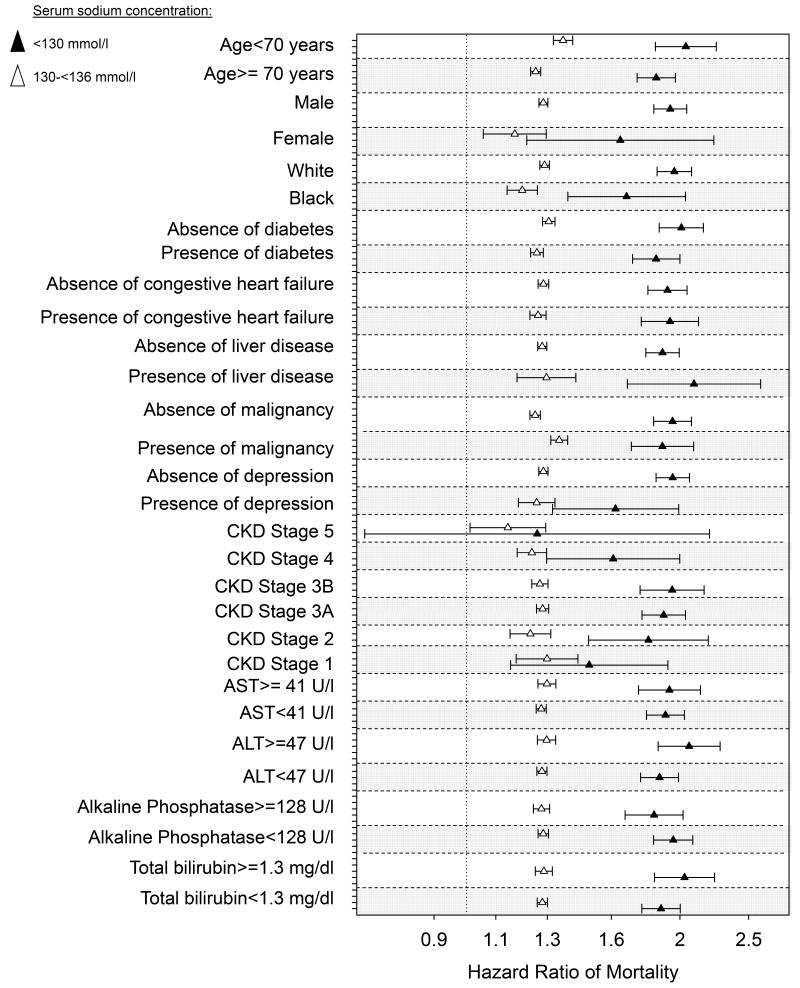
Forest plot of the multivariable adjusted natural log-transformed mortality hazard ratios (95%CI) associated with mild (130-135.9 mEq/l) and moderate-to-severe (<130 mEq/l) hyponatremia (Panel A), and with hypernatremia (serum sodium >145 mEq/l, Panel B) in various pre-specified subgroups of patients. Groups with normal (136-145 mEq/l) serum sodium levels served as referent. Estimates are from time-dependent Cox models adjusted for age, gender, race, geographic location, diabetes mellitus, ASCVD, CHF, liver disease, malignancy, depression, the Charlson comorbidity index, systolic blood pressure, eGFR, serum albumin, alkaline phosphatase, aspartate and alanine aminotransferase, total bilirubin, blood hemoglobin, glucose and white blood cell count.
Figure 4
Figure 4
Forest plot of the multivariable adjusted natural log-transformed mortality hazard ratios (95%CI) associated with mild (130-135.9 mEq/l) and moderate-to-severe (<130 mEq/l) hyponatremia (Panel A), and with hypernatremia (serum sodium >145 mEq/l, Panel B) in various pre-specified subgroups of patients. Groups with normal (136-145 mEq/l) serum sodium levels served as referent. Estimates are from time-dependent Cox models adjusted for age, gender, race, geographic location, diabetes mellitus, ASCVD, CHF, liver disease, malignancy, depression, the Charlson comorbidity index, systolic blood pressure, eGFR, serum albumin, alkaline phosphatase, aspartate and alanine aminotransferase, total bilirubin, blood hemoglobin, glucose and white blood cell count.

References

    1. Upadhyay A, Jaber BL, Madias NE. Incidence and prevalence of hyponatremia. Am J Med. 2006;119:S30–S35. - PubMed
    1. Upadhyay A, Jaber BL, Madias NE. Epidemiology of hyponatremia. Semin Nephrol. 2009;29:227–238. - PubMed
    1. Anderson RJ, Chung HM, Kluge R, Schrier RW. Hyponatremia: a prospective analysis of its epidemiology and the pathogenetic role of vasopressin. Ann Intern Med. 1985;102:164–168. - PubMed
    1. Borroni G, Maggi A, Sangiovanni A, Cazzaniga M, Salerno F. Clinical relevance of hyponatraemia for the hospital outcome of cirrhotic patients. Dig Liver Dis. 2000;32:605–610. - PubMed
    1. Chung HM, Kluge R, Schrier RW, Anderson RJ. Postoperative hyponatremia. A prospective study. Arch Intern Med. 1986;146:333–336. - PubMed

Publication types

MeSH terms