


The frequency of subscapularis tears in arthroscopic rotator cuff repairs: A retrospective study comparing magnetic resonance imaging and arthroscopic findings
- PMID: 22223958
- PMCID: PMC3249929
- DOI: 10.4103/0973-6042.91000
The frequency of subscapularis tears in arthroscopic rotator cuff repairs: A retrospective study comparing magnetic resonance imaging and arthroscopic findings
Abstract
Purpose: With the advent of arthroscopic shoulder surgery the comprehension and description of rotator cuff tears have strongly evolved. Subscapularis tears are difficult to recognize and are underestimated. Our purpose is to report our observations concerning the relative frequency of subscapularis tears in patients undergoing arthroscopic rotator cuff repair and to compare the arthroscopic observations with the magnetic resonance imaging (MRI) findings.
Materials and methods: Retrospective cohort study including all patients undergoing arthroscopic rotator cuff repair was performed between March 2006 and March 2009 at our institution. Preoperative MRI findings, intraoperative arthroscopic findings, and details of surgical intervention were collected using medical charts.
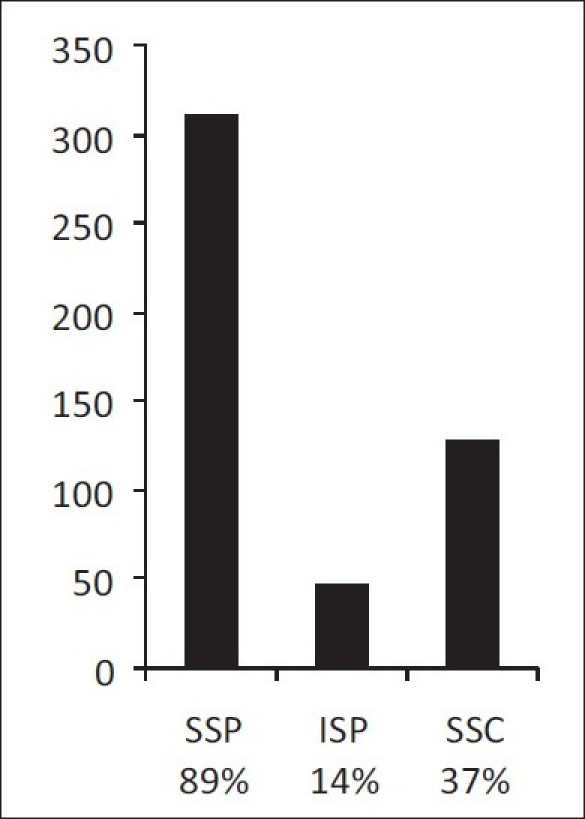
Results: We reviewed the medical charts of a total of 348 consecutive arthroscopic rotator cuff repairs. There were 311 supraspinatus tears (89%), 48 infraspinatus tears (14%), and 129 subscapularis tears (37%). MRI sensitivity and specificity were respectively 0.25 and 0.98 for subscapularis tendon tears, 0.67 and 1.0 for supraspinatus tears and 0.5 and 0.99 for infraspinatus tears.
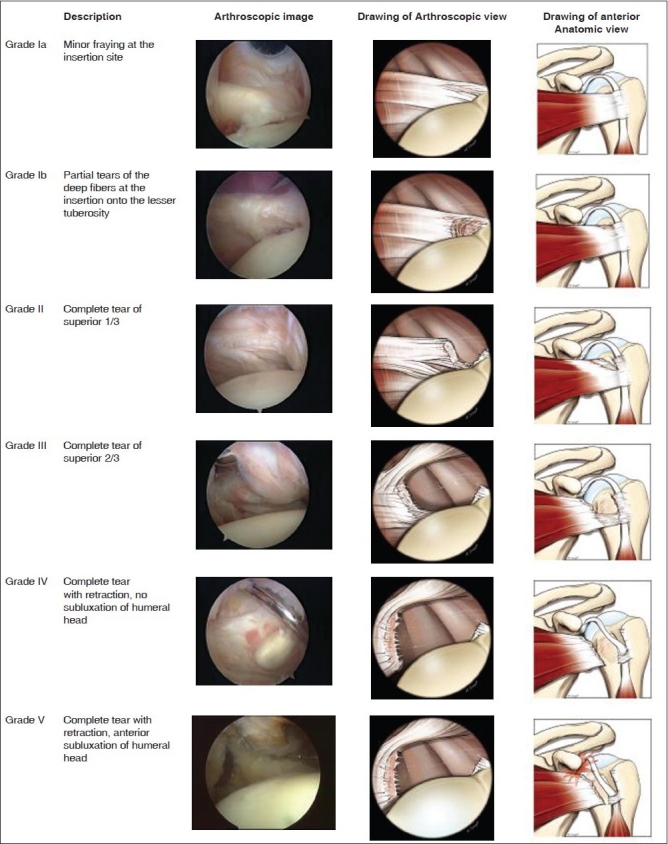
Conclusion: Subscapularis tears are frequent lesions and usually appear concomitantly with supra or infraspinatus lesions. We propose a classification of subscapularis tendon tears, based on our observations of the pathoanatomy of the tears. While concordance with MRI results are good for the supraspinatus, MRI often fails to diagnose the presence of subscapularis tears and infraspinatus tears.
Keywords: Classification of subscapularis tears; rotator cuff; shoulder arthroscopy; subscapularis tendon.
Conflict of interest statement
Figures
References
-
- De Jesus JO, Parker L, Frangos AJ, Nazarian LN. Accuracy of MRI, MR arthrography, and ultrasound in the diagnosis of rotator cuff tears: a meta-analysis. AJR Am J Roentgenol. 2009;192:1701–7. - PubMed
-
- Kuhn JE, Dunn WR, Ma B, Wright RW, Jones G, Spencer EE, et al. Interobserver agreement in the classification of rotator cuff tears. Am J Sports Med. 2007;35:437–41. - PubMed
-
- Quinn SF, Sheley RC, Demlow TA, Szumowski J. Rotator cuff tendon tears: Evaluation with fat-suppressed MR imaging with arthroscopic correlation in 100 patients. Radiology. 1995;195:497–500. - PubMed
-
- Schröder RJ, Bostanjoglo M, Kääb M, Herzog H, Hidajat N, Röttgen R, et al. Accuracy of routine MRI in lesions of the supraspinatus tendon--comparison with surgical findings. Rofo. 2003;175:920–8. - PubMed
-
- Theodoropoulos JS, Andreisek G, Harvey EJ, Wolin P. Magnetic resonance imaging and magnetic resonance arthrography of the shoulder: Dependence on the level of training of the performing radiologist for diagnostic accuracy. Skeletal Radiol. 2010;39:661–7. - PubMed
LinkOut - more resources
Full Text Sources
