. 2012 May;166(2):650-8.
doi: 10.1111/j.1476-5381.2011.01823.x.

3-Iodothyronamine: a modulator of the hypothalamus-pancreas-thyroid axes in mice

Affiliations

3-Iodothyronamine: a modulator of the hypothalamus-pancreas-thyroid axes in mice

Maria Elena Manni et al. Br J Pharmacol. 2012 May.

Abstract

BACKGROUND AND PURPOSE Preclinical pharmacology of 3-iodothyronamine (T1AM), an endogenous derivative of thyroid hormones, indicates that it is a rapid modulator of rodent metabolism and behaviour. Since T1AM undergoes rapid enzymatic degradation, particularly by MAO, we hypothesized that the effects of T1AM might be altered by inhibition of MAO. EXPERIMENTAL APPROACH We investigated the effects of injecting T1AM (i.c.v.) on (i) feeding behaviour, hyperglycaemia and plasma levels of thyroid hormones and (ii) T1AM systemic bioavailability, in overnight fasted mice, under control conditions and after pretreatment with the MAO inhibitor clorgyline. T1AM (1.3, 6.6, 13, 20 and 26 µg·kg(-1) ) or vehicle were injected i.c.v. in fasted male mice not pretreated or pretreated i.p. with clorgyline (2.5 mg·kg(-1) ). Glycaemia was measured by a glucorefractometer, plasma triiodothyronine (fT3) by a chemiluminescent immunometric assay, c-fos activation immunohistochemically and plasma T1AM by HPLC coupled to tandem-MS. KEY RESULTS T1AM, 1.3 µg·kg(-1) , produced a hypophagic effect (-24% vs. control) and reduced c-fos activation. This dose showed systemic bioavailability (0.12% of injected dose), raised plasma glucose levels and reduced peripheral insulin sensitivity (-33% vs. control) and plasma fT3 levels. These effects were not linearly related to the dose injected. Clorgyline pretreatment strongly increased the systemic bioavailability of T1AM and prevented the hyperglycaemia and reduction in fT3 induced by T1AM. CONCLUSIONS AND IMPLICATIONS T1AM induces central and peripheral effects including hyperglycaemia and a reduction in plasma fT3 levels in fasted mice. These effects critically depend on the concentration of T1AM or its metabolites in target organs.


Figures

Figure 1
Figure 1
The i.c.v. administration of T1AM resulted in hypo- and hyperphagia: the effect of clorgyline pretreatment. Mice fasted for 16 h were pretreated i.p. with saline solution (A) or with clorgyline 2.5 mg·kg−1 (B). After 30 min, mice (n= 10) were injected i.c.v. with vehicle or with T1AM (from 1.3 to 26 µg kg−1; n= 10 mice for each dose), mice were then allowed food and water ad libitum. The amount of food consumed after 30, 60, 90 and 120 min following T1AM or vehicle injection was evaluated as described in the Methods section. Results are expressed as means ± SEM of two experiments. Clorgyline pretreatment did not affect mice feeding behaviour compared to vehicle-injected mice. *P < 0.05 vs. vehicle.
Figure 2
Figure 2
T1AM reduces c-fos expression in the hypothalamus of fasted mice. Hypothalamus was isolated from the brain of animals killed within 60 min after i.c.v. injection of vehicle (Veh.) or T1AM 1.3 and 20 µg kg−1. Sections were prepared for immunohistochemistry (A) and evaluation of optical density (B) was performed as described in the Methods section. *P < 0.05 vs. vehicle.
Figure 3
Figure 3
T1AM injected i.c.v. increases plasma glycaemia: the effect of clorgyline pretreatment. The blood was collected from the tail vein of two groups (n= 5 each) of mice (fasted for 16 h) pretreated i.p. with clorgyline (2.5 mg·kg−1) or with saline, 30 min before i.c.v. injection of vehicle or T1AM 1.3 and 20 µg kg−1. Glycaemia was evaluated by a glucorefractometer at 0, 15, 30 and 60 min after i.c.v. injections. Results are the means ± SEM of two experiments carried out on five mice for each experimental setting. The value of glycaemia measured 15 min after T1AM injection is shown. *P < 0.05 vs. vehicle i.c.v and saline i.p; § and °P < 0.05 vs. T1AM 1.3 and 20 µg kg−1, respectively, in the absence of clorgyline pretreatment.
Figure 4
Figure 4
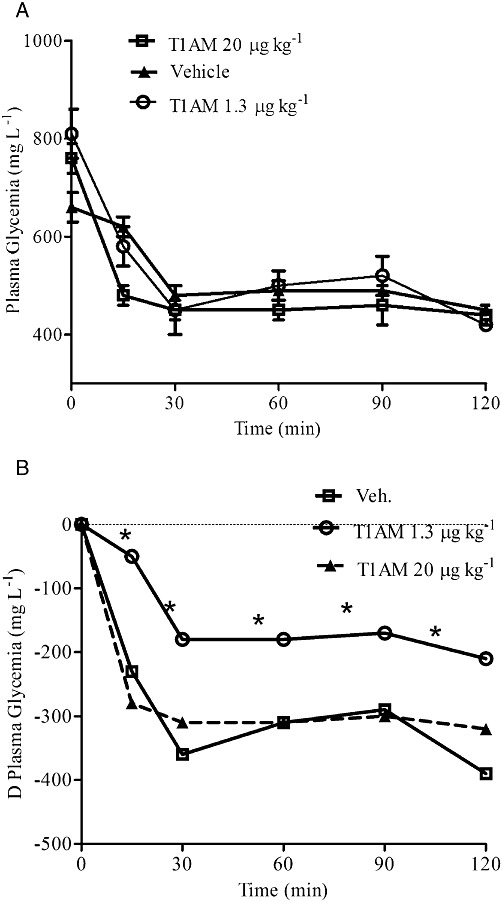
T1AM 1.3 µg·kg−1reduces peripheral insulin sensitivity. Fifteen mice fasted for 4 h, were divided into three groups (five mice each). One group was injected i.c.v. with T1AM 1.3 µg kg−1, one with T1AM 20 µg kg−1, and both i.p. with insulin (1 U·kg−1). The remaining group was injected i.c.v. with vehicle and i.p. with insulin (1 U·kg−1). Small blood samples from the lateral tail vein were collected to measure glycaemic levels at 0, 15, 30, 60, 90 and 120 min after i.p. insulin treatment. Results are shown as glucose levels (mg·L−1) and as the difference between glycaemia at one time point and the value at T = 0 (Δ glycaemia mg·L−1). Results represent the means ± SEM of the values of two experiments carried on five mice for each time point. *P < 0.05 vs. vehicle.
Figure 5
Figure 5
Exenatide treatment prevented T1AM (1.3 µg kg−1)-induced increase in plasma glycaemia. Glycaemia was also monitored in the blood collected from the tail vein of 4 h fasted mice (n= 5 mice for each injection) treated as described in the Methods section. Mice received T1AM 1.3 µg·kg−1 i.c.v and saline i.p., or T1AM 1.3 µg·kg−1 i.c.v and exenatide (0.25 mg·mL−1) i.p., or vehicle (Veh.) i.c.v and exenatide (0.25 mg·mL−1) i.p. Results represent the means ± SEM of the values of two experiments carried out on five mice for each time point. *P < 0.05 vs. basal glycaemia level (T = 0); §P < 0.05 vs. T1AM in the absence of exenatide.

References

    1. Becskei C, Lutz TA, Riediger T. Reduced fasting-induced activation of hypothalamic arcuate neurons is associated with hyperleptinemia and increased leptin sensitivity in obese mice. Am J Physiol Regul Integr Comp Physiol. 2010;299:R632–R641. - PubMed
    1. Coppola A, Liu ZW, Andrews ZB, Paradis E, Roy MC, Friedman JM, et al. A central thermogenic-like mechanism in feeding regulation: an interplay between arcuate nucleus T3 and UCP2. Cell Metab. 2007;5:21–33. - PMC - PubMed
    1. Dhillo WS, Bewick GA, White NE, Gardiner JV, Thompson EL, Bataveljic A, et al. The thyroid hormone derivative 3-iodothyronamine increases food intake in rodents. Diabetes Obes Metab. 2009;11:251–260. - PubMed
    1. Gompfa SH, Greenberg JH, Aston-Jones G, Ianculescu AG, Scanlan TS, Dratman MB. 3-Monoiodothyronamine: the rationale for its action as an endogenous adrenergic-blocking neuromodulator. Brain Res. 2010;1351:130–140. - PMC - PubMed
    1. Haley TJ, McCormick WG. Pharmacological effects produced by intracerebral injection of drugs in the conscious mouse. Br J Pharmacol Chemother. 1957;12:12–15. - PMC - PubMed

Publication types

MeSH terms