Online resources for genomic structural variation
- PMID: 22228017
- PMCID: PMC3804003
- DOI: 10.1007/978-1-61779-507-7_13
Online resources for genomic structural variation
Abstract
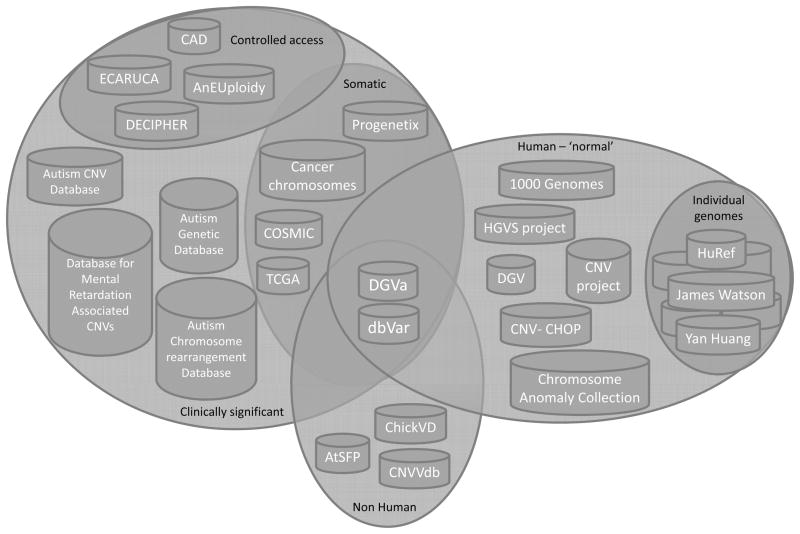
Genomic structural variation (SV) can be thought of on a continuum from a single base pair insertion/deletion (INDEL) to large megabase-scale rearrangements involving insertions, deletions, duplications, inversions, or translocations of whole chromosomes or chromosome arms. These variants can occur in coding or noncoding DNA, they can be inherited or arise sporadically in the germline or somatic cells. Many of these events are segregating in the population and can be considered common alleles while others are new alleles and thus rare events. All species studied to date harbor structural variants and these may be benign, contributing to phenotypes such as sensory perception and immunity, or pathogenic resulting in genomic disorders including DiGeorge/velocardiofacial, Smith-Margenis, Williams-Beuren, and Prader-Willi syndromes. As structural variants are identified, validated, and their significance, origin, and prevalence are elucidated, it is of critical importance that these data be collected and collated in a way that can be easily accessed and analyzed. This chapter describes current structural variation online resources (see Fig. 1 and Table 1), highlights the challenges in capturing, storing, and displaying SV data, and discusses how dbVar and DGVa, the genomic structural variation databases developed at NCBI and EBI, respectively, were designed to address these issues.
Figures
References
-
- Lupski JR, de Oca-Luna RM, Slaugenhaupt S, Pentao L, Guzzetta V, Trask BJ, Saucedo-Cardenas O, Barker DF, Killian JM, Garcia CA, Chakravarti A, Patel PI. DNA duplication associated with Charcot-Marie-Tooth disease type 1A. Cell. 1991;66:219–232. - PubMed
-
- Koolen DA, Vissers LE, Pfundt R, de Leeuw N, Knight SJ, Regan R, Kooy RF, Reyniers E, Romano C, Fichera M, Schinzel A, Baumer A, Anderlid BM, Schoumans J, Knoers NV, van Kessel AG, Sistermans EA, Veltman JA, Brunner HG, de Vries BB. A new chromosome 17q21.31 microdeletion syndrome associated with a common inversion polymorphism. Nat Genet. 2006;38:999–1001. - PubMed
-
- Shaw-Smith C, Pittman AM, Willatt L, Martin H, Rickman L, Gribble S, Curley R, Cumming S, Dunn C, Kalaitzopoulos D, Porter K, Prigmore E, Krepischi-Santos AC, Varela MC, Koiffmann CP, Lees AJ, Rosenberg C, Firth HV, de Silva R, Carter NP. Microdeletion encompassing MAPT at chromosome 17q21.3 is associated with developmental delay and learning disability. Nat Genet. 2006;38:1032–1037. - PubMed
-
- Weiss LA, Shen Y, Korn JM, Arking DE, Miller DT, Fossdal R, Saemundsen E, Stefansson H, Ferreira MA, Green T, Platt OS, Ruderfer DM, Walsh CA, Altshuler D, Chakravarti A, Tanzi RE, Stefansson K, Santangelo SL, Gusella JF, Sklar P, Wu BL, Daly MJ. Association between Microdeletion and Microduplication at 16p11.2 and Autism. N Engl J Med 2008 - PubMed
-
- Gonzalez E, Kulkarni H, Bolivar H, Mangano A, Sanchez R, Catano G, Nibbs RJ, Freedman BI, Quinones MP, Bamshad MJ, Murthy KK, Rovin BH, Bradley W, Clark RA, Anderson SA, O’Connell RJ, Agan BK, Ahuja SS, Bologna R, Sen L, Dolan MJ, Ahuja SK. The influence of CCL3L1 gene-containing segmental duplications on HIV-1/AIDS susceptibility. Science. 2005;307:1434–1440. - PubMed
Publication types
MeSH terms
Grants and funding
LinkOut - more resources
Full Text Sources
Research Materials