. 2012 Jan 31;109(5):E218-24.
doi: 10.1073/pnas.1109709109. Epub 2012 Jan 6.

Full-length myosin Va exhibits altered gating during processive movement on actin

Affiliations

Full-length myosin Va exhibits altered gating during processive movement on actin

Jessica M Armstrong et al. Proc Natl Acad Sci U S A. .

Abstract

Myosin Va (myoV) is a processive molecular motor that transports intracellular cargo along actin tracks with each head taking multiple 72-nm hand-over-hand steps. This stepping behavior was observed with a constitutively active, truncated myoV, in which the autoinhibitory interactions between the globular tail and motor domains (i.e., heads) that regulate the full-length molecule no longer exist. Without cargo at near physiologic ionic strength (100 mM KCl), full-length myoV adopts a folded (approximately 15 S), enzymatically-inhibited state that unfolds to an extended (approximately 11 S), active conformation at higher salt (250 mM). Under conditions favoring the folded, inhibited state, we show that Quantum-dot-labeled myoV exhibits two types of interaction with actin in the presence of MgATP. Most motors bind to actin and remain stationary, but surprisingly, approximately 20% are processive. The moving motors transition between a strictly gated and hand-over-hand stepping pattern typical of a constitutively active motor, and a new mode with a highly variable stepping pattern suggestive of altered gating. Each head of this partially inhibited motor takes longer-lived, short forward (35 nm) and backward (28 nm) steps, presumably due to globular tail-head interactions that modify the gating of the individual heads. This unique mechanical state may be an intermediate in the pathway between the inhibited and active states of the motor.


Conflict of interest statement

The authors declare no conflict of interest.

Figures
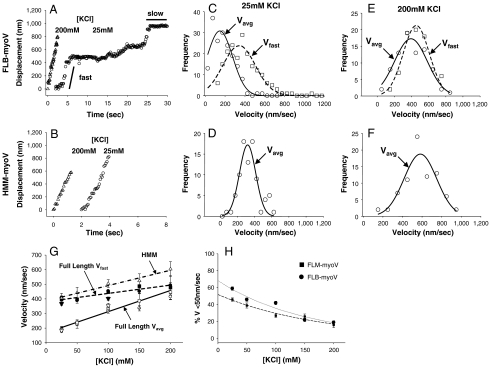
Fig. 1.
Fig. 1.
Ionic strength dependence of myoV displacements and velocities. Typical displacement versus time traces for FLB-myoV (A) and HMM-myoV (B) at 200 mM (triangles) and 25 mM (circles) KCl at 1 mM ATP. In A, solid lines highlight the periods of fast and slow processive movement (CF) Velocity histograms for FLB-myoV and HMM-myoV at 25 mM and 200 mM KCl. Circles represent Vavg and squares represent Vfast. At 25 mM KCL Vavg and Vfast for FLB-myoV are 147 ± 10 nm/s and 343 ± 12 nm/s (n = 175), respectively, while Vavg for HMM-myoV is 320 ± 18 nm/s (n = 145). At 200 mM KCl, Vavg and Vfast for FLB-myoV are 394 ± 22 nm/s and 456 ± 17 nm/s (n = 80), respectively, while Vavg for HMM-myoV is 583 ± 19 nm/s (n = 115). (G) Vavg and Vfast as a function of ionic strength for the FL-myoV. FLB-myoV (open and closed circles), FLM-myoV (open and closed squares), YFP-FL-myoV (open and closed down triangles) and Vavg for HMM-myoV (open up triangles). Vavg of the FL-myoV is significantly slower than Vavg of HMM-myoV at all [KCl] (ANOVA, p ≤ 0.05). (H) The percentage of time that the FL-myoV spend traveling at slow processive speeds (%Vslow) vs. KCl concentration. Values are reported as mean ± S.E.M.
Fig. 2.
Fig. 2.
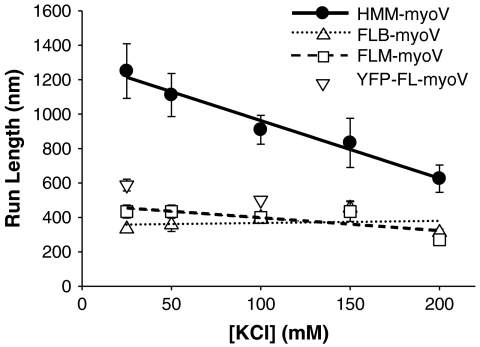
Ionic strength dependence of run lengths and termination rates at 1 mM ATP. Characteristic run length constants of FL- and HMM-myoV as a function of ionic strength. FLB-myoV (up triangles, dotted line), FLM-myoV (squares, dashed line), and YFP-FL-myoV (down triangles at 25 and 100 mM KCl only) have significantly shorter characteristic run lengths than the HMM-myoV (filled circles, solid line) at all KCl concentrations tested (T test; p ≤ 0.002).
Fig. 3.
Fig. 3.
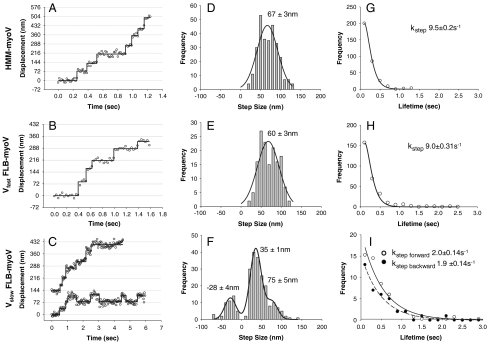
Stepping dynamics of HMM-myoV and FLB-myoV. Displacement vs. time traces for HMM-myoV captured at 60 fps (A), during a Vfast period captured at 30 fps (B) and two different traces one of which shows a period of dynamic stall during a Vslow period captured at 30 fps (C) for FLB-myoV. Step size distributions and their mean ± S.E. of HMM-myoV (n = 290) (D), during Vfast periods for FLB-myoV (n = 266) (E), and Vslow periods for FLB-myoV (n = 235) where the distribution was fitted (R2 = 0.94) by the sum of three Gaussians (F). Step lifetime frequency histograms for HMM-myoV (G), for steps during Vfast (H) and Vslow (I) of FLB-myoV with forward steps (open circles) and backward steps (closed circles) as indicated. The stepping rate (kstep) is the exponential decay constant ± S.E.M. Conditions: 25 mM KCl, 1 mM ATP.
Fig. 4.
Fig. 4.
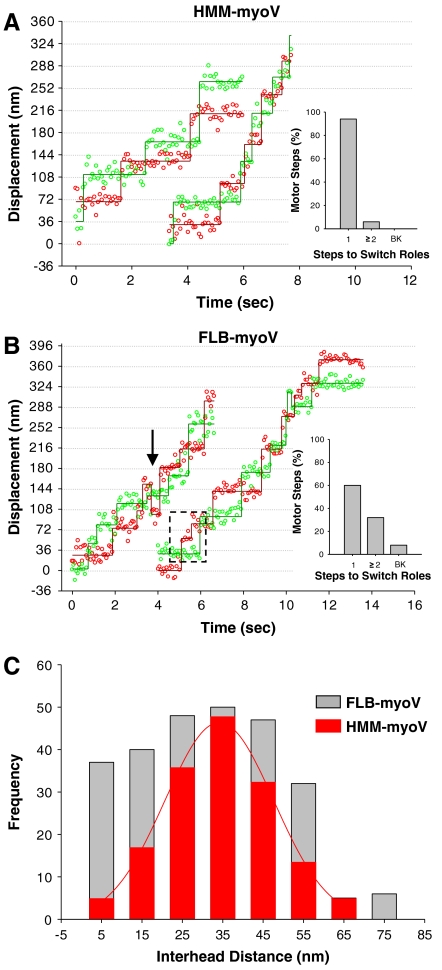
Dual-colored Qdot-labeled FLB- and HMM-myoV stepping dynamics. Representative displacement vs. time traces for dual-labeled HMM-myoV (A) and FLB-myoV (B) at 100 mM KCl and 10 μM ATP, captured at 15 fps. (A) HMM-myoV exhibits almost exclusively (94%) hand-over-hand stepping. The bar chart shows the percentage of motor steps for which it took one (1) or two or more (≥2) steps before the heads switch roles between leading and trailing, and the occurrence of backward (BK) steps. (B) FLB-myoV has a mixture of hand-over-hand (60%) and altered gating (33%) steps where the motor took ≥2 steps before the heads switched roles (highlighted by dashed box). FLB-myoV also took occasional (7%) backward (BK) steps, identified by an arrow in the trace. (C) Interhead distances for the HMM-myoV (red bars) fit to a Gaussian (34 ± 2 nm) and the FLB-myoV (gray bars).
Fig. 5.
Fig. 5.
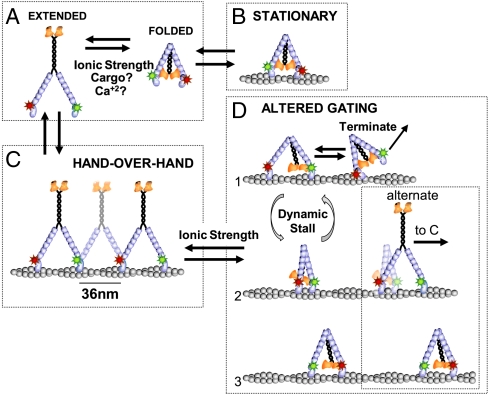
Model of FL-myoV folding equilibrium and stepping dynamics. (A) Ionic strength, cargo binding, and changes in Ca+2 concentration affect the folded/ inhibited to extended/active state equilibrium in the absence of actin. (B) The folded motor can bind actin, but remains stationary. Whether one or both heads bind actin is unknown. (C) If the extended motor binds actin, it takes multiple hand-over-hand steps, where the red and green Qdot-labeled heads alternate between being the leading and trailing head. The motor steps along the pseudo actin repeat to the right with a constant interhead distance of approximately 36 nm as observed for the constitutively active HMM-myoV and thus defines the fast FL-myoV processive periods. (D) During the slow processive periods, FL-myoV adopts a conformation with altered gating where the GTD binds to one of the heads (D1) forcing the motor at times to take multiple short steps (D1 to D2) or periods of dynamic stall (D1D2) before the heads switch roles as leading or trailing head (D2 to D3). An alternate scheme (D2 alternate) for short forward steps is that unfolding of the tail frees the leading head to adopt its preferred position on actin, following which the tail either refolds (D3) or the motor switches to hand-over-hand stepping (C).
Fig. P1.
Fig. P1.
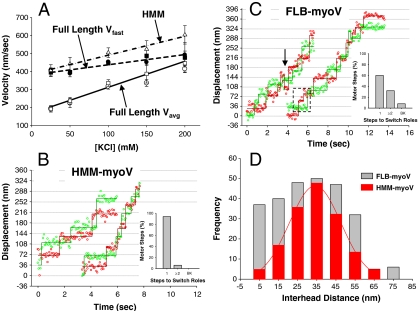
Stepping dynamics of full-length myosin Va (FL-myoV) and a constitutively active heavy meromyosin Va (HMM-myoV). (A) The average velocity (Vavg) and the velocity for periods of fast processive movement (Vfast) versus ionic strength for two FL-myoV splice variants (circles and squares), and Vavg for HMM-myoV (triangles). The FL-myoV Vavg was slower than the Vavg of HMM-myoV at all KCl concentrations (p ≤ 0.05). (B)–(C) Representative displacement vs. time traces for dual-labeled HMM-myoV (B) and the brain splice variant, FLB-myoV (C) at 100 mM KCl. (B) HMM-myoV exhibits almost exclusively hand-over-hand stepping. (C) FLB-myoV has a mixture of hand-over-hand (60%) and altered gating (33%) steps where the motor took ≥2 steps before the heads switched roles (highlighted by dashed box). FLB-myoV also took occasional backsteps, identified by an arrow. (D) Distributions of interhead distances for the HMM-myoV (red bars; Gaussian fit: 34 ± 2 nm) and the FLB-myoV (gray bars).

References

    1. Yildiz A, et al. Myosin V walks hand-over-hand: Single fluorophore imaging with 1.5-nm localization. Science. 2003;300:2061–2065. - PubMed
    1. Warshaw DM, et al. Differential labeling of myosin V heads with quantum dots allows direct visualization of hand-over-hand processivity. Biophys J. 2005;88:L30–32. - PMC - PubMed
    1. Trybus KM. Myosin V from head to tail. Cell Mol Life Sci. 2008;65:1378–1389. - PMC - PubMed
    1. Li XD, Mabuchi K, Ikebe R, Ikebe M. Ca2+-induced activation of ATPase activity of myosin Va is accompanied with a large conformational change. Biochem Biophys Res Commun. 2004;315:538–545. - PubMed
    1. Lu H, Krementsova EB, Trybus KM. Regulation of myosin V processivity by calcium at the single molecule level. J Biol Chem. 2006;281:31987–31994. - PubMed

Publication types

LinkOut - more resources