


When is diabetes distress clinically meaningful?: establishing cut points for the Diabetes Distress Scale
- PMID: 22228744
- PMCID: PMC3263871
- DOI: 10.2337/dc11-1572
When is diabetes distress clinically meaningful?: establishing cut points for the Diabetes Distress Scale
Abstract
Objective: To identify the pattern of relationships between the 17-item Diabetes Distress Scale (DDS17) and diabetes variables to establish scale cut points for high distress among patients with type 2 diabetes.
Research design and methods: Recruited were 506 study 1 and 392 study 2 adults with type 2 diabetes from community medical groups. Multiple regression equations associated the DDS17, a 17-item scale that yields a mean-item score, with HbA(1c), diabetes self-efficacy, diet, and physical activity. Associations also were undertaken for the two-item DDS (DDS2) screener. Analyses included control variables, linear, and quadratic (curvilinear) DDS terms.
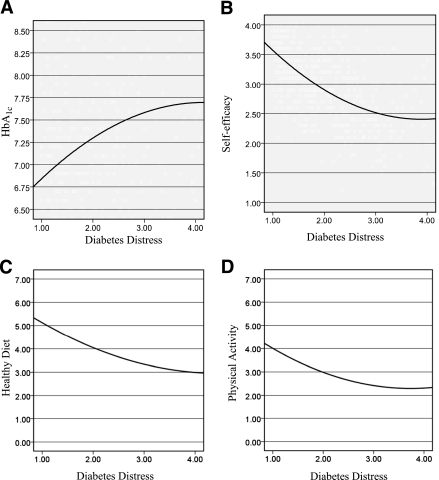
Results: Significant quadratic effects occurred between the DDS17 and each diabetes variable, with increases in distress associated with poorer outcomes: study 1 HbA(1c) (P < 0.02), self-efficacy (P < 0.001), diet (P < 0.001), physical activity (P < 0.04); study 2 HbA(1c) (P < 0.03), self-efficacy (P < 0.004), diet (P < 0.04), physical activity (P = NS). Substantive curvilinear associations with all four variables in both studies began at unexpectedly low levels of DDS17: the slope increased linearly between scores 1 and 2, was more muted between 2 and 3, and reached a maximum between 3 and 4. This suggested three patient subgroups: little or no distress, <2.0; moderate distress, 2.0-2.9; high distress, ≥3.0. Parallel findings occurred for the DDS2.
Conclusions: In two samples of type 2 diabetic patients we found a consistent pattern of curvilinear relationships between the DDS and HbA(1c), diabetes self-efficacy, diet, and physical activity. The shape of these relationships suggests cut points for three patient groups: little or no, moderate, and high distress.
Figures
References
-
- Fisher L, Skaff MM, Mullan JT, et al. Clinical depression versus distress among patients with type 2 diabetes: not just a question of semantics. Diabetes Care 2007;30:542–548 - PubMed
