


Respective roles of CYP2A5 and CYP2F2 in the bioactivation of 3-methylindole in mouse olfactory mucosa and lung: studies using Cyp2a5-null and Cyp2f2-null mouse models
- PMID: 22228748
- PMCID: PMC3310420
- DOI: 10.1124/dmd.111.044081
Respective roles of CYP2A5 and CYP2F2 in the bioactivation of 3-methylindole in mouse olfactory mucosa and lung: studies using Cyp2a5-null and Cyp2f2-null mouse models
Abstract
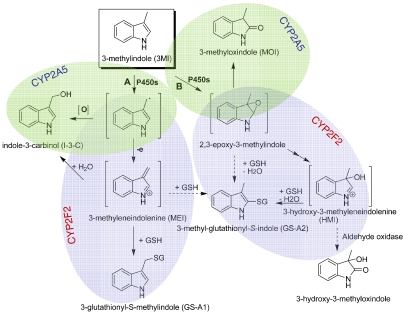
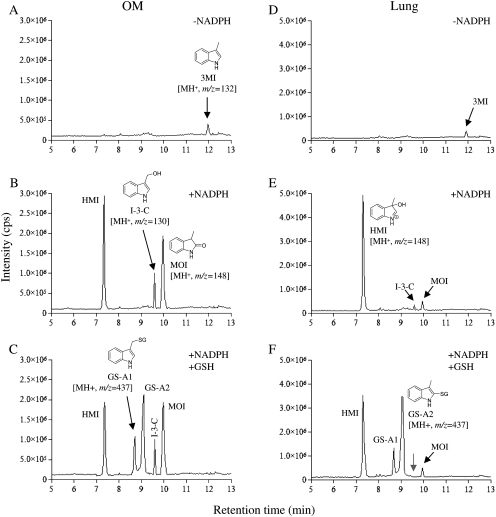
The aim of this study was to determine whether mouse CYP2A5 and CYP2F2 play critical roles in the bioactivation of 3-methylindole (3MI), a tissue-selective toxicant, in the target tissues, the nasal olfactory mucosa (OM) and lung. Five metabolites of 3MI were identified in NADPH- and GSH-fortified microsomal reactions, including 3-glutathionyl-S-methylindole (GS-A1), 3-methyl-2-glutathionyl-S-indole (GS-A2), 3-hydroxy-3-methyleneindolenine (HMI), indole-3-carbinol (I-3-C), and 3-methyloxindole (MOI). The metabolite profiles and enzyme kinetics of the reactions were compared between OM and lung, and among wild-type, Cyp2a5-null, and Cyp2f2-null mice. In lung reactions, GS-A1, GS-A2, and HMI were detected as major products, and I-3-C and MOI, as minor metabolites. In OM reactions, all five metabolites were detected in ample amounts. The loss of CYP2F2 affected formation of all 3MI metabolites in the lung and formation of HMI, GS-A1, and GS-A2 in the OM. In contrast, loss of CYP2A5 did not affect formation of 3MI metabolites in the lung but caused substantial decreases in I-3-C and MOI formation in the OM. Thus, whereas CYP2F2 plays a critical role in the 3MI metabolism in the lung, both CYP2A5 and CYP2F2 play important roles in 3MI metabolism in the OM. Furthermore, the fate of the reactive metabolites produced by the two enzymes through common dehydrogenation and epoxidation pathways seemed to differ with CYP2A5 supporting direct conversion to stable metabolites and CYP2F2 supporting further formation of reactive iminium ions. These results provide the basis for understanding the respective roles of CYP2A5 and CYP2F2 in 3MI's toxicity in the respiratory tract.
Figures
References
-
- Baldwin RM, Jewell WT, Fanucchi MV, Plopper CG, Buckpitt AR. (2004) Comparison of pulmonary/nasal CYP2F expression levels in rodents and rhesus macaque. J Pharmacol Exp Ther 309:127–136 - PubMed
-
- D'Agostino J, Zhuo X, Shadid M, Morgan DG, Zhang X, Humphreys WG, Shu YZ, Yost GS, Ding X. (2009) The pneumotoxin 3-methylindole is a substrate and a mechanism-based inactivator of CYP2A13, a human cytochrome P450 enzyme preferentially expressed in the respiratory tract. Drug Metab Dispos 37:2018–2027 - PMC - PubMed
-
- Gu J, Zhang QY, Genter MB, Lipinskas TW, Negishi M, Nebert DW, Ding X. (1998) Purification and characterization of heterologously expressed mouse CYP2A5 and CYP2G1: role in metabolic activation of acetaminophen and 2,6-dichlorobenzonitrile in mouse olfactory mucosal microsomes. J Pharmacol Exp Ther 285:1287–1295 - PubMed
-
- Lanza DL, Code E, Crespi CL, Gonzalez FJ, Yost GS. (1999) Specific dehydrogenation of 3-methylindole and epoxidation of naphthalene by recombinant human CYP2F1 expressed in lymphoblastoid cells. Drug Metab Dispos 27:798–803 - PubMed
-
- Lanza DL, Yost GS. (2001) Selective dehydrogenation/oxygenation of 3-methylindole by cytochrome p450 enzymes. Drug Metab Dispos 29:950–953 - PubMed
Publication types
MeSH terms
Substances
Grants and funding
LinkOut - more resources
Full Text Sources
