


The Soft Underbelly of System Change: The Role of Leadership and Organizational Climate in Turnover during Statewide Behavioral Health Reform
- PMID: 22229021
- PMCID: PMC3252234
- DOI: 10.1037/a0026196
The Soft Underbelly of System Change: The Role of Leadership and Organizational Climate in Turnover during Statewide Behavioral Health Reform
Abstract
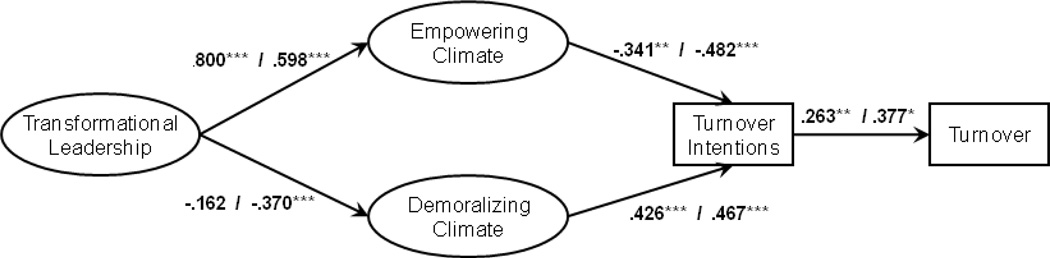
This study examined leadership, organizational climate, staff turnover intentions, and voluntary turnover during a large-scale statewide behavioral health system reform. The initial data collection occurred nine months after initiation of the reform with a follow-up round of data collected 18 months later. A self-administered structured assessment was completed by 190 participants (administrators, support staff, providers) employed by 14 agencies. Key variables included leadership, organizational climate, turnover intentions, turnover, and reform-related financial stress ("low" versus "high") experienced by the agencies. Analyses revealed that positive leadership was related to a stronger empowering climate in both high and low stress agencies. However, the association between more positive leadership and lower demoralizing climate was evident only in high stress agencies. For both types of agencies empowering climate was negatively associated with turnover intentions, and demoralizing climate was associated with stronger turnover intentions. Turnover intentions were positively associated with voluntary turnover. Results suggest that strong leadership is particularly important in times of system and organizational change and may reduce poor climate associated with turnover intentions and turnover. Leadership and organizational context should be addressed to retain staff during these periods of systemic change.
Figures
References
-
- Aarons GA, Horowitz J. Leading evidence-based practice implementation in mental health and social services. Paper presented at the Annual Meeting of the American Psychological Association; San Diego, CA. 2010. Aug,
Grants and funding
LinkOut - more resources
Full Text Sources