


How does the canadian general public rate moderate Alzheimer's disease?
- PMID: 22229093
- PMCID: PMC3250621
- DOI: 10.4061/2011/682470
How does the canadian general public rate moderate Alzheimer's disease?
Abstract
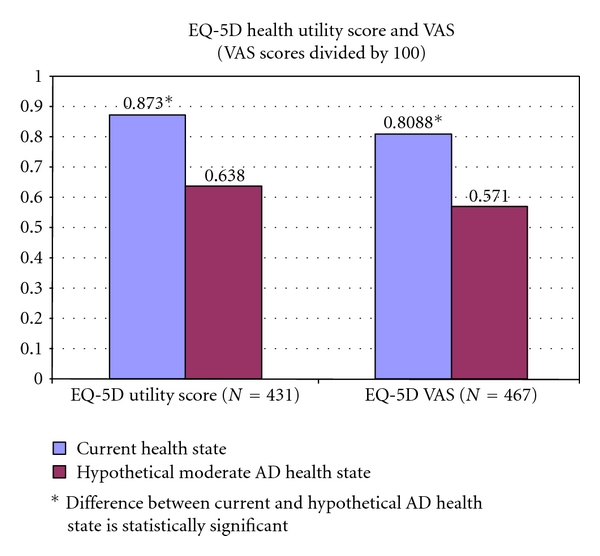
Objectives. The objectives of this study were to elicit health utility scores for moderate Alzheimer's disease (AD) using members of the general public. Methods. Five-hundred Canadians were chosen randomly to participate in a telephone interview. The EQ-5D was administered to estimate the health utility score for respondents' current health status (i.e., no AD) and for a hypothetical moderate AD health state. Regression analyses were conducted to explain the perceived utility decrement associated with AD. Results. The mean age of the respondents was 51 years, 60% were female, and 42% knew someone with AD. Respondents' mean EQ-5D scores for their current health status and a hypothetical moderate AD were 0.873 (SD: 0.138) and 0.638 (SD: 0.194), respectively (P < 0.001). Age, gender, and education were significant factors explaining this decrement in utility. Conclusion. Members of the general public may serve as an alternative to patients and caregivers in the elicitation of health-related quality of life in AD.
Figures
References
-
- Heron M, Hoyert DL, Murphy SL, Xu J, Kochanek KD, Tejada-Vera B. Deaths: final data for 2006. National Vital Statistics Reports. 2009;57(14):1–134. - PubMed
-
- Alzheimer’s Association. Early Onset Dementia: A National Challenge, a Future Crisis. Washington, DC, USA: Alzheimer’s Association; 2006.
-
- Alzheimer’s Association. 2009 Alzheimer’s disease facts and figures. Alzheimers Dement. 2009;5(3):234–270. - PubMed
-
- Alzheimer’s Association. Saving Lives. Saving Money: Dividends for Americans Investing in Alzheimer Research. Report of the Lewin Group to the Alzheimer’s Association. Washington, DC, USA: Alzheimer’s Association; 2004.
-
- Bloom BS, de Pouvourville N, Straus WL. Cost of illness of Alzheimer’s disease: how useful are current estimates? Gerontologist. 2003;43(2):158–164. - PubMed
LinkOut - more resources
Full Text Sources
