


Review
doi: 10.1186/1756-3305-5-6.
Biology and pathogenesis of Acanthamoeba
Affiliations
- PMID: 22229971
- PMCID: PMC3284432
- DOI: 10.1186/1756-3305-5-6
Item in Clipboard
Review
Biology and pathogenesis of Acanthamoeba
Parasit Vectors.
.
Abstract
Acanthamoeba is a free-living protist pathogen, capable of causing a blinding keratitis and fatal granulomatous encephalitis. The factors that contribute to Acanthamoeba infections include parasite biology, genetic diversity, environmental spread and host susceptibility, and are highlighted together with potential therapeutic and preventative measures. The use of Acanthamoeba in the study of cellular differentiation mechanisms, motility and phagocytosis, bacterial pathogenesis and evolutionary processes makes it an attractive model organism. There is a significant emphasis on Acanthamoeba as a Trojan horse of other microbes including viral, bacterial, protists and yeast pathogens.
Figures
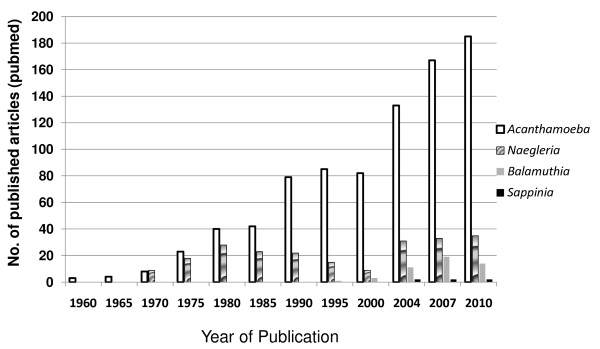
Increasing scientific interest in the field of free-living amoebae as determined by published articles over the last five decades. A pubmed search using "Acanthamoeba", "Balamuthia", Naegleria" or "Sappinia" was carried out.
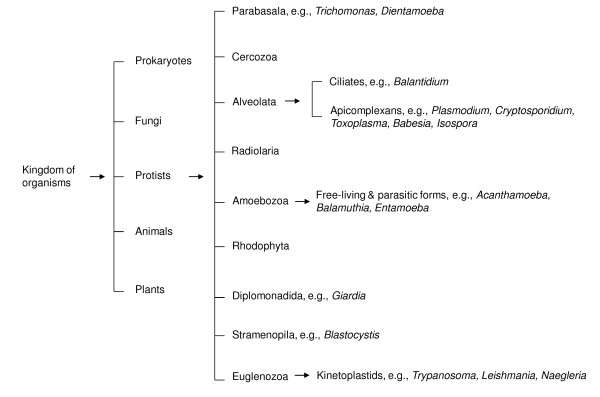
The classification of protists, based on ribosomal rRNA sequences (modified from Khan NA Acanthamoeba: Biology and Pathogenesis, Caister Academic Press, 2009, ISBN: 978-1-904455-43-1).
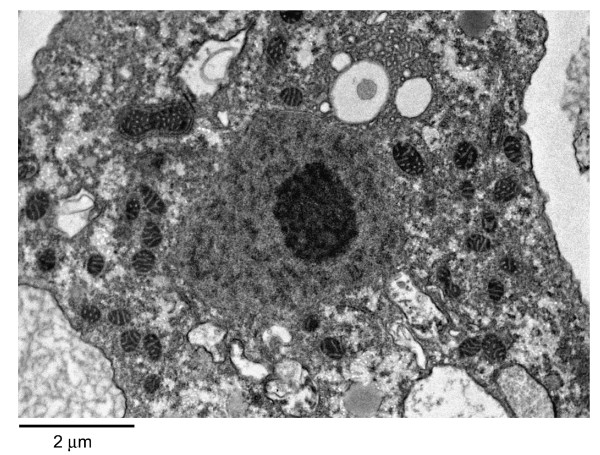
The transmission electron micrograph of Acanthamoeba trophozoite. M is mitochondria; N is nucleus; V is vacuole and arrow indicates plasma membrane.
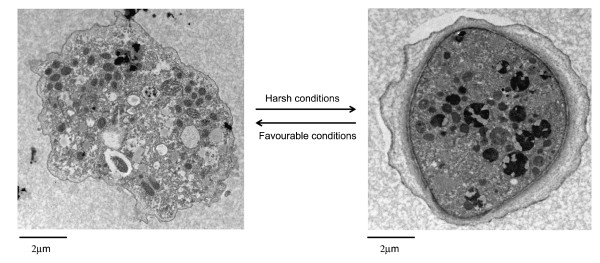
The life cycle of Acanthamoeba spp. Under favourable conditions, Acanthamoeba remains in the trophozoite form and divides mitotically (A) and produces infection, while under harsh conditions amoeba transforms into a dormant cyst form (B) that is highly resistant to harsh conditions.
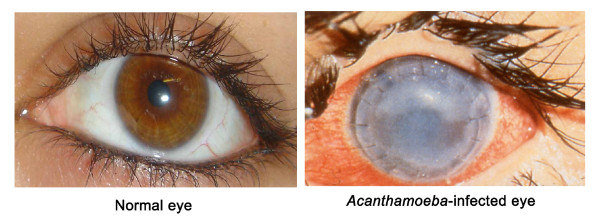
(A) Normal eye and (B) Infected eye exhibiting recurrent Acanthamoeba infection following corneal transplant with severe corneal damage and loss of vision.
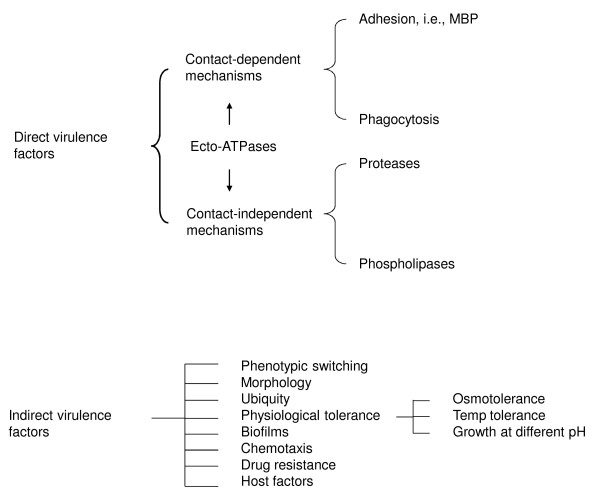
Acanthamoeba pathogenesis involves contact-dependent and -independent factors together with indirect virulence features (taken from Khan NA Acanthamoeba: Biology and Pathogenesis, Caister Academic Press, 2009, ISBN: 978-1-904455-43-1).
References
-
- Visvesvara GS, Moura H, Schuster FL. Pathogenic and opportunistic free-living amoebae: Acanthamoeba spp., Balamuthia mandrillaris, Naegleria fowleri, and Sappinia diploidea. FEMS Immunol Med Microbiol. 2007;50:1–26. - PubMed
-
- Khan NA. Acanthamoeba: biology and increasing importance in human health. FEMS Microbiol Rev. 2006;30(4):564–95. - PubMed
-
- Taylor PW. Isolation and experimental infection of free-living amebae in freshwater fishes. J Parasitol. 1997;63:232–7. - PubMed
-
- Van der Lugt JJ, Van der Merwe HE. Amoebic meningoencephalitis in a sheep. J S Afr Vet Assoc. 1990;61:33–6. - PubMed
Publication types
MeSH terms
LinkOut - more resources
Full Text Sources
Other Literature Sources
Medical
