


Auditory orienting and inhibition of return in schizophrenia: a functional magnetic resonance imaging study
- PMID: 22230646
- PMCID: PMC3690330
- DOI: 10.1016/j.pnpbp.2011.12.011
Auditory orienting and inhibition of return in schizophrenia: a functional magnetic resonance imaging study
Abstract
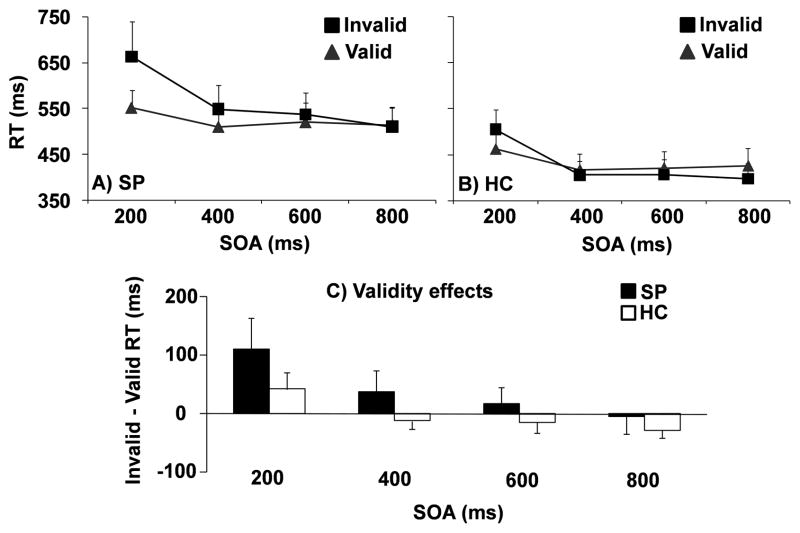
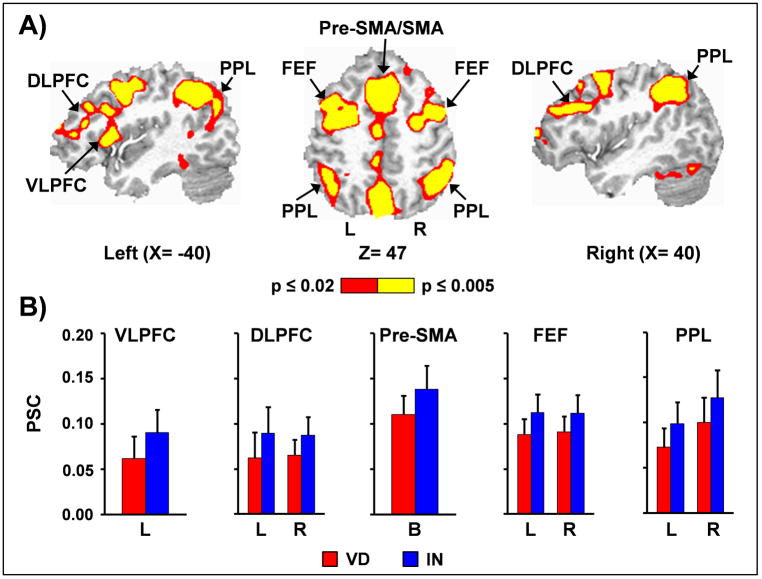
Patients with schizophrenia (SP) exhibit deficits in both attentional reorienting and inhibition of return (IOR) during visual tasks. However, it is currently unknown whether these deficits are supramodal in nature and how these deficits relate to other domains of cognitive dysfunction. In addition, the neuronal correlates of this pathological orienting response have not been investigated in either the visual or auditory modality. Therefore, 30 SP and 30 healthy controls (HC) were evaluated with an extensive clinical protocol and functional magnetic resonance imaging (fMRI) during an auditory cuing paradigm. SP exhibited both increased costs and delayed IOR during auditory orienting, suggesting a prolonged interval for attentional disengagement from cued locations. Moreover, a delay in the development of IOR was associated with cognitive deficits on formal neuropsychological testing in the domains of attention/inhibition and working memory. Event-related fMRI showed the characteristic activation of a frontoparietal network (invalid trials>valid trials), but there were no differences in functional activation between patients and HC during either attentional reorienting or IOR. Current results suggest that orienting deficits are supramodal in nature in SP, and are related to higher-order cognitive deficits that directly interfere with day-to-day functioning.
Copyright © 2011 Elsevier Inc. All rights reserved.
Figures
References
-
- Addington D, Addington J, Maticka-Tyndale E. Assessing depression in schizophrenia: the Calgary Depression Scale. The British journal of psychiatry. 1993:39–44. - PubMed
-
- Amado I, Bourdel MC, Daban C, Poirier MF, Loo H, Bouhours P, et al. Preattentional processes and disorganization in schizophrenia: Influence of a 6-week risperidone treatment. Progress in neuro-psychopharmacology & biological psychiatry. 2009;33:1107–12. - PubMed
-
- Amenta F, Ricci A, Tayebati SK, Zaccheo D. The peripheral dopaminergic system: morphological analysis, functional and clinical applications. Ital J Anat Embryol. 2002;107:145–67. - PubMed
-
- Arrington CM, Carr TH, Mayer AR, Rao SM. Neural mechanisms of visual attention: object-based selection of a region in space. Journal of cognitive neuroscience. 2000;12 (Suppl 2):106–17. - PubMed
Publication types
MeSH terms
Grants and funding
LinkOut - more resources
Full Text Sources
Medical
