Comparative Study
. 2012 Mar;60(1):683-92.
doi: 10.1016/j.neuroimage.2011.12.069. Epub 2012 Jan 2.

Neural systems for guilt from actions affecting self versus others

Affiliations
Comparative Study

Neural systems for guilt from actions affecting self versus others

Rajendra A Morey et al. Neuroimage. 2012 Mar.

Abstract

Guilt is a core emotion governing social behavior by promoting compliance with social norms or self-imposed standards. The goal of this study was to contrast guilty responses to actions that affect self versus others, since actions with social consequences are hypothesized to yield greater guilty feelings due to adopting the perspective and subjective emotional experience of others. Sixteen participants were presented with brief hypothetical scenarios in which the participant's actions resulted in harmful consequences to self (guilt-self) or to others (guilt-other) during functional MRI. Participants felt more intense guilt for guilt-other than guilt-self and guilt-neutral scenarios. Guilt scenarios revealed distinct regions of activity correlated with intensity of guilt, social consequences of actions, and the interaction of guilt by social consequence. Guilt intensity was associated with activation of the dorsomedial PFC, superior frontal gyrus, supramarginal gyrus, and anterior inferior frontal gyrus. Guilt accompanied by social consequences was associated with greater activation than without social consequences in the ventromedial and dorsomedial PFC, precuneus, posterior cingulate, and posterior superior temporal sulcus. Finally, the interaction analysis highlighted select regions that were more strongly correlated with guilt intensity as a function of social consequence, including the left anterior inferior frontal gyrus, left ventromedial PFC, and left anterior inferior parietal cortex. Our results suggest these regions intensify guilt where harm to others may incur a greater social cost.


Figures

Figure 1
Figure 1
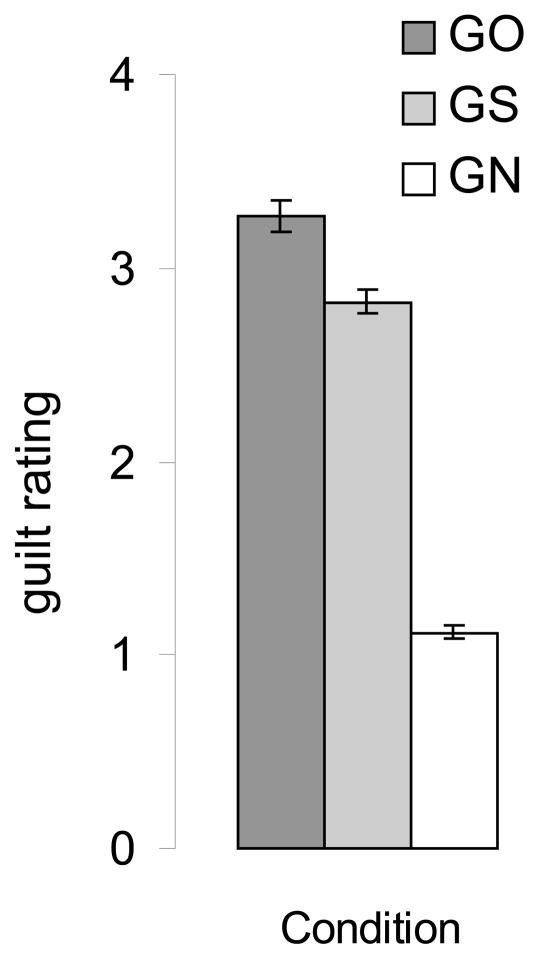
The participant ratings for the intensity of guilt experienced in response to scenarios differed for guilt-other (GO), guilt-self (GS), and guilt-neutral (GN) conditions. Greater intensity of guilt was reported for guilt-other than guilt-self and guilt-neutral conditions, as well as greater intensity of guilt for guilt-self than the guilt-neutral condition.
Figure 2
Figure 2
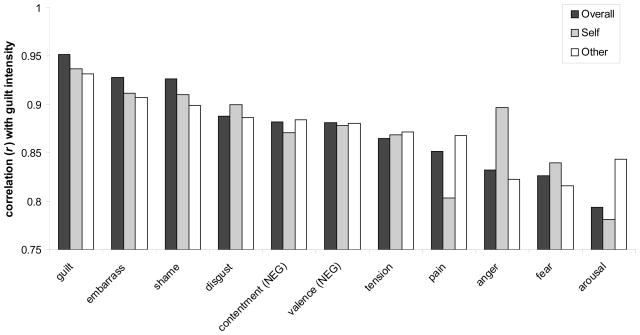
A separate correlation between guilt and each of the 11 emotions was computed from the guilt intensity (1=low, 4=high) for each scenario provided by subjects in the scanner (n=16) and the emotional intensity experienced (1=low, 4=high) for each scenario provided by a separate group of subjects outside the scanner (n=12). The correlation is represented by the height of the bar, separately for self- and other-perspective scenarios and for all scenarios. The strongest correlations were present for guilt and progressively decreasing correlation strengths for embarrassment, shame, disgust, contentment, valence, tension, pain, anger, fear, and arousal.
Figure 3
Figure 3
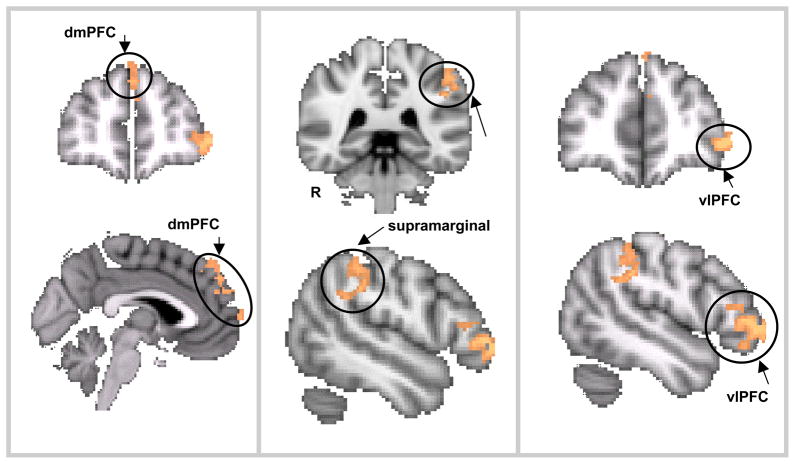
The main effect of guilt, where activation was positively correlated with guilt ratings, included the dorsomedial PFC (left), the supramarginal gyrus (center), and the ventrolateral PFC (right)
Figure 4
Figure 4
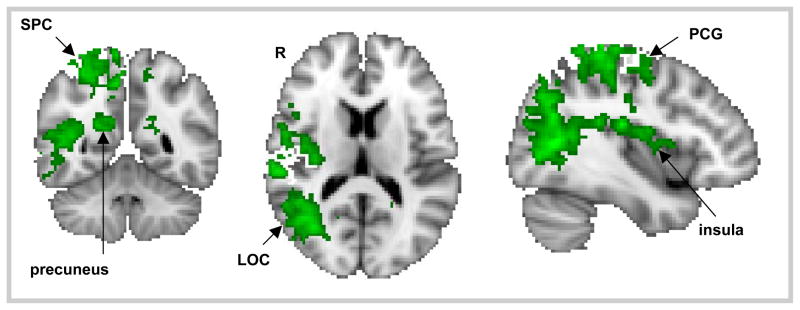
The main effect of guilt, where activation was negatively correlated with guilt ratings, included the right lateral occipital cortex (LOC), the right superior parietal cortex (SPC), the right and left precuneus, the right posterior middle temporal gyrus, right postcentral gyrus (PCG), right superior frontal gyrus, and right insular cortex
Figure 5
Figure 5
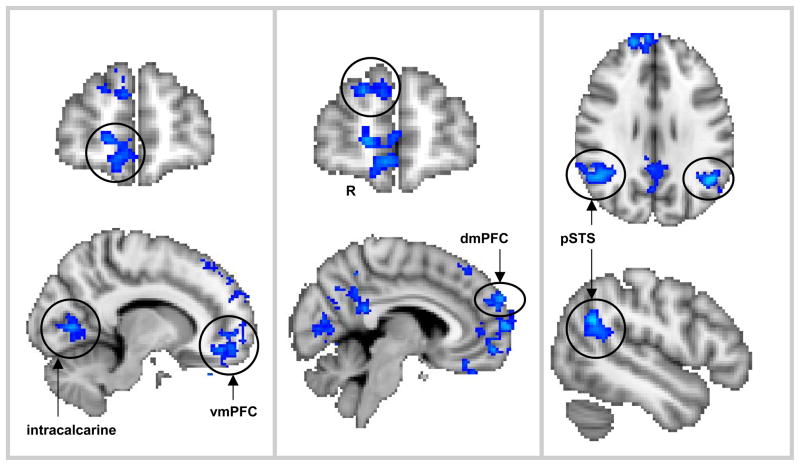
The main effect of social consequence, where activation was greater for other- than self-consequences, included the ventromedial PFC, intracalcarine (left panel), dorsomedial PFC (center panel), the posterior superior temporal sulcus (pSTS), precuneus (right panel), and the posterior cingulate cortex.
Figure 6
Figure 6
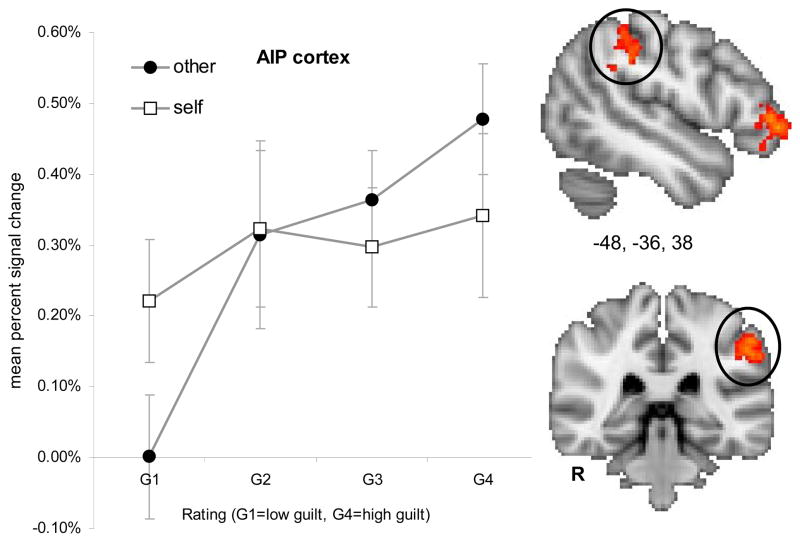
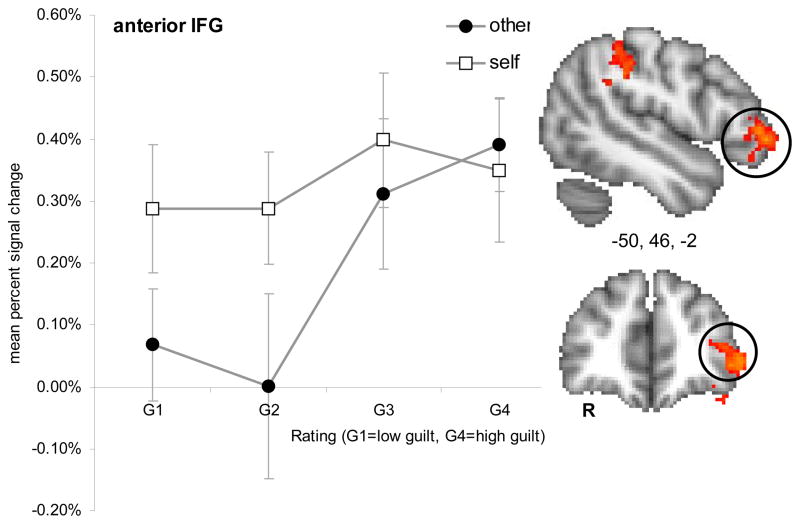
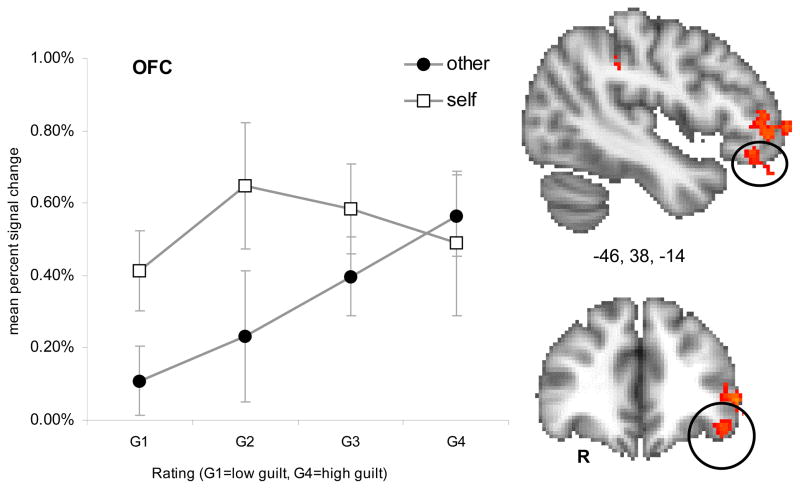
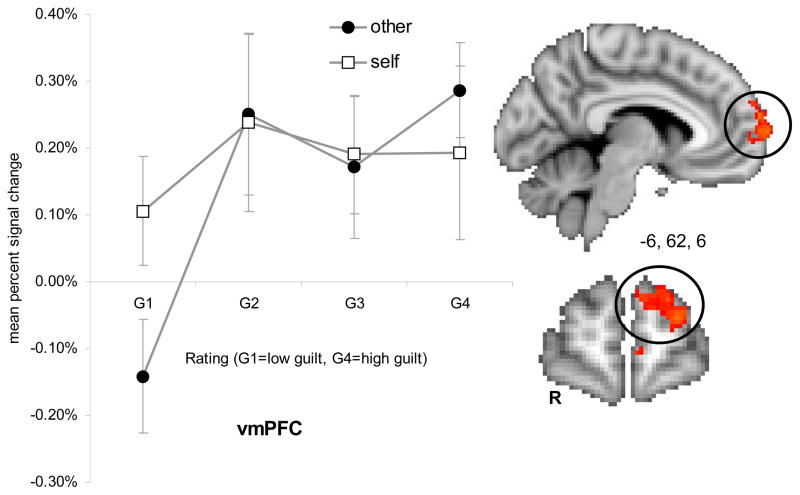
Figure 6a. Interaction effect of guilt (G1–G4) and social consequence (self or other) in the left anterior inferior parietal (AIP) cortex. Error bars represent standard error of the mean (SEM). Figure 6b. Interaction effect of guilt (G1–G4) and social consequence (self or other) in the left anterior inferior frontal gyrus (IFG). Error bars represent standard error of the mean (SEM). Figure 6c. Interaction effect of guilt (G1–G4) and perspective (self or other) in the left orbitofrontal cortex (OFC). Error bars represent standard error of the mean (SEM). Figure 6d. Interaction effect of guilt (G1–G4) and perspective in the left ventromedial prefrontal cortex (vmPFC). Error bars represent standard error of the mean (SEM).
Figure 6
Figure 6
Figure 6a. Interaction effect of guilt (G1–G4) and social consequence (self or other) in the left anterior inferior parietal (AIP) cortex. Error bars represent standard error of the mean (SEM). Figure 6b. Interaction effect of guilt (G1–G4) and social consequence (self or other) in the left anterior inferior frontal gyrus (IFG). Error bars represent standard error of the mean (SEM). Figure 6c. Interaction effect of guilt (G1–G4) and perspective (self or other) in the left orbitofrontal cortex (OFC). Error bars represent standard error of the mean (SEM). Figure 6d. Interaction effect of guilt (G1–G4) and perspective in the left ventromedial prefrontal cortex (vmPFC). Error bars represent standard error of the mean (SEM).
Figure 6
Figure 6
Figure 6a. Interaction effect of guilt (G1–G4) and social consequence (self or other) in the left anterior inferior parietal (AIP) cortex. Error bars represent standard error of the mean (SEM). Figure 6b. Interaction effect of guilt (G1–G4) and social consequence (self or other) in the left anterior inferior frontal gyrus (IFG). Error bars represent standard error of the mean (SEM). Figure 6c. Interaction effect of guilt (G1–G4) and perspective (self or other) in the left orbitofrontal cortex (OFC). Error bars represent standard error of the mean (SEM). Figure 6d. Interaction effect of guilt (G1–G4) and perspective in the left ventromedial prefrontal cortex (vmPFC). Error bars represent standard error of the mean (SEM).
Figure 6
Figure 6
Figure 6a. Interaction effect of guilt (G1–G4) and social consequence (self or other) in the left anterior inferior parietal (AIP) cortex. Error bars represent standard error of the mean (SEM). Figure 6b. Interaction effect of guilt (G1–G4) and social consequence (self or other) in the left anterior inferior frontal gyrus (IFG). Error bars represent standard error of the mean (SEM). Figure 6c. Interaction effect of guilt (G1–G4) and perspective (self or other) in the left orbitofrontal cortex (OFC). Error bars represent standard error of the mean (SEM). Figure 6d. Interaction effect of guilt (G1–G4) and perspective in the left ventromedial prefrontal cortex (vmPFC). Error bars represent standard error of the mean (SEM).

References

    1. Ames DL, Jenkins AC, Banaji MR, Mitchell JP. Taking another person’s perspective increases self-referential neural processing. Psychological Science. 2008;19:642–644. - PubMed
    1. Amodio DM, Frith CD. Meeting of minds: the medial frontal cortex and social cognition. Nature Reviews Neuroscience. 2006;7:268–277. - PubMed
    1. Basile B, Mancini F, Macaluso E, Caltagirone C, Frackowiak RS, Bozzali M. Deontological and Altruistic Guilt: Evidence for Distinct Neurobiological Substrates. Human Brain Mapping. 2010 In press. - PMC - PubMed
    1. Batson CD. Two forms of perspective taking: Imagining how another feels and imagining how you would feel. In: Markman KD, Klein WMP, Suhr JA, editors. Handbook of imagination and mental simulation. New York, NY US: Psychology Press; 2009. pp. 267–279.
    1. Bechara A, Damasio H, Damasio AR. Emotion, decision making and the orbitofrontal cortex. Cerebral Cortex. 2000;10:295–307. - PubMed

Publication types