Comparative Study
. 2012 Feb 10;30(5):497-506.
doi: 10.1200/JCO.2011.38.6060. Epub 2012 Jan 9.

Online tool to guide decisions for BRCA1/2 mutation carriers

Affiliations
Comparative Study

Online tool to guide decisions for BRCA1/2 mutation carriers

Allison W Kurian et al. J Clin Oncol. .

Abstract

Purpose: Women with BRCA1 or BRCA2 (BRCA1/2) mutations must choose between prophylactic surgeries and screening to manage their high risks of breast and ovarian cancer, comparing options in terms of cancer incidence, survival, and quality of life. A clinical decision tool could guide these complex choices.

Methods: We built a Monte Carlo model for BRCA1/2 mutation carriers, simulating breast screening with annual mammography plus magnetic resonance imaging (MRI) from ages 25 to 69 years and prophylactic mastectomy (PM) and/or prophylactic oophorectomy (PO) at various ages. Modeled outcomes were cancer incidence, tumor features that shape treatment recommendations, overall survival, and cause-specific mortality. We adapted the model into an online tool to support shared decision making.

Results: We compared strategies on cancer incidence and survival to age 70 years; for example, PO plus PM at age 25 years optimizes both outcomes (incidence, 4% to 11%; survival, 80% to 83%), whereas PO at age 40 years plus MRI screening offers less effective prevention, yet similar survival (incidence, 36% to 57%; survival, 74% to 80%). To characterize patients' treatment and survivorship experiences, we reported the tumor features and treatments associated with risk-reducing interventions; for example, in most BRCA2 mutation carriers (81%), MRI screening diagnoses stage I, hormone receptor-positive breast cancers, which may not require chemotherapy.

Conclusion: Cancer risk-reducing options for BRCA1/2 mutation carriers vary in their impact on cancer incidence, recommended treatments, quality of life, and survival. To guide decisions informed by multiple health outcomes, we provide an online tool for joint use by patients with their physicians (http://brcatool.stanford.edu).


Conflict of interest statement

Authors' disclosures of potential conflicts of interest and author contributions are found at the end of this article.

Figures
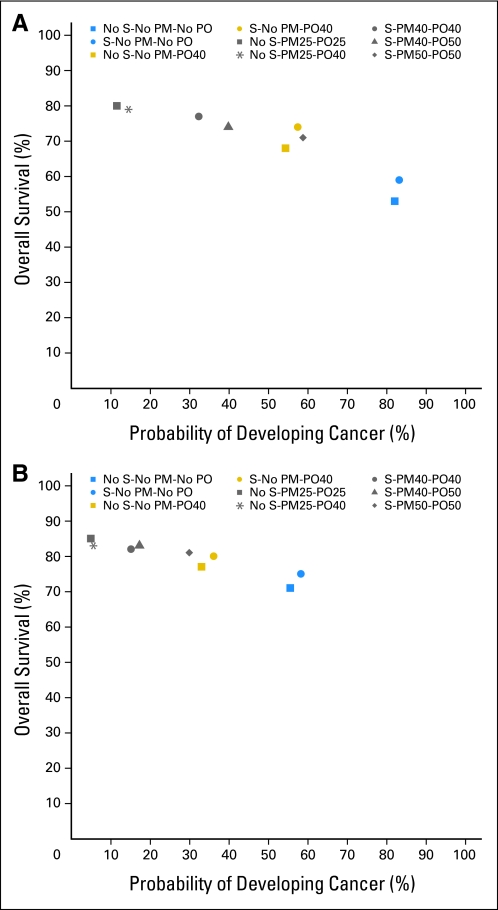
Fig 1.
Fig 1.
(A) Probability of developing cancer (combining breast and ovarian cancers) versus survival by age 70 years for BRCA1 mutation carriers choosing different risk-reducing strategies, including prophylactic mastectomy (PM), prophylactic oophorectomy (PO), and/or annual breast screening (S) with mammography and magnetic resonance imaging, performed at various ages (age in years at time of surgery indicated by number after PM or PO). (B) Probability of developing cancer (combining breast and ovarian cancers) versus survival by age 70 years for BRCA2 mutation carriers choosing different risk-reducing strategies, including PM, PO, and/or S, performed at various ages (age in years at time of surgery indicated by number after PM or PO).
Fig 2.
Fig 2.
(A) Absolute risk of developing breast cancer by age 70 years, stratified by guideline-recommended systemic treatments according to stage, size, and estrogen receptor expression, for BRCA1 mutation carriers who choose risk-reducing strategies including annual breast screening (S) with mammography and magnetic resonance imaging, prophylactic mastectomy (PM), and/or prophylactic oophorectomy (PO) performed at various ages (age in years indicated by number after PM or PO). (B) Absolute risk of developing breast cancer by age 70 years, stratified by guideline-recommended systemic treatments according to stage, size, and estrogen receptor expression, for BRCA2 mutation carriers who choose risk-reducing strategies including S, PM, and/or PO performed at various ages (age in years indicated by number after PM or PO).
Fig 3.
Fig 3.
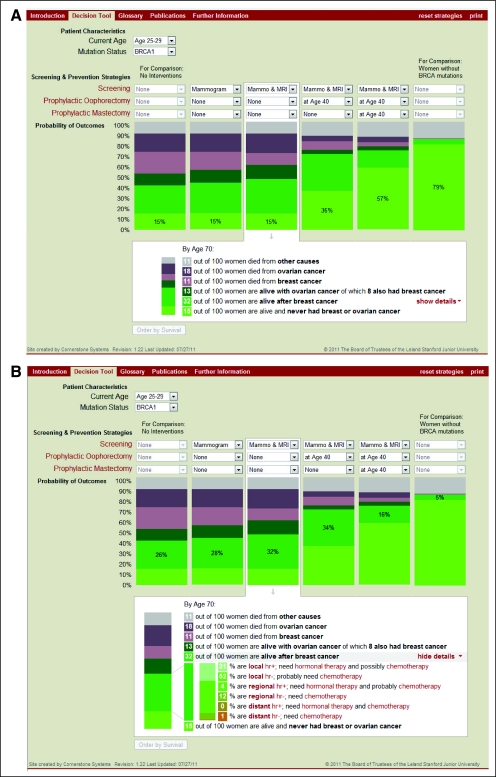
(A) Display screen of online decision tool (brcatool.stanford.edu) comparing user-selected scenarios for cancer risk reduction. Screening options include yearly mammography (Mammo) and/or magnetic resonance imaging (MRI); preventive options include prophylactic mastectomy or salpingo-oophorectomy at various ages. Each bar shows the probability of outcomes by age 70 years under the selected strategy in terms of cancer-free survival (light green), survival after breast cancer (darker green), survival with ovarian cancer (darkest green), and death resulting from breast cancer (pink), ovarian cancer (purple), and other causes (gray). Terms in red font are linked to definitions in the glossary. (B) Expanded display screen of decision tool, showing additional details of each user-selected scenario (vertical bars) in terms of breast cancer stage (local, regional, distant), hormone receptor (hr) expression (negative – or positive +), and recommended systemic therapies according to practice guidelines.

Comment in

References

    1. Antoniou A, Pharoah PD, Narod S, et al. Average risks of breast and ovarian cancer associated with BRCA1 or BRCA2 mutations detected in case Series unselected for family history: A combined analysis of 22 studies. Am J Hum Genet. 2003;72:1117–1130. - PMC - PubMed
    1. Chen S, Parmigiani G. Meta-analysis of BRCA1 and BRCA2 penetrance. J Clin Oncol. 2007;25:1329–1333. - PMC - PubMed
    1. Domchek SM, Friebel TM, Neuhausen SL, et al. Mortality after bilateral salpingo-oophorectomy in BRCA1 and BRCA2 mutation carriers: A prospective cohort study. Lancet Oncol. 2006;7:223–229. - PubMed
    1. Domchek SM, Friebel TM, Singer CF, et al. Association of risk-reducing surgery in BRCA1 or BRCA2 mutation carriers with cancer risk and mortality. JAMA. 2010;304:967–975. - PMC - PubMed
    1. Kauff ND, Domchek SM, Friebel TM, et al. Risk-reducing salpingo-oophorectomy for the prevention of BRCA1- and BRCA2-associated breast and gynecologic cancer: A multicenter, prospective study. J Clin Oncol. 2008;26:1331–1337. - PMC - PubMed

Publication types

MeSH terms