Patient-centered medical home characteristics and staff morale in safety net clinics
- PMID: 22232143
- PMCID: PMC3752653
- DOI: 10.1001/archinternmed.2011.580
Patient-centered medical home characteristics and staff morale in safety net clinics
Abstract
Background: We sought to determine whether perceived patient-centered medical home (PCMH) characteristics are associated with staff morale, job satisfaction, and burnout in safety net clinics.
Methods: Self-administered survey among 391 providers and 382 clinical staff across 65 safety net clinics in 5 states in 2010. The following 5 subscales measured respondents' perceptions of PCMH characteristics on a scale of 0 to 100 (0 indicates worst and 100 indicates best): access to care and communication with patients, communication with other providers, tracking data, care management, and quality improvement. The PCMH subscale scores were averaged to create a total PCMH score.
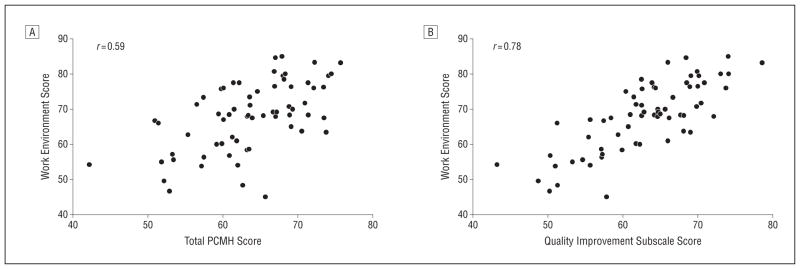
Results: Six hundred three persons (78.0%) responded. In multivariate generalized estimating equation models, a 10% increase in the quality improvement subscale score was associated with higher morale (provider odds ratio [OR], 2.64; 95% CI, 1.47-4.75; staff OR, 3.62; 95% CI, 1.84-7.09), greater job satisfaction (provider OR, 2.45; 95% CI, 1.42-4.23; staff OR, 2.55; 95% CI 1.42-4.57), and freedom from burnout (staff OR, 2.32; 95% CI, 1.31-4.12). The total PCMH score was associated with higher staff morale (OR, 2.63; 95% CI, 1.47-4.71) and with lower provider freedom from burnout (OR, 0.48; 95% CI, 0.30-0.77). A separate work environment covariate correlated highly with the quality improvement subscale score and the total PCMH score, and PCMH characteristics had attenuated associations with morale and job satisfaction when included in models.
Conclusions: Providers and staff who perceived more PCMH characteristics in their clinics were more likely to have higher morale, but the providers had less freedom from burnout. Among the PCMH subscales, the quality improvement subscale score particularly correlated with higher morale, greater job satisfaction, and freedom from burnout.
Figures
Comment in
-
The potential impact of the medical home on job satisfaction in primary care.Arch Intern Med. 2012 Jan 9;172(1):31-2. doi: 10.1001/archinternmed.2011.579. Arch Intern Med. 2012. PMID: 22232144 No abstract available.
References
-
- American Academy of Family Physicians, American Academy of Pediatrics, American College of Physicians, American Osteopathic Association. American College of Physicians Web site. [Accessed March 1, 2011];Joint principles of a patient-centered medical home released by organizations representing more than 300,000 physicians. 2007 Mar 5; http://www.acponline.org/pressroom/pcmh.htm.
-
- National Committee for Quality Assurance. [Accessed August 1, 2011];Patient-centered medical home. http://www.ncqa.org/tabid/631/Default.aspx.
-
- Nutting PA, Crabtree BF, Miller WL, Stewart EE, Stange KC, Jaén CR. Journey to the patient-centered medical home: a qualitative analysis of the experiences of practices in the National Demonstration Project [published correction appears in Ann Fam Med. 2010;8(4):369] Ann Fam Med. 2010;8(suppl 1):S45–S56. S92. - PMC - PubMed
-
- Hayashi AS, Selia E, McDonnell K. Stress and provider retention in underserved communities. J Health Care Poor Underserved. 2009;20(3):597–604. - PubMed
-
- Rosenblatt RA, Andrilla CHA, Curtin T, Hart LG. Shortages of medical personnel at community health centers: implications for planned expansion. JAMA. 2006;295(9):1042–1049. - PubMed