


Temporal interplay between efflux pumps and target mutations in development of antibiotic resistance in Escherichia coli
- PMID: 22232279
- PMCID: PMC3318314
- DOI: 10.1128/AAC.05693-11
Temporal interplay between efflux pumps and target mutations in development of antibiotic resistance in Escherichia coli
Abstract
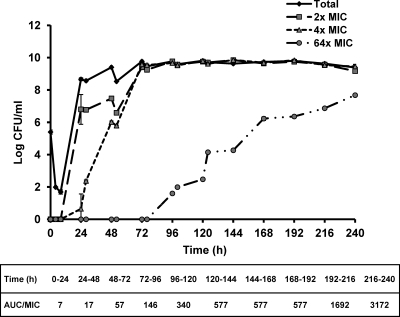
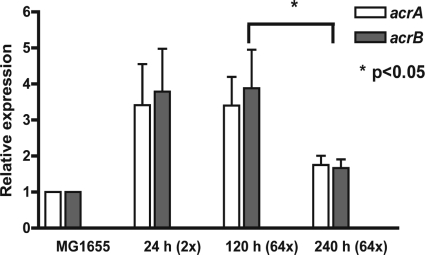
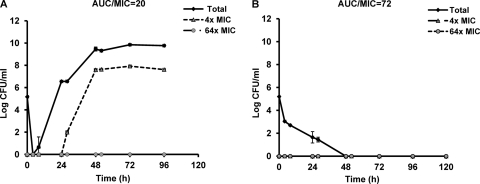
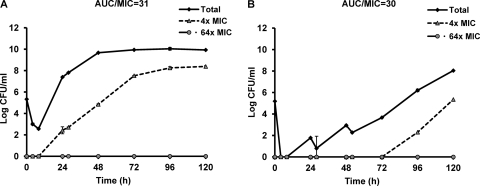
The emergence of resistance presents a debilitating change in the management of infectious diseases. Currently, the temporal relationship and interplay between various mechanisms of drug resistance are not well understood. A thorough understanding of the resistance development process is needed to facilitate rational design of countermeasure strategies. Using an in vitro hollow-fiber infection model that simulates human drug treatment, we examined the appearance of efflux pump (acrAB) overexpression and target topoisomerase gene (gyrA and parC) mutations over time in the emergence of quinolone resistance in Escherichia coli. Drug-resistant isolates recovered early (24 h) had 2- to 8-fold elevation in the MIC due to acrAB overexpression, but no point mutations were noted. In contrast, high-level (≥ 64× MIC) resistant isolates with target site mutations (gyrA S83L with or without parC E84K) were selected more readily after 120 h, and regression of acrAB overexpression was observed at 240 h. Using a similar dosing selection pressure, the emergence of levofloxacin resistance was delayed in a strain with acrAB deleted compared to the isogenic parent. The role of efflux pumps in bacterial resistance development may have been underappreciated. Our data revealed the interplay between two mechanisms of quinolone resistance and provided a new mechanistic framework in the development of high-level resistance. Early low-level levofloxacin resistance conferred by acrAB overexpression preceded and facilitated high-level resistance development mediated by target site mutation(s). If this interpretation is correct, then these findings represent a paradigm shift in the way quinolone resistance is thought to develop.
Figures
References
-
- Cattaneo C, et al. 2008. Recent changes in bacterial epidemiology and the emergence of fluoroquinolone-resistant Escherichia coli among patients with haematological malignancies: results of a prospective study on 823 patients at a single institution. J. Antimicrob. Chemother. 61:721–728 - PubMed
-
- Chang TM, et al. 2007. Characterization of fluoroquinolone resistance mechanisms and their correlation with the degree of resistance to clinically used fluoroquinolones among Escherichia coli isolates. J. Chemother. 19:488–494 - PubMed
MeSH terms
Substances
Grants and funding
LinkOut - more resources
Full Text Sources
Medical
Molecular Biology Databases
