


doi: 10.3389/fnhum.2011.00172.
eCollection 2011.
Misdirection - past, present, and the future
Affiliations
- PMID: 22232587
- PMCID: PMC3252563
- DOI: 10.3389/fnhum.2011.00172
Item in Clipboard
Misdirection - past, present, and the future
Front Hum Neurosci.
.
Abstract
Misdirection refers to the magician's ability to manipulate people's attention, thoughts, and memory. It has been argued that some of the techniques used by magicians to orchestrate people's attention and awareness may provide valuable insights into human cognition. In this paper we review the scientific, as well as some of the magic literature on misdirection. We focus on four main points: (1) the magician's concept of misdirection, (2) the paradigms used to study misdirection scientifically, (3) review of the current scientific findings, and (4) future directions.
Keywords: attention; awareness; magic; misdirection.
Figures
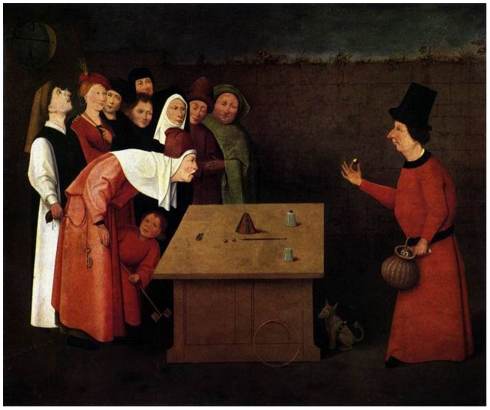
The Conjuror by Hieronymus Bosch (estimated 1475–1505). The conjuror on the right captures his audience attention with a game of cups and balls. Cups and balls routines were first introduced more than 2000 years ago and entail a host of classic effects of magic, such as vanishes, appearances, transpositions, and substitutions. Performing a cups and balls trick is highly regarded amongst magicians since it requires a great deal of motor skills and coordination, combined with an excellent audience management to effectively misdirect the spectators’ attention away from the method. In this painting, misdirection is so powerful that the spectator in the forefront, mesmerized by the conjuror’s performance, fails to notice that someone standing behind him is stealing his wallet.
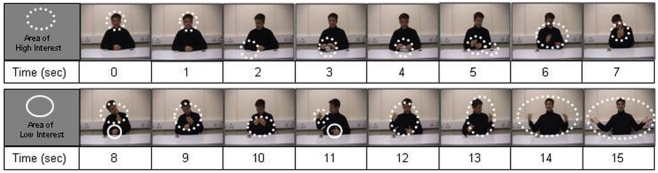
Zones of high and low interest during a magic trick. The figure shows the second by second breakdown of a misdirection routine. The magic effect behind the trick was the disappearing of a lighter and a cigaret; the method was for the magician to simply drop the items into his lap. Although the dropping gesticulation was fully visible, misdirection prevented most of the observers from seeing this event. The dotted and solid ovals represent the areas of high and low interest, respectively. A cigaret is removed from the packet and deliberately placed in the magician’s mouth the wrong way round (1–7 s). The magician then pretends to light the cigaret (7 s). The flame creates a high luminance and attracts attention. Both the spectator and magician then notice this mistake, which raises the interest in the cigaret (8 s). The magician then turns the cigaret around, while keeping his gaze fixed on the cigaret and the hand manipulating it (8–9 s). During this maneuver, the hand holding the lighter is lowered to the tabletop and drops the lighter into the magician’s lap. This dropping of the lighter happens in a low area of interest. The disappearing lighter is dramatically revealed by snapping his fingers and waving his hands (11 s). The method for making the cigaret disappear relies on it being dropped into the lap. This action is fully visible, with the cigaret dropped from 15 cm above the table top (11 s). Surprisingly, most participants did not see this: at the time the cigaret is dropped it is an area of low interest (the other hand is an area of high interest). In this case, the high interest is manipulated by three things: (i) surprise: the disappearance of the lighter automatically leads to interest, (ii) social cues: the magician looks at the hand that previously held the lighter and rotates his body in that direction, and (iii) movement and sound: at the time of the drop the magician snaps his fingers and waves his hand, thereby attracting attention. Adapted from Kuhn et al. (2008a).
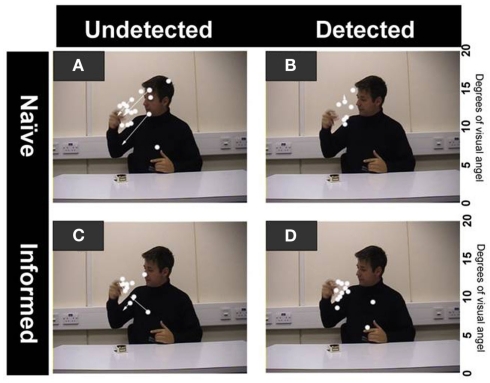
Misdirection works independently of direction of gaze. An eye-tracker was used to record the subjects’ fixation points at the time of the cigaret drop during the magic trick presented in Figure 2. (A) Results from naïve participants who missed the cigaret drop. (B) Naïve participants who detected the cigaret drop. (C) Informed participants who missed the cigaret drop. (D) Informed participants who detected the cigaret drop. Most of the naïve participants fixated either on the lighter hand, the head, or the area between the lighter hand and the head. Most of the informed participants looked at the lighter hand or the area between the lighter hand and the head. Interestingly, only one informed participant was able to detect the cigaret drop by using his foveal vision, showing that no systematic differences were found between the two conditions. Adapted from Kuhn et al. (2008a).
References
-
- Ascanio A., Etcheverry J. (2000). La magia de Ascanio, Vol. 1 Madrid: Editorial Páginas
-
- Christopher M. (2006). The Illustrated History of Magic. New York: Carroll & Graf Publishers
