


Atrial fibrillation after pulmonary lobectomy for lung cancer affects long-term survival in a prospective single-center study
- PMID: 22233837
- PMCID: PMC3287133
- DOI: 10.1186/1749-8090-7-4
Atrial fibrillation after pulmonary lobectomy for lung cancer affects long-term survival in a prospective single-center study
Abstract
Background: Atrial fibrillation (AF) after thoracic surgery is a continuing source of morbidity and mortality. The effect of postoperative AF on long-term survival however has not been studied. Our aim was to evaluate the impact of AF on early outcome and on survival > 5 years after pulmonary lobectomy for lung cancer.
Methods: From 1996 to June 2009, 454 consecutive patients undergoing lobectomy for lung cancer were enrolled and followed-up until death or study end (October 2010). Patients with postoperative AF were identified; AF was investigated with reference to its predictors and to short- and long-term survival (> 5 years).
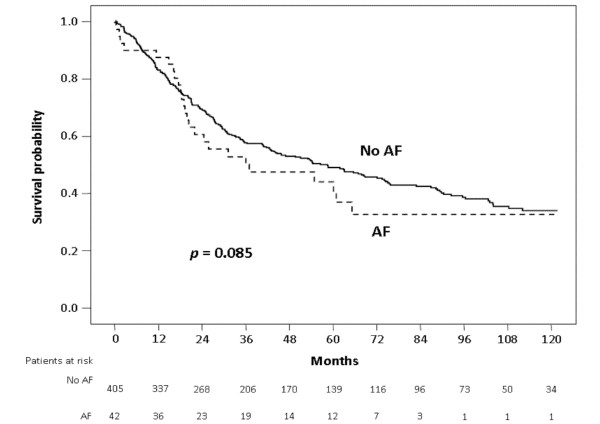
Results: Hospital mortality accounted for 7 patients (1.5%), while postoperative AF occurred in 45 (9.9%). Independent AF predictors were: preoperative paroxysmal AF (odds ratio [OR] 5.91; 95%CI 2.07 to 16.88), postoperative blood transfusion (OR 3.61; 95%CI 1.67 to 7.82) and postoperative fibro-bronchoscopy (OR 3.39; 95%CI 1.48 to 7.79). Patients with AF experienced higher hospital mortality (6.7% vs. 1.0%, p = 0.024), longer hospitalization (15.3 ± 10.1 vs. 12.2 ± 5.2 days, p = 0.001) and higher intensive care unit admission rate (13.3% vs. 3.9%, p = 0.015). The median follow-up was 36 months (maximum: 179 months). Among the 445 discharged subjects with complete follow-up, postoperative AF was not an independent predictor of mortality; however, among the 151 5-year survivors, postoperative AF independently predicted poorer long-term survival (HR 3.75; 95%CI 1.44 to 9.08).
Conclusion: AF after pulmonary lobectomy for lung cancer, in addition to causing higher hospital morbidity and mortality, predicts poorer long-term outcome in 5-year survivors.
Figures
References
-
- Roselli EE, Murthy SC, Rice TW, Houghtaling PL, Pierce CD, Karchmer DP, Blackstone EH. Atrial fibrillation complicating lung cancer resection. J Thorac Cardiovasc Surg. 2005;130:438–444. - PubMed
MeSH terms
LinkOut - more resources
Full Text Sources
Medical
