. 2012 Mar;153(3):1538-47.
doi: 10.1210/en.2011-1864. Epub 2012 Jan 10.

GLP-1 receptor agonists and the thyroid: C-cell effects in mice are mediated via the GLP-1 receptor and not associated with RET activation

Affiliations

GLP-1 receptor agonists and the thyroid: C-cell effects in mice are mediated via the GLP-1 receptor and not associated with RET activation

Lars Wichmann Madsen et al. Endocrinology. 2012 Mar.

Abstract

Liraglutide and exenatide are glucagon-like peptide receptor (GLP-1R) agonists used in the treatment of type 2 diabetes. Both molecules have been associated with the development of thyroid C-cell tumors after lifetime exposure in rodents. Previously, it has been reported that these tumors are preceded by increased plasma calcitonin and C-cell hyperplasia. We can now document that the murine C-cell effects are mediated via GLP-1R. Thus, 13 wk of continuous exposure to GLP-1R agonists was associated with marked increases in plasma calcitonin and in the incidence of C-cell hyperplasia in wild-type mice. In contrast, similar effects were not seen in GLP-1R knockout mice. Human C-cell cancer is often caused by activating mutations in the rearranged-during-transfection (RET) protooncogene. We developed an immunohistochemical method to assess RET activation in tissues. Liraglutide dosing to mice was not found to activate RET. Further evaluation of the signaling pathways demonstrated that liraglutide increased ribosomal S6, but not MAPK kinase, phosphorylation. These observations are consistent with effects of GLP-1R agonists on rodent C cells being mediated via mammalian target of rapamycin activation in a RET- and MAPK-independent manner.


Figures

Fig. 1.
Fig. 1.
Plasma calcitonin (picograms per milliliter) after 13 wk treatment, group geometric mean, and 95% confidence interval in male (A) and female (B) mice (n = 36 mice per sex per group). WT, Wild type.
Fig. 2.
Fig. 2.
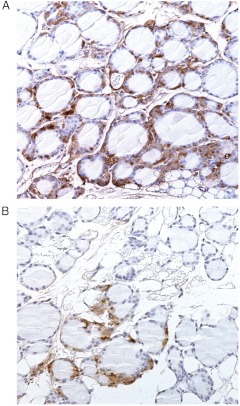
Thyroid histology after 13 wk treatment with liraglutide (3 mg/kg · d) in CD-1 wild-type mice showing diffuse C-cell hyperplasia (A) and GLP-1R KO mice with normal C cells (B). Calcitonin IHC (brown), ×20 objective.
Fig. 3.
Fig. 3.
GLP-1R ISLB on frozen sections of thyroid from mice. A and B, Mouse thyroid stained immunohistochemically for calcitonin (pink) and assessed by autoradiography for GLP-1R (black silver grains): A, incubated with 0.3 nm [125I]GLP-1 (hot) to show the sum of bound ligand; B, incubated with 0.3 nm [125I]GLP-1 plus 1 μm nonradioactive GLP-1 (cold) to compete out specific binding. The low-magnification insets illustrate that neighboring sections were used. C, After 13 wk treatment, GLP-1R density, that is, specific [125I]GLP-1 binding (dpm) per calcitonin-positive area (square micrometers), was higher in mice dosed with liraglutide compared with vehicle controls. **, P < 0.01.
Fig. 4.
Fig. 4.
Phosphoprotein IHC validation experiments. A, TPC1 cells were incubated for 24 h with vehicle or the RET kinase inhibitor AST487. IHC was done on sections of TPC1 cells using anti-RET (Y1062) at 0.01 or 0.05 μg/ml. B, pRET IHC in MTC-M cells expressing wild-type RET. IHC was done on paraffin sections of MTC-M cells using anti-RET (Y1062) at 0.01 or 0.05 μg/ml. C, pRET IHC in mouse papillary thyroid cancers expressing constitutively active RET. IHC was done on paraffin sections of MTC-M cells using anti-RET (Y1062) at 0.01 or 0.05 μg/ml. D, AST487 inhibits MEK and S6 phosphorylation as determined by IHC in TPC1 cells. IHC was done on paraffin sections of TPC1 cells with anti-MEK (S217/S221) at 0.2 μg/ml or anti-S6 (S235/S236) at 0.12 μg/ml.
Fig. 5.
Fig. 5.
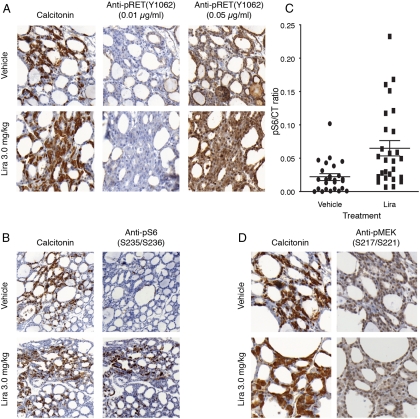
IHC for phosphoproteins after 13 wk treatment with liraglutide (Lira, 3 mg/kg · d) in CD-1 wild-type mice. A, No up-regulation of pRET in calcitonin-positive cells in thyroids from liraglutide- vs. vehicle-treated mice. IHC is shown for pRET (Y1062) at 0.01 or 0.05 μg/ml in representative sections of thyroid tissue with C-cell hyperplasia from a liraglutide-treated mouse and a region with many C cells from a vehicle-treated mouse. B, Up-regulation of pS6 in calcitonin-positive cells in thyroids from liraglutide- vs. vehicle-treated mice. Representative IHC is shown for pS6 (S235/S236) and calcitonin performed on adjacent sections of thyroid tissue blocks of liraglutide- or vehicle-treated mice. C, Increased number of calcitonin- and pS6-positive cells in CD-1 mice treated with liraglutide (3 mg/kg · d) for 13 wk. Bars represent the ratio of pS6/calcitonin-positive cells. D, No up-regulation of pMEK in calcitonin-positive cells in thyroids from liraglutide- vs. vehicle-treated mice. Representative IHC is shown for pMEK (S217/S221) and calcitonin performed on adjacent sections of thyroid tissue blocks of liraglutide- or vehicle-treated mice.

References

    1. Garber AJ. 2011. Long-acting glucagon-like peptide 1 receptor agonists: a review of their efficacy and tolerability. Diabetes Care 34(Suppl 2):S279–S284 - PMC - PubMed
    1. Buse JB, Rosenstock J, Sesti G, Schmidt WE, Montanya E, Brett JH, Zychma M, Blonde L; LEAD-6 Study Group 2009. Liraglutide once a day versus exenatide twice a day for type 2 diabetes: a 26-week, randomised, parallel-group, multinational, open-label trial (LEAD-6). Lancet 374:39–47 - PubMed
    1. Buse JB, Nauck MA, Forst T, Sheu WHH, Hoogwerf BJ, Shenouda SK, Heilmann CR, Boardman MK, Fineman M, Porter L, Schernthaner G. 2011. Efficacy and safety of exenatide once weekly versus liraglutide in subjects with type 2 diabetes (DURATION-6): a randomised, open-label study. Diabetologia 54(Suppl 1):S38 (Abstract 75) - PubMed
    1. European Medicines Agency (EMA) 2006: Assessment report for Byetta http://www.ema.europa.eu/docs/en_GB/document_library/EPAR_-_Scientific_D... (accessed Sept 27, 2011)
    1. European Medicines Agency (EMA) 2009: Assessment report for Victoza http://www.ema.europa.eu/docs/en_GB/document_library/EPAR_-_Public_asses... (accessed Sept 27, 2011)

Publication types

MeSH terms